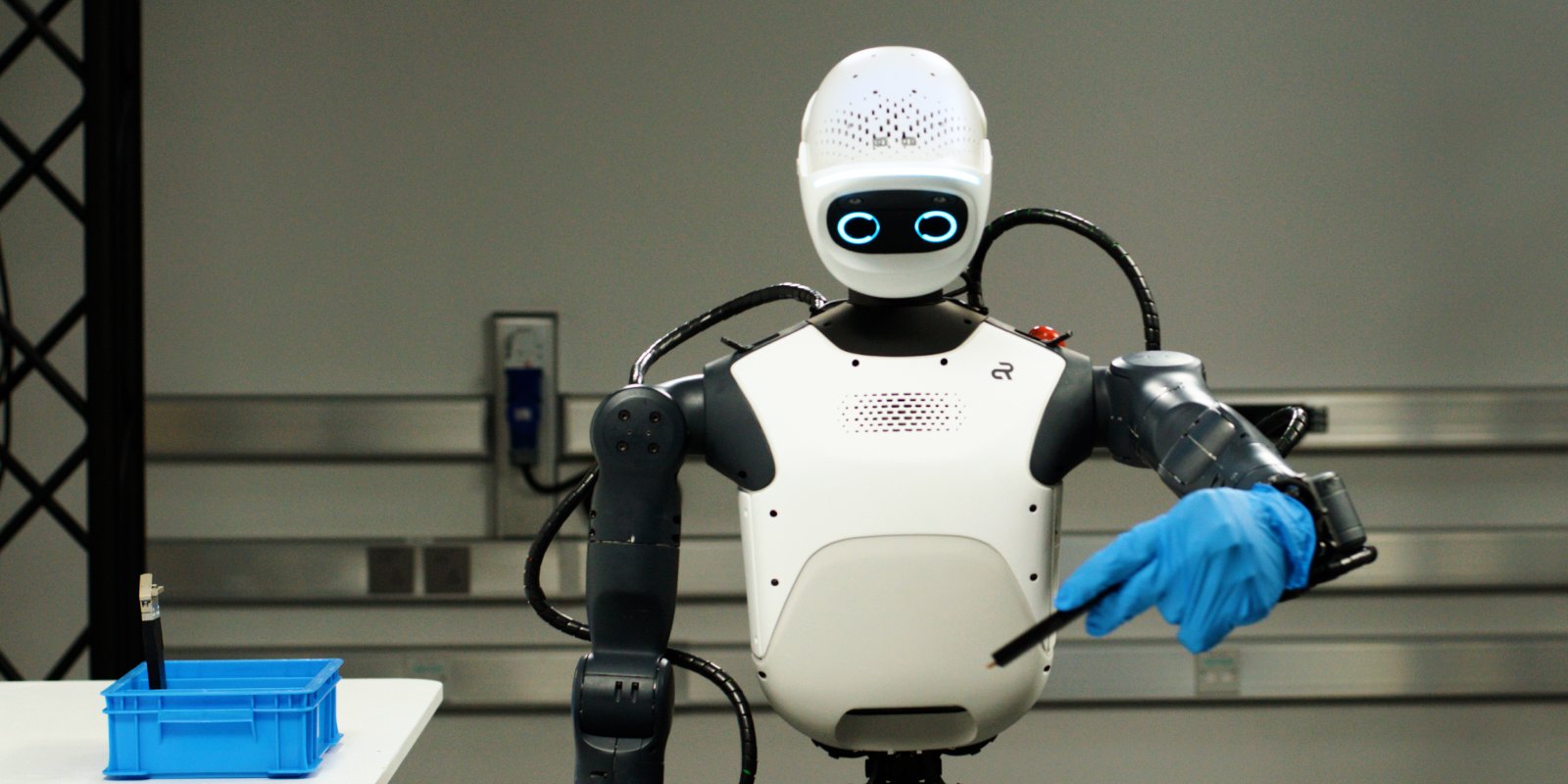
An Agile Robots humanoid in a press image Nvidia released with its Isaac robotics announcements at GTC Berlin, October 21, 2026. Image: Nvidia
Robots are about to have their big breakthrough, according to Nvidia’s Jensen Huang. “The ChatGPT moment for robotics is fast approaching,” Huang said on Wednesday as Nvidia unveiled a reference humanoid that robot makers and university labs can build on. It led a batch of announcements around his GTC Berlin keynote, alongside AI data centres that ship in containers, a robotaxi deal and new tools for company AI agents.
A humanoid for developers #
The robot is the Agile ONE SN, made by Munich’s Agile Robots, one of the four German start-ups Nvidia said on Monday it plans to invest in. It is meant as a ready-made starting point rather than a finished product: a complete humanoid that developers can use to train and test new skills without designing their own body, sensors and software first. Huang, who announced it on stage, said it should cut researchers’ setup time from weeks to days.
It stands 1.40 metres (about 4 ft 7 in) tall, weighs 40 kg (88 lb), has 31 degrees of freedom and can carry 3 kg in each arm. Its two five-fingered hands have 20 degrees of freedom each, with touch sensing. It runs Nvidia’s Jetson Thor computer and Isaac GR00T robot models, and Nvidia says Stanford University and ETH Zurich are interested in using it. It is due in early 2027; no price was given.
Agile Robots’ founder put the pitch this way:
The breakthrough for humanoids is usefulness at scale: one adaptable machine that learns many skills and works across environments built for people.
Zhaopeng Chen, founder and CEO of Agile Robots
Nvidia also made its Isaac Lab 3.0 robot training software generally available, put a library of more than 2,000 simulation-ready robot and factory parts on Hugging Face, and released a dataset of human activity filmed from three angles for teaching robots by example. Huang framed it as a full kit:
With Nvidia Isaac, our full-stack open robotics platform, we are giving developers the models, data, simulation tools and computing systems to bring physical AI to the world’s largest industries.
Jensen Huang, Nvidia founder and CEO
The launch puts a German-made design at the centre of Nvidia’s robot platform, in a market where Chinese companies built more than 95% of the world’s humanoids in the first half of this year.
“You want to be producing the AI” #
Huang’s wider message to European governments and companies was to build their own AI rather than rent it. “To be part of this AI economy, you don’t want to just be consuming the AI; you want to be producing the AI,” he said, according to Nvidia’s keynote blog.
To make that quicker, Nvidia introduced DSX POD, a design for complete Vera Rubin AI data centres that partners build inside containers and test before they ship. Nvidia says that cuts setup at a prepared site from six months to as little as 14 days. Seventeen partners, including Dell, HPE, Lenovo, Foxconn, Schneider Electric and the defence company Anduril, plan to deliver them worldwide in early 2027.
The keynote capped a week-long European tour in which Nvidia put its commitment to Europe’s tech scene at nearly $10 billion (about €8.6 billion) and pledged $250 million in computing for UK AI safety research.
Robotaxis and phone masts #
Ride-hailing company Bolt chose Nvidia’s Alpamayo self-driving software for its European robotaxis. It plans to start gathering driving data in Madrid in 2027, subject to regulatory approval, with Germany next, as part of a planned rollout of at least 25,000 self-driving Lucid cars built on Nvidia’s Hyperion platform. Robotaxis remain rare in Europe: even Waymo’s London launch keeps slipping. Huang said next-generation vehicles from Mercedes-Benz, Volvo, JLR and Volkswagen’s van division will be compatible with Hyperion.
For telecoms, Nvidia said T-Mobile had made the world’s first “AI-RAN” call on a commercial network, in Bellevue, Washington, using Nvidia and Nokia equipment that runs AI inside the mobile network itself. BT, Deutsche Telekom and Elisa are running pilots, with BT planning live trials in Birmingham in 2027.
Agents that know the company #
For businesses, Nvidia expanded its Agent Toolkit with tools for connecting AI agents to company documents and databases, adopted by firms including SAP, ServiceNow, Snowflake, Databricks and Palantir. It also published a reference design for running agents safely on OpenShell, its sandbox for keeping agents in check. “The most important thing is to make sure the agent is secure,” Huang said.
Why it matters #
Nvidia sells the chips behind today’s chatbots, and Berlin showed where it wants the next wave of demand to come from: robots, self-driving cars, telecom networks and national AI data centres. Whether the “ChatGPT moment” arrives depends on robots like the Agile ONE SN doing useful work outside a demo, which won’t be tested until they ship in 2027.
Sources: Nvidia (Isaac and Agile ONE SN); Nvidia keynote blog; Nvidia (DSX POD); Nvidia (Hyperion); Nvidia (telecoms); Nvidia (Agent Toolkit); Nvidia GTC Berlin news.