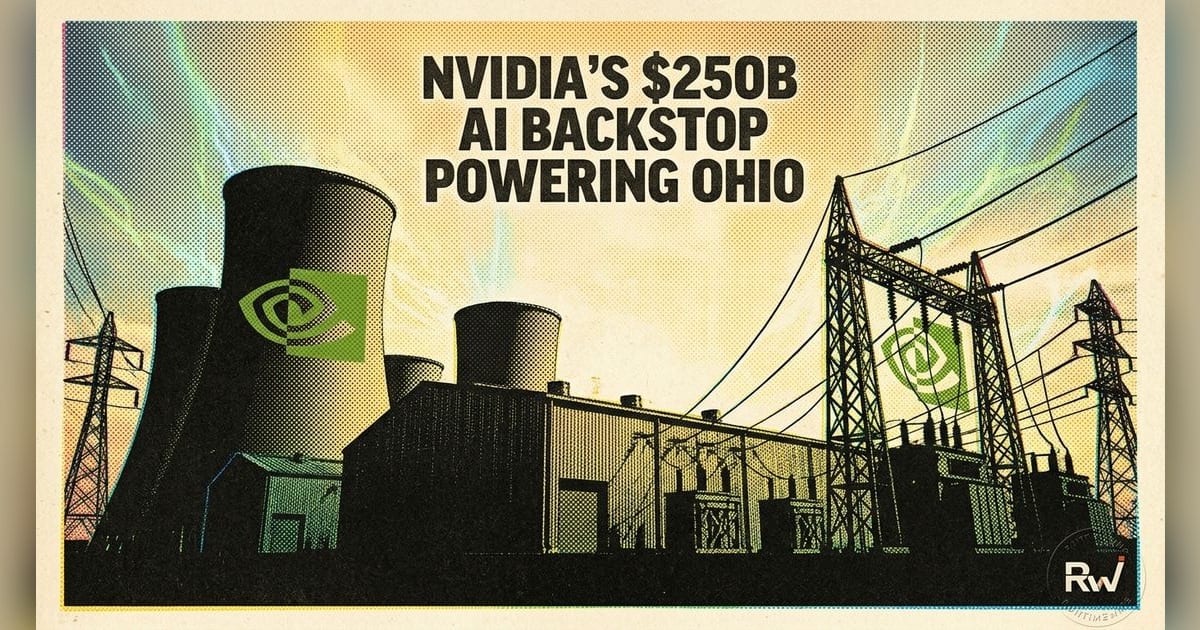
Nvidia, co-founded and led by Jensen Huang, is discussing a roughly $250 billion financial backstop that would help OpenAI lease a 10-gigawatt data center project in southern Ohio, Reuters reported on July 26, citing The Wall Street Journal.
The talks would push Nvidia beyond supplying the accelerators that power AI models and into supporting the financing behind one of its largest prospective customers. Huang founded Nvidia in 1993 after working at AMD and LSI Logic. Three decades later, the chipmaker he built may put its balance sheet behind the physical infrastructure required to keep AI demand growing.
Sam Altman, co-founder and CEO of OpenAI, helped launch OpenAI in 2015 as a nonprofit research organization whose original plan said it would operate without pressure to generate a financial return. OpenAI's capital requirements have since expanded from funding researchers and compute into securing land, generation, transmission and long-term data center leases.
SoftBank founder Masayoshi Son, who started the Japanese group in 1981 and remains its chairman and CEO, controls the third leg of the proposed arrangement. SoftBank's U.S. energy subsidiary, SB Energy, would develop the Ohio project, according to the report.
Reuters said it could not independently verify the Journal's account. The public reporting describes negotiations rather than a signed guarantee, and the report does not explain the legal structure, duration, collateral or conditions attached to the proposed $250 billion backstop.
A supplier starts underwriting demand
Nvidia and OpenAI already tied their corporate plans together in a September 22, 2025 letter of intent. The companies said they planned to deploy at least 10 gigawatts of Nvidia systems, representing millions of GPUs, while Nvidia intended to invest as much as $100 billion in OpenAI as each gigawatt entered service. The first gigawatt was targeted for the second half of 2026 using Nvidia's Vera Rubin platform.
The Ohio talks take that logic into project finance. Nvidia would help OpenAI obtain the facilities where compute is installed, extending its role beyond chip design and an equity position in a customer buying capacity.
A guarantee would also create a different category of risk from an equity investment. Nvidia might never have to fund the full headline amount because a backstop is generally contingent on defined events. The amount still measures potential exposure that cannot be evaluated without the contract. A lease guarantee, debt guarantee, capacity purchase commitment and limited completion guarantee can all produce sharply different obligations.
The commercial incentive is clear even before the Ohio campus's hardware mix is known. Nvidia benefits when developers can finance AI infrastructure that creates demand for accelerators, networking equipment and software. Reuters's summary did not identify the chips planned for the site or establish how much of the campus would be dedicated to OpenAI.
Ohio already has the power plan
The specifications in the report match a large project the Department of Energy announced on March 20, 2026, though Reuters's summary did not explicitly identify it as the same development.
The department said SB Energy planned to build 10 gigawatts of new generation for a 10-gigawatt data center development at the Portsmouth Site in Pike County. The power plan includes 9.2 gigawatts of natural gas generation, backed by $33.3 billion in Japanese funding. SB Energy and AEP Ohio would also put $4.2 billion into transmission lines and substations, according to the department.
The federal announcement said construction was expected to begin in 2026. It also said the generation and transmission investments would impose no cost on local ratepayers, a government claim whose durability will depend on the final contracts, construction costs and allocation of overruns.
According to SB Energy, it has raised $18 billion in project financing since its founding in 2019. The $250 billion figure under discussion would place the proposed OpenAI commitment on a different scale, requiring a much broader group of lenders and capital providers even with Nvidia support.
OpenAI and SoftBank had already each invested $500 million in SB Energy under a January 9, 2026 partnership. SB Energy separately secured $800 million in redeemable preferred equity from Ares. That announcement also included a 1.2-gigawatt OpenAI lease at a data center in Milam County, Texas. OpenAI did not tie those investments to the Ohio project.
The Texas agreement nevertheless established the operating model now being considered at far greater scale: SB Energy develops and runs the campus, while OpenAI commits to occupy the compute capacity. The Ohio proposal adds Nvidia as a potential financial backstop.
The missing contract is the story
The $250 billion headline describes possible obligations of that magnitude rather than a cash payment Nvidia has agreed to make. OpenAI's infrastructure ambitions may require a creditworthy partner to stand behind very large lease or financing commitments.
The eventual contract would determine whether Nvidia supports lease payments, project debt, hardware purchases or another part of the capital stack. It would also show which party absorbs delays in generation, transmission or data center construction, and whether Nvidia receives equity, fees, purchasing commitments or other consideration for its support.
Those terms matter because each founder is solving a different problem. Altman needs enough compute to train and operate future models. Son is turning an energy developer into a builder of AI campuses. Huang needs customers capable of financing the infrastructure that consumes Nvidia systems.
The three strategies converge in Ohio, where chips, power and credit are being negotiated as one project. A completed agreement would make Nvidia a financial foundation for OpenAI's expansion. For now, the reported talks show how far the AI buildout has moved beyond ordinary technology procurement: its founders are assembling power plants, federal land, transmission infrastructure and balance-sheet guarantees alongside the computers themselves.