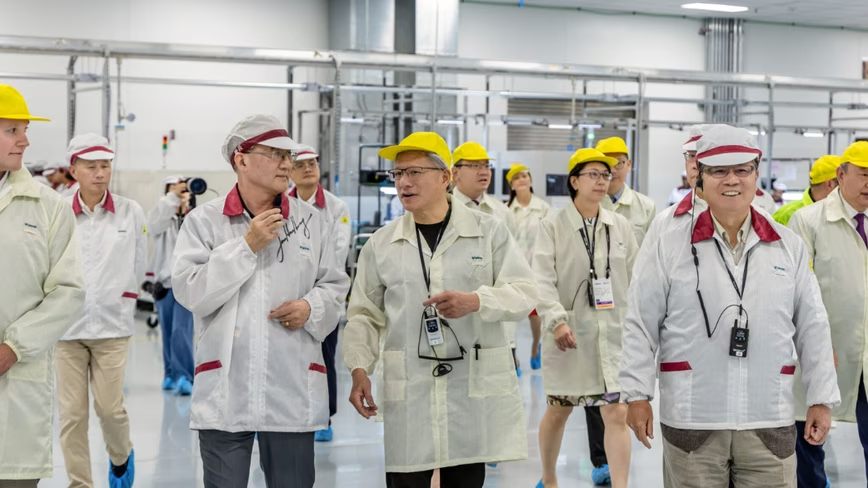
Wistron, the Taiwanese contract manufacturer that builds server hardware for Nvidia, has opened its first factory on American soil, a $700 million plant in Fort Worth, Texas, that is already assembling Nvidia’s GB300 Grace Blackwell Ultra superchips.
The site held its grand opening on 21 July, and Nvidia says it is the first place the GB300 has been built and mass-produced in the United States.
The chip is the current flagship of Nvidia’s data centre line, and Fort Worth will eventually turn out its successor too: the Vera Rubin superchips due to follow Blackwell. It is a notable vote of confidence in US-made chips, a category that a year ago barely existed at this scale.
The launch sits inside a much larger onshoring push. Nvidia committed in 2025 to half a trillion dollars of American manufacturing and AI infrastructure over four years, and its suppliers have been following the money to Texas.
Wistron’s plant is one of the more concrete results, a working factory rather than a memorandum of understanding.
The facility runs to roughly 324,000 sq ft (about 30,100 sq m). Wistron plans to scale it to tens of thousands of computing boards a month, according to Nvidia, which called Fort Worth its partner’s first US manufacturing base.
The plant has created more than 500 jobs so far, across construction, plumbing, electrical, and manufacturing roles, with the workforce expected to reach 1,000 by the end of the year.
Wistron calls the site its D1 Smart Factory. “The operation here is not typical manufacturing,” chairman Simon Lin said.* “It is new, very comprehensive, and high-tech.”*
He framed speed as the defining pressure of the moment. “In the AI era, the pressure of speed is also a form of responsibility. We don’t just need to build fast; we need to build right.”
Lin also positioned Fort Worth as central to Wistron’s next few years. “In the next couple of years, this location will be one of the most important, as we build AI infrastructure here in the United States,” he said.
Huang, for his part, kept the message plain: “Manufacturing is an essential pillar for every economy and every country.”
Building right, in this case, meant building the factory twice. Before breaking ground, Wistron modelled the entire plant as a digital twin using Nvidia’s own Omniverse simulation software, testing the layout and workflows virtually before any physical construction started.
It is the sort of recursive detail Nvidia enjoys: the company’s software used to design the factory that makes the chips that run the software.
The product itself is not a modest object. Jensen Huang, Nvidia’s chief executive, described a single GB300 system as containing *“one-and-a-half million parts inside, two tons, 4 million dollars.” *
Producing tens of thousands of boards a month from a standing start is less a factory ramp than a logistics problem with a clock attached.
Investors liked what they saw. Wistron’s shares surged in Taiwan after the opening, a reminder that the AI trade now runs well beyond the chip designers themselves and into the contract manufacturers, assemblers, and suppliers wiring the systems together.
Fort Worth is quickly becoming a hub for that build-out. The city and the wider state have drawn a run of AI infrastructure projects, including an $810 million data centre bond raise nearby, as cheap land and power pull compute towards Texas.
The pressure has rippled up the supply chain as well, tightening the market for the high-bandwidth memory that Grace Blackwell parts depend on.
What comes next is a ramp. Wistron has to lift board output through the rest of 2026, hire its way to a thousand workers, and then retool for Vera Rubin, all while the plant is still finding its rhythm.
For now, the more symbolic fact is the simpler one: an Nvidia superchip that used to exist only as an import is now being screwed together in Texas.
Get the TNW newsletter #
Get the most important tech news in your inbox each week.