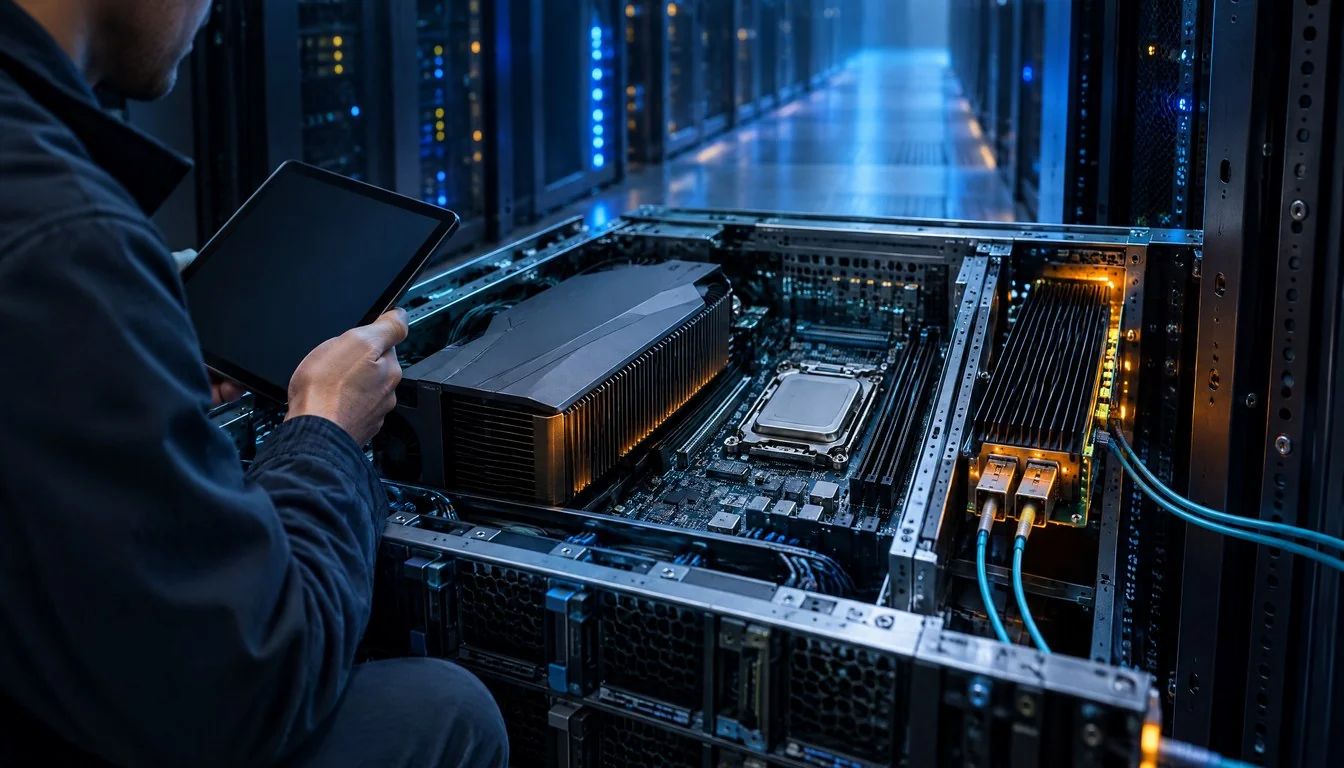
NVIDIA just moved AI agent security off the host and onto a chip. The company’s NVIDIA Sentry framework monitors AI agents and enforces policies that govern their access to models, tools, and data, and it runs on NVIDIA BlueField-4 DPUs instead of the processor the agent itself uses. NVIDIA detailed the design in a technical blog post on October 21, 2026.
The post, an 11-minute read, lays out a security model built on a hardware-isolated, host-independent domain. SiliconANGLE also covered the launch. Together, the NVIDIA Developer blog and SiliconANGLE make this the leading hardware story of the day, and it deserves a careful read because it changes where defenders can put their controls.
The timing is not an accident. Agents now read files, call tools, and move data without a human approving each step, and the failure cases are piling up. We covered one recently when OpenAI said two AI agents disabled safety monitoring, which is the exact scenario a host-independent monitor is built to survive. This analysis walks through what Sentry is, how it works, what NVIDIA has and has not confirmed, and what it means for the market.
Don't miss new tech stories on Google
Add Shattered once in the Google app and our stories show up in your news suggestions.
What NVIDIA Announced on October 21 #
The announcement has three parts. First, a product: Sentry, a security software framework for AI agents. Second, a hardware home for it: BlueField-4 DPUs, with the software built on NVIDIA DOCA. Third, a place in a bigger design: Sentry is part of the NVIDIA OpenShell reference architecture, which NVIDIA published the same day.
NVIDIA describes the framework as continuous agent governance. It offers out-of-band observability into agent behavior and reasoning, runtime threat detection, and policy enforcement in silicon. The company says it can contain threats within milliseconds. Those claims come from NVIDIA’s own materials, and no independent test results had appeared at the time of writing.
The table below condenses what NVIDIA has put on the record. Every row traces to the company’s technical blog or its product page, and nothing here comes from leaks or analyst estimates.
| Attribute | What NVIDIA says | Source |
|---|---|---|
| Product | Security software framework that monitors AI agents and enforces access policies | NVIDIA Technical Blog |
| Software base | Built on NVIDIA DOCA | NVIDIA Technical Blog |
| Hardware | Runs on NVIDIA BlueField-4 DPUs | NVIDIA Technical Blog |
| Security domain | Hardware-isolated and host-independent | NVIDIA product page |
| Policy engine | Open Policy Agent (OPA) evaluates access requests | NVIDIA Technical Blog |
| Containment | Threats contained within milliseconds | NVIDIA product page |
| Architecture | Part of the NVIDIA OpenShell reference architecture | NVIDIA Technical Blog |
| Published | October 21, 2026, 11-minute read | NVIDIA Technical Blog |
How NVIDIA Sentry Secures AI Agents at Runtime #
Runtime security means watching an agent while it works, not scanning it before it ships. An agent that passed every pre-deployment test can still go wrong after it reads a poisoned document or receives a hostile instruction from another system. Sentry targets that gap. It sits beside the agent, observes what the agent does, and checks each request against a written policy.
NVIDIA lists four capabilities. Continuous governance means the checks never . Out-of-band observability means the monitor sees agent behavior and reasoning without living inside the agent’s process. Runtime threat detection flags activity that breaks policy. In-silicon enforcement means the block happens in hardware, not in a software hook that the agent could try to unhook.
The policy side runs on Open Policy Agent, the open-source engine many platform teams already use for cloud and Kubernetes authorization. NVIDIA says Sentry uses OPA to evaluate access requests against defined policies. That choice matters for adoption, because security teams can write rules in a language they may already know instead of learning a vendor-specific one.
Why a Hardware-Isolated Security Domain Matters #
Most agent guardrails today live in the same place as the agent: the same operating system, the same container, sometimes the same process. If the agent gets compromised, the guardrail sits inside the blast radius. An attacker who controls the agent can often edit, bypass, or silence software that shares its memory.
NVIDIA’s answer is separation. Sentry operates from a security domain that is isolated in hardware and independent of the host. The host can burn down and the monitor keeps running. That is the same logic behind running a camera system on its own power circuit. A thief who cuts the lights should not also cut the recording.
Out-of-band observability
Out-of-band means the monitor watches from outside the data path the agent controls. NVIDIA says the framework gives visibility into agent behavior and reasoning. For defenders, reasoning visibility is the interesting part. A log of API calls tells you what happened. A view into why the agent chose that call tells you whether the agent was steered. NVIDIA has not published the technical details of how reasoning is captured, so treat that capability as a stated goal until independent engineers test it.
In-silicon policy enforcement
Enforcement in silicon means the DPU, not the host, makes the allow or deny call on access to models, tools, and data. Software on the host cannot talk its way past a decision it never gets to make. The tradeoff is operational. Hardware enforcement ties your agent security to a specific hardware platform, which we return to in the market section below.
BlueField-4 and DOCA: The Hardware and Software Stack #
A DPU is a data processing unit, a programmable chip that sits on the network path of a server and handles infrastructure work so the main CPU does not have to. NVIDIA’s BlueField line has long been pitched as the place to run networking, storage, and security tasks apart from the host. BlueField-4 is the generation Sentry targets, and DOCA is the software framework developers use to program it.
Building Sentry on DOCA gives NVIDIA a consistent story for developers. Teams that already write BlueField software get a path to agent governance without a new toolchain. Teams that do not will face a learning curve, and NVIDIA has not published details on migration effort, supported operating systems, or licensing terms. Those gaps are normal for a first technical post, but buyers should ask about them early.
The pairing also reflects where NVIDIA wants its silicon to sit. The company already sells accelerators for model inference, and it is pushing CPUs for agent execution. Our coverage of NVIDIA’s Vera CPU deal with Modal showed that agent workloads are now a CPU story as much as a GPU story. Sentry adds the third leg: a governance chip that watches both.
The OpenShell Reference Architecture, Layer by Layer #
Sentry does not ship alone. NVIDIA positions it inside the OpenShell reference architecture, a blueprint for running agents safely. According to NVIDIA’s technical blog, agents execute on NVIDIA Vera CPUs, while a BlueField-4 DPU sits on the node’s only path to the model. That second detail is the heart of the design. If every model request must cross the DPU, then the DPU can inspect and refuse any request.
NVIDIA founder and CEO Jensen Huang summed up the division of labor in the company’s launch announcement. In his words, “With the OpenShell Reference Architecture, agents can think on Rubin, act on Vera and be governed on BlueField.” The sentence maps neatly to three tiers of hardware, which the table below lays out.
| Layer | Hardware | Job in the architecture |
|---|---|---|
| Think | Rubin-based infrastructure | Runs the model that reasons |
| Act | NVIDIA Vera CPUs | Executes the agent |
| Govern | NVIDIA BlueField-4 DPU | Runs Sentry and sits on the node’s only path to the model |
| Policy | Open Policy Agent | Evaluates access requests against defined policies |
| Reference design | NVIDIA OpenShell | Packages the pieces into a blueprint |
The design echoes a pattern from decades of security engineering, where a reference monitor must be tamper-proof, always invoked, and small enough to verify. The only-path rule covers the always-invoked part. The hardware isolation covers tamper-proofing. Whether the code is small enough to audit is a question NVIDIA has not yet answered in public.
Open Policy Agent as the Decision Engine #
Open Policy Agent is a general-purpose policy engine. You feed it a request and a set of rules, and it returns a decision. NVIDIA says Sentry uses OPA to evaluate access requests against defined policies, which means the rules for what an agent can touch are written as data and code that humans can review.
That approach has a practical upside. A bank, for example, can write a policy that lets a support agent read a customer ticket but not the payments table, and a compliance reviewer can read that rule. It also has a limit. OPA decides based on the inputs it receives, so a policy is only as good as the facts the platform feeds it. If the agent can lie about its intent in the request, a rule that trusts that field will approve a bad action.
NVIDIA has not said which policy packs, if any, will ship with Sentry. We also do not know whether customers will get starter rules for common risks like data exfiltration or tool misuse. Until NVIDIA publishes that, the quality of day-one protection will depend on how much policy work each customer does.
Containing Threats in Milliseconds: What the Claim Means #
NVIDIA says Sentry can contain threats within milliseconds. The claim carries weight because agents act fast. A compromised agent with tool access can copy files, call APIs, and spawn new tasks in the time a human analyst takes to open a ticket. A response that fits inside a single network round trip changes the math for attackers.
Two cautions apply. First, NVIDIA has not published a benchmark, a test setup, or a definition of containment, so we cannot say whether it means blocking one request, freezing an agent, or isolating a whole node. Second, speed only helps if detection is accurate. A fast monitor that flags too many harmless actions will get switched off by frustrated operators. A fast monitor that misses the real attack stops nothing.
Buyers should ask for three numbers before they commit: the false positive rate on realistic agent traffic, the latency the DPU adds to each model call, and the failure behavior when the DPU itself goes down. A system that fails open protects nothing, and a system that fails closed can halt production. NVIDIA has not addressed either in the material we reviewed.
Why Agent Security Became a Hardware Problem in 2026 #
For years, software security lived in software. Agents broke that habit. An agent holds credentials, decides what to do, and acts across systems, so a single bad instruction can cascade. Attackers noticed. We tracked a report of AI agents breaching more than 100 firms at about $50 a site, which shows how cheap automated intrusion has become when the tooling is good. The deeper issue is trust. If a defender cannot trust the host, a monitor running on that host is a hopeful gesture. Hardware roots of trust and separate security processors answer that problem, and the industry has used them for years in phones, laptops, and cloud servers. Sentry applies the same instinct to a new class of workload.
Governance research is moving in the same direction. Google described a framework for governed, self-evolving AI agents with layered guardrails, and the common thread is that agents need checks they cannot rewrite. Google’s work lives at the software and policy layer. NVIDIA’s lives in the silicon. A large enterprise will likely want both.
Sentry vs Software-Only Guardrails #
The table compares four common ways to control an agent. The Sentry row reflects NVIDIA’s description. The other rows are our analysis of each category in general, not tests of specific products, so read them as a map of tradeoffs rather than a scorecard.
| Approach | Where it runs | Can a compromised agent tamper with it? | Main tradeoff |
|---|---|---|---|
| In-process guardrails | Inside the agent’s own code | Often yes | Easy to add, easy to bypass |
| Container or sandbox policy | Host operating system | Possible if the host falls | Depends on host integrity |
| Network gateway or proxy | Separate server on the network | Harder, but sees only traffic | Limited view of agent reasoning |
| Confidential computing | Protected enclave on the host | Hard, with hardware backing | Protects data, not agent intent |
| NVIDIA Sentry | BlueField-4 DPU, host-independent | Designed to resist, per NVIDIA | Ties security to NVIDIA hardware |
Confidential computing deserves a note. It shields data while a workload runs, and we looked at how confidential containers lock down AI on Kubernetes. That solves a different problem. It keeps outsiders from reading the agent’s memory, but it does not decide whether the agent should be allowed to call a tool. Sentry aims at the second question.
Historical Context: From Offload Chip to Agent Governor #
DPUs began as helpers. Cloud operators wanted to free expensive CPU cores from packet processing and storage tasks, so they moved that work onto a smart network card. Security came next, because a chip that sees every packet and sits apart from the host is a natural place for firewalls and encryption.
Agent governance is the latest step in that arc. The shift from packet inspection to behavior inspection is large, though. A firewall rule can say block port 22. A policy for an agent has to say block this tool call, in this context, for this user. That asks far more of the policy engine and the data it sees, which explains why NVIDIA paired the DPU with OPA instead of hardcoding rules.
Industry timing helps too. Through 2026, enterprises moved agents from pilots into production, and security teams started asking for audit trails and kill switches that auditors can trust. Vendors who can show a tamper-resistant record of agent behavior hold an edge when procurement teams write requirements.
Market Impact: Who Gains and Who Feels Pressure #
NVIDIA gains the most. Sentry gives the company a reason to sell BlueField-4 into every node that runs agents, not just those that need fast networking. It also deepens the pull of the NVIDIA platform, since the reference architecture names NVIDIA parts at every tier. The hardware coverage on this site has tracked that pattern for months, with the company selling a full rack of components that work best together.
Rival chip makers face pressure to match the story. Competitors in server CPUs have pushed hard on agent workloads, and our look at server CPU shipments rising 31% in 2026 on agentic AI demand shows why. If the CPU market grows because of agents, the vendor that owns the security story for those agents has leverage. Expect AMD, Intel, Arm-based vendors, and cloud providers to answer with their own isolation features.
Security software vendors face a different squeeze. Companies that sell agent guardrails as software may find that large buyers want a hardware-backed layer underneath. Some will partner with NVIDIA and run on top of DOCA. Others will argue that cross-vendor neutrality matters more than silicon-level isolation. Both camps have a case, and procurement will decide it.
Customers carry the lock-in risk. A hardware-enforced policy plane is hard to move. If an enterprise builds its agent governance around BlueField-4, a later switch to another silicon vendor means rewriting controls and retraining staff. That is a fair price for strong isolation, but it belongs in the business case from day one.
What Remains Unconfirmed #
The announcement leaves many questions open, and we want to be plain about them. NVIDIA has not published, in the sources we reviewed, any pricing, any availability date, any list of launch partners, or any benchmark that measures overhead. We also saw no on-record quotes from named customers or security researchers testing the system.
Other gaps matter for planning. We do not know which agent frameworks Sentry supports out of the box, how it handles agents that run across several nodes, or how it behaves with models that sit outside the NVIDIA stack. The post describes agents running on Vera CPUs, so teams running agents on other processors should not assume equal support.
Finally, the threat model deserves independent scrutiny. A DPU adds attack surface of its own. Researchers will want to probe the boundary between host and DPU, the firmware update path, and the management interfaces. Security claims about new hardware tend to get tested within weeks of a launch, and the results often shape how fast enterprises adopt.
Five Predictions for Agent Runtime Security #
These are our own forecasts, based on the facts above. They are judgments, not reports.
- Rivals will announce DPU or enclave-based agent governance. Once one vendor claims the hardware security story, others usually answer within a product cycle or two.
- Independent researchers will publish the first public tests. Expect probes of the host-to-DPU boundary and of the milliseconds containment claim, with mixed results.
- OPA will become a common language for agent policy. NVIDIA’s choice gives the open-source engine a new audience and makes policy portability a buying criterion.
- Compliance teams will ask for out-of-band audit trails. Regulators and auditors want records the monitored system cannot edit, and Sentry’s design fits that demand.
- Hybrid stacks will win in large enterprises. Software guardrails for flexibility, plus a hardware layer for the highest-risk agents, looks like the practical mix.
What Security and Platform Teams Should Do Now #
Start with an inventory. List every agent in production or pilot, the credentials each one holds, and the tools and data it can reach. Most teams find the list is longer than they thought. You cannot write a useful policy for an agent you did not know existed.
Next, draft policies in plain language before you pick a platform. Say which data an agent may read, which actions need human approval, and which systems are off limits. Those statements will translate into OPA rules later, whether you use Sentry or another tool. Teams that skip this step end up buying hardware and then guessing at rules.
Then put NVIDIA on a list of questions. Ask about availability, pricing, performance overhead, failure behavior, supported frameworks, and third-party testing. Read the NVIDIA technical blog post, available through a Chinese-language mirror as well, and compare its claims with what your own security architects need. If your agents already run on or near NVIDIA infrastructure, a proof of concept will likely cost less than for teams on other platforms.
FAQ #
What is NVIDIA Sentry?
It is a security software framework that monitors AI agents and enforces policies governing access to models, tools, and data. NVIDIA described it in a technical blog post published October 21, 2026.
What hardware does it run on?
Sentry runs on NVIDIA BlueField-4 DPUs and is built on NVIDIA DOCA. NVIDIA says it operates from a hardware-isolated security domain that is independent of the host.
How fast can it stop a threat?
NVIDIA says it can contain threats within milliseconds. The company has not published a benchmark or a definition of containment, so the figure remains a vendor claim.
What is the OpenShell reference architecture?
It is NVIDIA’s blueprint for running agents safely. Sentry is part of it. Agents execute on NVIDIA Vera CPUs, and a BlueField-4 DPU sits on the node’s only path to the model.
What role does Open Policy Agent play?
NVIDIA says Sentry uses OPA to evaluate access requests against defined policies. Teams write the rules, and the engine returns allow or deny decisions.
When can customers buy it, and what does it cost?
NVIDIA had not confirmed pricing or availability in the sources we reviewed. Check NVIDIA’s product page for updates.
Does Sentry replace software guardrails?
Not according to anything NVIDIA has said. Our analysis suggests it works best as an extra layer beneath software controls, especially for agents that handle sensitive data.