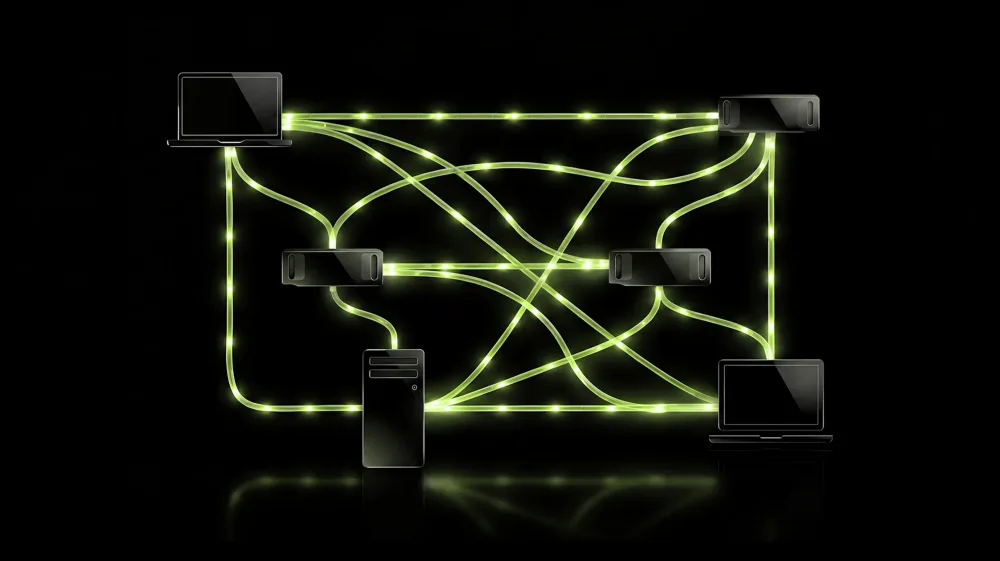
I've been looking into how people handle agentic workflows locally, and the bottleneck is always the same: you run out of memory once you start chaining multiple LLM agents together. PAIR attempts to solve this by discovering compatible hardware on your local network and syncing them up to tackle inference tasks. It's important to clarify right away that this isn't a physical piece of networking hardware. It's a software layer designed to work alongside the tools most of us are already using, like Ollama or LM Studio.
Hardware requirements and compatibility #
It's not going to work on just any old laptop, but the support for Nvidia users is quite broad. If you are running a modern gaming rig or a workstation, you're likely good to go.
Nvidia Support: Specifically optimized for GeForce RTX 20-series cards and newer.Professional Grade: Works with RTX Pro GPUs and DGX Spark systems.Apple Silicon: Surprisingly, it includes support for Apple M4 chips or newer, which suggests they are targeting unified memory architectures for distributed tasks.
The goal here seems to be creating a seamless AI workflow where your primary machine can offload the heavy lifting to a secondary PC in the next room. Instead of buying a single, massive A100 or a high-end H100, you're essentially "pooling" your existing consumer hardware.
How it fits into an AI workflow #
If you are setting up a local LLM agent environment from scratch, PAIR acts as the orchestration layer. Typically, when you run a heavy model, you're limited by the VRAM on a single card. If you have an RTX 3060 with 12GB and another with 16GB, they usually act as totally isolated islands. PAIR is designed to bridge that gap so they can work on the same computational problem. This is particularly useful for:
-
Distributed Inference: Splitting model layers across multiple GPUs in different machines.
-
Agentic Workflows: Running different "specialist" agents on different machines simultaneously to avoid resource contention.
-
Local Privacy: Keeping all that heavy processing inside your own four walls without needing to ping a cloud API.
I'm curious to see how much latency this adds to the communication between nodes. Since it's running over a standard home network, your Ethernet speed or Wi-Fi stability is going to be the new bottleneck. If you're planning to try this, I'd highly recommend a wired gigabit connection between your machines to keep the token generation speed from tankる. It's a solid step toward making local, high-parameter model deployment actually practical for enthusiasts.
Nvidia might just swallow the entire open-source AI ecosystem 5h ago NBA 2K27 is bringing DLSS 5 to GeForce NOW this month 6h ago
NVIDIA is buying Hugging Face and the AI open-source crowd is 7h ago NVIDIA and CrowdStrike are building a specialized agentic stack 13h ago
NVIDIA DLSS 5 is officially here and it looks massive 1d ago
Anthropic just locked in a massive $35B cloud deal with Nvidia 1d ago
Next GPT-6 Astra is live — but the benchmarks tell a more complicated →