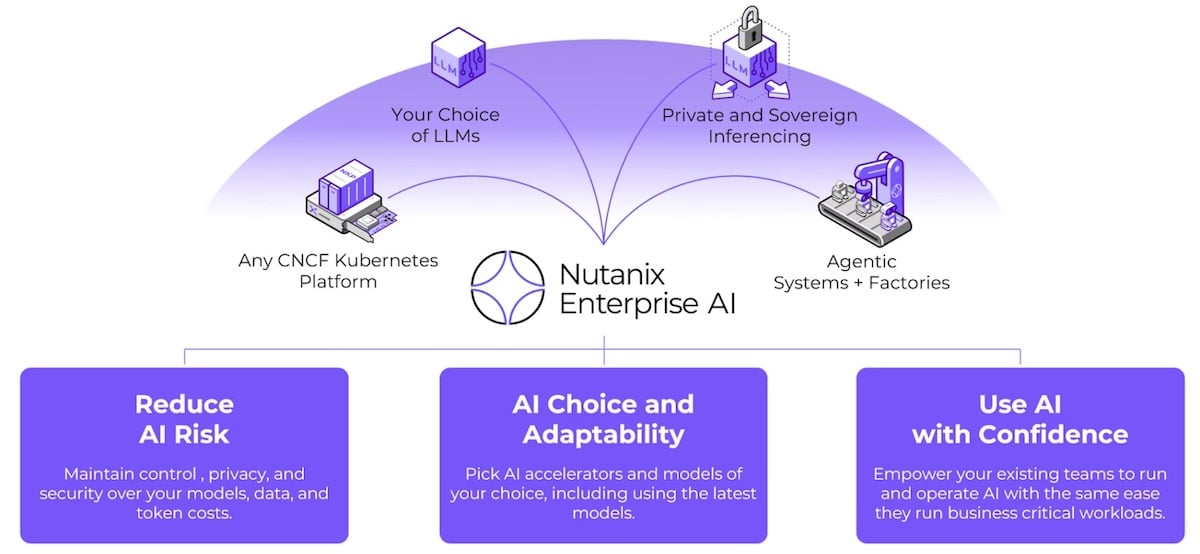
Nutanix has announced the general availability of Nutanix Enterprise AI (NAI) 2.8 alongside the upcoming release of Nutanix Kubernetes Platform (NKP) 2.19. The updates focus on bridging the gap between legacy virtualized environments and modern containerized AI workloads. By implementing a dual-native architecture, Nutanix aims to allow organizations to run virtual machines and containerized AI applications side by side on existing infrastructure, minimizing the need to create distinct infrastructure silos or migrate data across complex networking layers.
“Enterprise AI should not require customers to rebuild the systems that already run their business,” said Thomas Cornely, EVP of product management at Nutanix. The company’s dual-native approach is designed to maintain consistent management and governance across VMs, containers, and AI frameworks, enabling near bare-metal execution on virtualized systems while retaining architectural flexibility.
Nutanix Enterprise AI 2.8 Architecture and Capabilities #
NAI 2.8 provides a unified management plane for deploying, governing, and scaling large language models (LLMs) and agentic workflows across hybrid environments. The control plane delivers centralized visibility into token consumption, built-in observability metrics, and model-as-a-service functionality.
To facilitate agentic AI frameworks, the platform introduces a generally available Model Context Protocol (MCP) Gateway. This gateway serves as a standardized access layer for AI agents to interface with external tools and enterprise datasets without requiring custom engineering. A companion MCP Server for Nutanix Cloud Platform (NCP) is also available to grant agents secure, governed access to Nutanix-managed infrastructure resources.
On the compute and serving side, NAI 2.8 adds multi-GPU private inference and fine-tuning capabilities. High-throughput serving is achieved through tensor parallelism across distributed nodes, supplemented by batch processing and speculative decoding. Speculative decoding uses lightweight draft models to reduce token-generation latency by up to 2.5 times without impacting model precision. For model customization, the platform introduces Parameter-Efficient Fine-Tuning with Low-Rank Adaptation (LoRA) for models with fewer than 8 billion parameters, enabling organizations to train adapters on domain-specific data using single-GPU instances and deploy them directly into production serving pipelines.
Security controls within NAI have been structured to isolate agentic workloads and prevent model breakout. The platform enforces granular Identity and Access Management (IAM), custom role-based access controls, model-sharing restrictions, and full support for air-gapped NVIDIA NIM deployments.
Nutanix Kubernetes Platform 2.19 Additions #
The upcoming NKP 2.19 release focuses on standardizing Kubernetes operations across bare-metal and virtualized deployments. The platform has received formal CNCF Certified Kubernetes AI Conformance, verifying API standardization for enterprise AI orchestration.
The release introduces NKP Metal, which applies hyperconverged infrastructure management principles to bare-metal Kubernetes. This includes automated provisioning of operating systems, firmware, and container runtime components, along with native persistent storage. For virtualized deployments, NKP Full Stack on Nutanix AHV integrates with Nutanix Flow to enforce microsegmentation and network-level sandboxing, thereby isolating AI agents and preventing lateral movement within the network.
NKP 2.19 also adds a curated AI Applications Catalog for automated deployment of frameworks such as Kubeflow, Milvus, and Slurm. Hardware resource management has been updated with validated GPU integration profiles and dynamic hardware allocation.
Storage Architecture and Partner Programs #
Storage throughput remains a critical dependency for sustained GPU compute efficiency. To support high-concurrency training and inference pipelines, Nutanix Unified Storage (NUS) has achieved enterprise-level NVIDIA certification. The validated architecture provides low-latency, linear-scaling data paths to keep accelerator pipelines saturated during distributed workloads.
Alongside the platform updates, Nutanix launched the Powered by Nutanix: Verified Services program and announced the general availability of Service Provider (SP) Central. SP Central provides a multitenant control plane that allows managed service providers to provision, operate, and monetize infrastructure, container, and AI services under flexible licensing models.
NAI 2.8 and SP Central are available immediately, with NKP 2.19 scheduled for release in the near term.