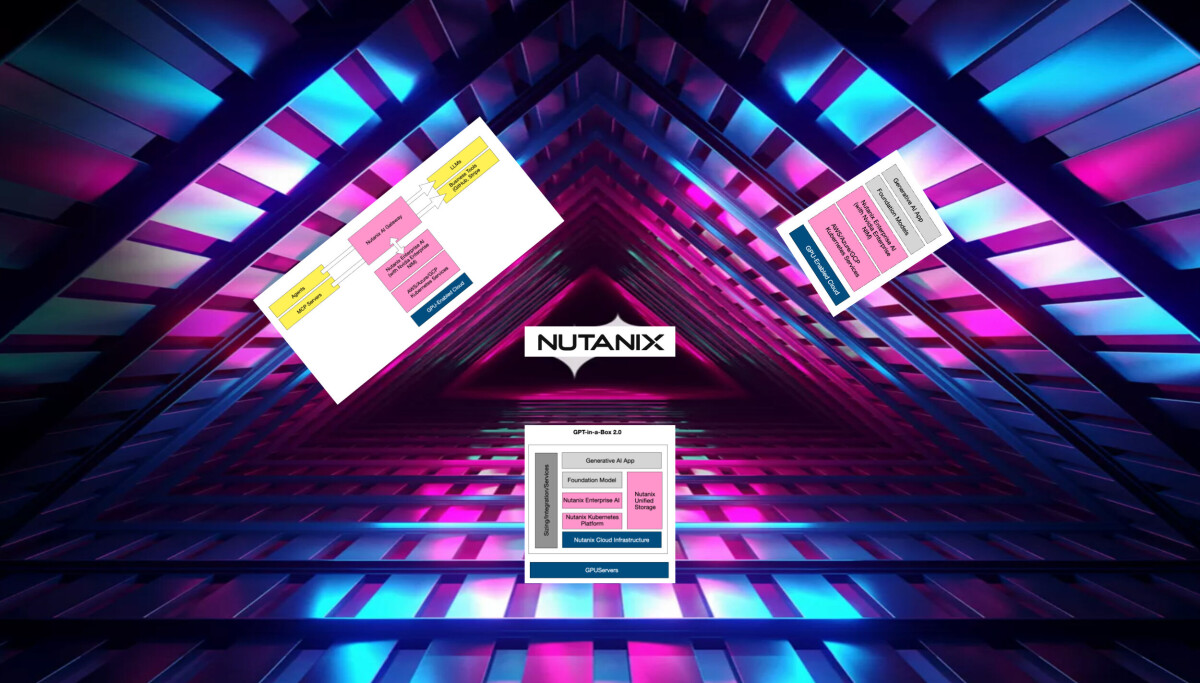
Nutanix’ Agent Gateway is generally available as a control point to manage AI agent activity, access policies, and token consumption across agentic AI deployments.
The product is positioned to help customers monitor and optimize (reduce) AI agent and model token consumption which can cause huge cost increases of unconstrained, setup and enforce agent access policies so, like human operators, they can’t run rampant through an enterprise’s IT estate, and oversee agent activity. The background here is that having generative AI models used in initial pilot AI projects is changing over to production AI with potentially hundreds if not thousands of AI agents with autonomous features.
They simply cannot be allowed uncontrolled access to do whatever they want inside a customer’s IT operation but it’s not feasible to have multiple distributed and separate agent control points. Instead, Nutanix says, you need an agent gateway and it’s built one as part of its Nutanix Enterprise AI software product
Nicole O’Keefe, Product Marketing Manager, NAI, Nutanix and Ashwini Vasanth, Group Product Manager, NAI, Nutanix, write in a [blog](https://www.nutanix.com/blog/introducing-nutanix-agent-gateway# troducing Nutanix Agent): “The generative AI landscape has undergone a fundamental shift. What began as reactive chatbots answering questions has evolved into autonomous agents that actively engage with enterprise tools, business systems, and LLMs. These same agents are now able to spawn sub-agents with the same level of capability. This evolution comes with a compounding challenge: as agent sprawl increases across organizations, so does the multiplier effect on token consumption and access control risks.”
NAI stands for Nutanix Enterprise AI. This was introduced in Nutanix’ GPT-in-a-Box v2.0 release in November 2024. It is a component of GPT-in-a-Box, along with Nutanix Cloud Infrastructure, Nutanix Kubernetes Platform, and Nutanix Unified Storage, plus services to support customer configuration and sizing needs for on-premises training and inferencing.
We wrote “NAI can run on-premises, at the edge, or in datacenters, and in the three main public clouds’ Kubernetes offerings – AWS EKS, Azure AKS, and Google GKE – as well as other Kubernetes run-time environments. This multi-cloud operating software can run LLMs with Nvidia NIM-optimized inference microservices as well as open source foundation models from Hugging Face. The LLMs operate atop the NAI platform and can access NAI-stored data.”
Back in March, we noted “Nutanix Enterprise AI (NAI) v2.6 includes an AI Gateway service for unified policy control over cloud-hosted and private LLMs. New support for the Model Context Protocol (MCP) server and fine tuning extends its existing MaaS capabilities to enable agents to securely connect to enterprise tools and data sources. NAI also supports the Nemotron family of open-source AI models, datasets, and training tools.”
NAI provides a private inference stack, which Dell describes as “an intuitive, centralized inferencing control plane for your models and inferencing operations that is cost-predictable. … With NAI, your team can select, deploy, and monitor large language models (LLMs) and secure API endpoints quickly.”
The Nutanix Agent Gateway (NAG - but Nutanix does not use this acronym) is integrated with NAI’s private inference stack and its control layer across public hosted models and private self-hosted models.
NAG features;
Nutanix Agent Gateway Governance for MCP: Set granular access control to MCP servers, enabling agents to securely connect to business tools and private data sources
Unified Observability: Centralize visibility into token usage, MCP server access, and LLM activity
Audit Logs: Record every MCP request with an audit trail for AI governance
Unified API: Access external provider models and self-hosted models through a single API, providing freedom to use the right model for the right use case
Granular Token-Based Rate Limiting: Enforce token quotas and limits centrally that deliver real-time visibility into token usage across every agent and team
It acts as a centralized gateway that manages and helps secure traffic from agents to LLMs and from Model Context Protocol (MCP) servers, in Tech Preview, accessing business tools such as GitHub and Stripe. Organizations can gain centralized policy enforcement, comprehensive usage visibility, and real-time token cost accountability across public cloud and self-hosted inference environments.
NAG is designed to deliver centralized token observability across model vendors, enabling IT and platform teams to track usage, attribute costs, and help control excessive token consumption. Hosted models can be excessively expensive, and tracking their costs can provide the impetus to move to lower-cost open weight (open-source) and self-hosted local models.
It applies access control policies and tool-level filtering of MCP servers, and provides a mechanism to self-host private models as well as consume them via a unified API. You can configure user management and policies once and have them apply to both the gateway and private inference.
Comment
This NutanixAgent Gateway is roughly equivalent to an Okta-like IAM (Identity Access Management) capability for humans accessing an IT estate and is an agent identity proxy.
Okta itself is partnering Google Cloud to integrate its identity functionality with GCP’s Gemini Enterprise Agent Platform and Chrome Enterprise. An initial release links Okta’s Auth0 for AI Agents to the Gemini Enterprise Agent Platform Runtime and so brings agent authentication and access controls into agentic workflows. Another feature will bring centralized visibility and policy control for agents. This is specific to GCP whereas Nutanix’ gateway covers all three main public clouds and on-premises installations.
Palo Alto’s Prisma AIRS 3.0 product has an AI Agent Gateway, currently available in limited preview, provides a central control plane to enforce agent runtime and identity security, governance and observability.
AI Agent identity access management is going to become a common requirement.