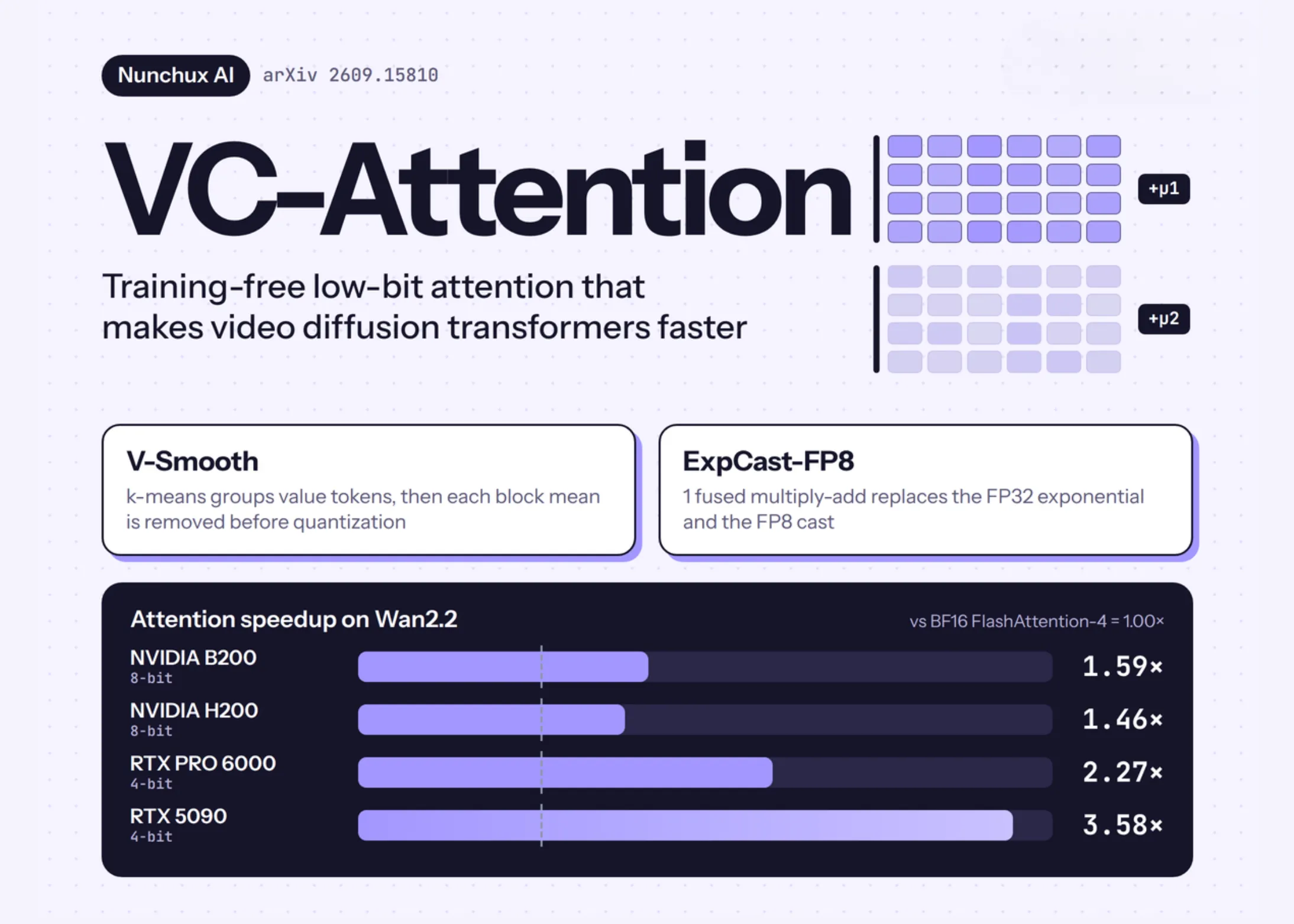
Nunchux AI has released VC-Attention, a training-free low-bit attention kernel built for video Diffusion Transformers (DiTs). It targets 2 problems at once: value quantization error and a slow softmax stage.
Why Attention is the Video Bottleneck #
Video DiTs flatten a clip into 1 sequence of spatiotemporal tokens and run full self-attention at every layer. A 5-second 720p Wan2.2-14B clip spans about 70K tokens. On the RTX 5090, attention takes more than 64% of generation time. The research team states that attention is about two thirds of every MiniMax-H3 denoising step on a single B200.
Low-bit Tensor Cores speed up the 2 matrix products, QK and PV. 2 obstacles remain. First, prior methods like SageAttention2 smooth queries and keys. After QK smoothing and rotation, the value term accounts for 82% of output error on Wan2.2. Second, the softmax between the products still runs in FP32. On B200 and H200, that exponential and its FP8 cast become the longest pipeline stage.
V-Smooth: Fixing Value Outliers #
Value outliers sit in a few tokens, and their channels shift across heads, layers, and steps. A Hadamard rotation preserves token norms, so it does not remove them. Rotating V changes value error by just 0.2%.
V-Smooth takes a different route:
- Group: An online k-means clusters value tokens per batch and head. Keys and values are permuted together, so non-causal attention output is unchanged.
- Demean: Each 128-token hardware block subtracts its mean. Only the residual is quantized, using per-channel E4M3 at 8 bits or NVFP4 at 4 bits.
- Restore: The mean is added back using the row sum online softmax already keeps. No second pass or extra buffer is needed.
Averaged over 100 Wan2.2 heads, the block mean removes 8% of block energy in sequence order. It removes 12% under DeltaQuant’s static cube and 36% after sorting. Each mean costs 0.125 bit per value element.
Grouping runs only on the first 25% of denoising steps. The permutation is reused across 4 adjacent steps. Averaged over the full schedule, grouping costs 3 to 4% of attention time.
ExpCast-FP8: Removing the Softmax Bottleneck #
An E4M3 byte is already close to a logarithm of the value it stores. Read as an integer, it equals roughly 8 log2(v) + 56. So ExpCast-FP8 writes the byte directly from the log-domain score with 1 fused multiply-add. The constant β = -0.35 centers the leftover error, and no constant is fitted per model.
The direct path writes the same byte as the FP32 exponent-then-cast path on 79.6% of each doubling. Elsewhere it lands 1 code away. The paper proves a per-row total variation bound under 3.64%, plus any underflow tail. Across 204.8K Wan2.2 attention rows, the measured average is 1.6%. ExpCast-FP8 applies only to the 8-bit kernel, since NVFP4 has no single affine log-to-code map.
Hand-written CuTe/CUDA fusion of the preprocessing chain cuts 1 V-Smooth call from 42.2 ms to 4.8 ms on B200.
Explainer: How VC-Attention Works #
Benchmarks #
Tests cover 4 open-weight video DiTs: Wan2.2-T2V-A14B, LongCat-Video, HunyuanVideo-1.5, and MiniMax-H3. Fidelity is scored against BF16 FlashAttention-4 outputs over 100 prompts.
| GPU (Wan2.2) | Precision | Attention speedup | End-to-end speedup |
|---|---|---|---|
| B200 | 8-bit | 1.59× | 1.19× | | H200 | 8-bit | 1.46× | 1.13× | | RTX PRO 6000 | 4-bit | 2.27× | 1.36× | | RTX 5090 | 4-bit | 3.58× | 1.70× |
On B200, VC-Attention is 6.02× faster than SageAttention2, which ships no Blackwell kernel. On H200, the gap is 1.16×. On workstation cards, 4-bit V-Smooth matches SageAttention3 on the RTX PRO 6000. It stays within 5% on the RTX 5090, so fidelity separates them.
Fidelity results:
-
At 8 bits, V-Smooth adds 2.3 dB PSNR over SageAttention2 on Wan2.2 and 2.8 dB on HunyuanVideo-1.5.
-
Adding ExpCast-FP8 gives back 0.7 to 2.1 dB but still beats SageAttention2 on all 4 models.
-
At 4 bits, V-Smooth beats SageAttention3 by 2.9 dB on Wan2.2 and 3.6 dB on LongCat-Video.
-
Run training-free, Attn-QAT falls 3.4 to 6.7 dB below SageAttention2. On MiniMax-H3 at 1344×768, attention runs 1.60× faster than BF16 FlashAttention-4 on B200. PSNR is 20.2 dB versus 19.9 dB for SageAttention2. On B300, the paper reports 1.47× versus 1.31× for a naive FP8 kernel. The blog chart lists 1.51× for B300.
Nunchux Attention, the company's proprietary extension, reaches 1.91× on B200 and 1.83× on B300 for MiniMax-H3 attention.
The method changes only per-interaction cost. So it can compose with sparse attention like Sparse VideoGen and Radial Attention, and distillation and multi-GPU execution. Nunchux says free MiniMax-H3 access is coming through its Modelverse waitlist.
Key Takeaways #
- VC-Attention is training-free low-bit attention for video DiTs from Nunchux AI.
- V-Smooth clusters value tokens, then quantizes only residuals after block-mean subtraction.
- ExpCast-FP8 replaces the FP32 exponential and cast with 1 multiply-add.
- Wan2.2 attention runs 1.59× faster on B200 and 3.58× on RTX 5090.
- No public kernel release yet; Nunchux runs a proprietary extension in its stack.
Check out the Paper and Technical details. All credit goes to the researcher of this project. Also, feel free to follow us on Twitter and don’t forget to join our 150k+ML SubReddit and Subscribe to our Newsletter. Wait! are you on telegram? now you can join us on telegram as well.
Need to partner with us for promoting your GitHub Repo OR Hugging Face Page OR Product Release OR Webinar etc.? Connect with us
Asif Razzaq is the CEO of Marktechpost AI Media Inc.. As a visionary entrepreneur and engineer, Asif is committed to harnessing the potential of Artificial Intelligence for social good. His most recent endeavor is the launch of an Artificial Intelligence Media Platform, Marktechpost, which stands out for its in-depth coverage of machine learning and deep learning news that is both technically sound and easily understandable by a wide audience. The platform boasts of over 2 million monthly views, illustrating its popularity among audiences.