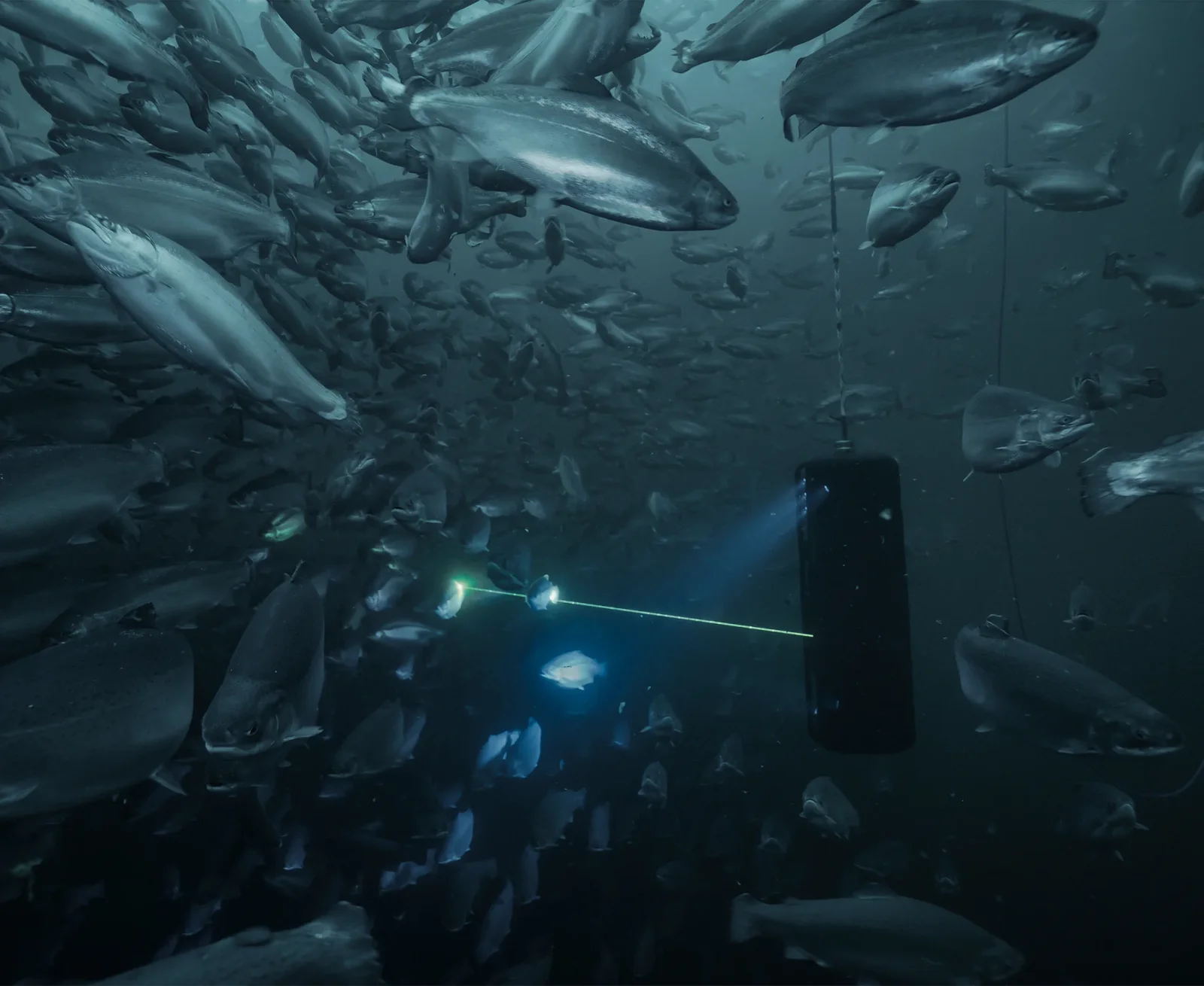
More than two thousand AI-guided laser units now swim inside Norwegian salmon pens, targeting sea lice without dragging fish through harsh chemical baths — according to Stingray Marine Solutions’ 2025 aquaculture report. The Oslo company says its Fish Health Hub already covers 20–25% of farmed Atlantic salmon in Norway, with ~15,000 cameras on 2,500+ active nodes feeding continuous improvement loops.
For AI readers, this is physical AI at production scale: underwater vision, real-time targeting, and measured welfare outcomes — not a conference demo.
TL;DR #
| Topic | Stingray-reported detail |
|---|---|
| Product | Optical Delousing — cameras + software +targeted laser |
| Deployed lasers | 2,000+ in Norwegian pens |
| Coverage | 20–25% offarmed salmon in Norway |
| Sensors | ~15,000 cameras ,2,500+ nodes |
| Treatment impact | 2023 model : ~50% fewer weekly treatment probability at10°C reference vs non-laser sites |
| Factory expansion | Second Norway plant (~2026) per trade press |
What optical delousing is #
Sea lice are parasites that weaken farmed salmon and trigger expensive, stressful treatments — mechanical removal, bath medicines, or feed-delivered drugs. Stingray’s approach:
- Underwater cameras detect lice on fish.
- Software tracks targets.
- A laser pulse neutralizes the lousewithout handling the fish.
The company describes the stack as patented optical delousing, combining robotics, AI, and around-the-clock monitoring.
Fish Farming Expert notes Mowi and Cermaq among customers, with more than 2,000 lasers deployed since commercial launch roughly a decade ago — aligning with Stingray’s annual report figures.
Fish Health Hub interface for laser sea lice control
Image: Stingray Marine Solutions
Measured impact on treatments #
Stingray’s report details collaboration with the University of Bergen to model weekly treatment probability in 2023:
- At a 10°C sea-temperature reference, siteswithout optical delousing showed about10% weekly treatment probability.
- Laser sites showed about5% — described as50% fewer reactive treatments nationally, across mechanical, bath, and medicinal categories.
The report stresses regional variation — warmer areas face more lice pressure — but claims the laser advantage appeared in every production area with enough market share to model.
That is outcome data, not a leaderboard benchmark. It matters because regulators and NGOs judge aquaculture on antibiotic use, fish mortality, and escape risk.
Scale and manufacturing #
Stingray’s 2025 report also highlights:
- Fish Health Hub™ analytics tying laser sites tolower lice levels andreduced mortality .
- Novo Holdings ownership supporting R&D acceleration (per report narrative).
- Support for Norwegian Food Safety Authority automation initiatives, includingautomatic lice counting continuing into2026 .
Trade press in May 2026 covered a second factory in Groruddalen, Oslo, roughly double the first plant’s footprint, targeting higher unit output from August production ramps.
Rows of sensor-equipped aquaculture monitoring evoking camera nodes along a Norwegian coast
Parallel physical-AI efforts in the same waters #
Norwegian salmon farming is a magnet for perception + actuation R&D:
| Player | Focus |
|---|---|
| Stingray | Laser delousing at pen scale |
| Mowi | Robots cleaning nets; lasers per WSJ overview |
| Tidal (Google X spinout) + SalMar | AI cameras, autonomous feeding, in-pen lice mitigation trials |
None of these replace the others; they stack hygiene robots, lice counters, and targeted removal.
explainx.ai covered agentic robotics foundations in Berkeley–Nvidia CORL work and warehouse-style autonomy in Crossnokaye Aura on Bedrock AgentCore. Salmon pens are harsher edge environments — corrosion, biofouling, and strict welfare law.
Norway policy context #
Our Statnett data-center grid post explains energy politics onshore. Aquaculture lasers sit in a different bucket: coastal industry defending export revenue and rural jobs.
AI regulation in Europe still shapes how camera data is stored and who can access biomass analytics — relevant if you sell fleet software into EU-adjacent supply chains.
What builders can learn from Stingray’s stack #
Perception loop
- 15,000 cameras implymassive labeling and drift monitoring — closer tofactory vision than chatbots.
Safety and welfare
- Mis-fired lasers hurt fish and triggerregulatory stops . Confidence thresholds matter more thancreative quality scores .
Fleet ops
- 2,500 nodes needOTA updates ,spares logistics , anduptime SLAs — thinkKubernetes for wet environments .
Evaluation
- Stingray pairs field data withuniversity modeling . Agent teams should likewise pairlive telemetry withoffline causal analysis , not vibe checks.
Trying similar ideas without a fish pen #
You cannot replicate lice physics in a laptop, but you can practice closed-loop targeting:
-
Use ROS 2 simulators withmoving targets andlatency budgets .
-
Benchmark detector mAP underturbidity augmentation .
-
Study Skild Steel Solver physics models for how labs publishsim-to-real discipline.
Iceland and colder-water constraints #
Stingray’s report dedicates space to Iceland, where wellboat delousing capacity is scarce and cold water slows healing after handling. The company argues in-pen laser control matters more when transport to treatment vessels is biologically risky.
That is a deployment constraint lesson for edge AI: the same algorithm may excel in Norway’s fjords but need different thresholds in Icelandic temperatures. Do not ship one global confidence cut-off.
Automatic lice counting and regulators #
Stingray says it supported the Norwegian Food Safety Authority push toward automated lice counting continuing through 2026. Computer vision here is not consumer glam — counts feed regulatory reporting and treatment authorizations.
If you sell vision models into regulated agriculture, expect audit trails: which model version counted lice on which pen, and how humans overrode failures.
Comparison table: laser vs bath vs mechanical #
| Method | Fish handling stress | Chemical exposure | Capex profile | Automation fit |
|---|---|---|---|---|
| Optical laser | Low direct handling | Avoids many bath drugs | High install, lower reactive opex | Strong CV loop |
| Mechanical delousing | High | Low chemistry | Vessel-heavy | Robotics on ships |
| Medicinal bath | High | Antiparasitic drugs | Recurring consumables | Weak autonomy |
Stingray’s statistics argue lasers shift the portfolio toward the first row, not eliminate the others overnight.
Supply chain and second factory #
The 2026 factory expansion matters for lead times if lice pressure spikes in warm summers. Physical AI vendors face semiconductor and optics lead times like any robotics firm — distinct from LLM API scaling.
Link to Nvidia Korea startup investments only at the infrastructure layer: GPU shortage stories rarely mention underwater housings, but both gate deployments.
Welfare and environmental debate (honest framing) #
Laser delousing reduces some treatments, but industrial salmon farming still draws criticism on escapes, sea lice spread to wild fish, and pen densities. Stingray’s data argues welfare improvement within the current model, not ending farming.
Readers building climate AI should cite primary vendor metrics while linking NGO critiques when you discuss net environmental impact — we stay with Stingray’s published measurements here.
What people are asking #
Are lasers allowed everywhere?
Norwegian regulators approve equipment and methods; Stingray notes Food Safety Authority collaboration on automated lice counting. Local licenses still govern each site.
Could this run on a phone model?
Unlikely at pen scale. Edge GPUs or custom vision SOCs with waterproof housings are the realistic stack.
Does Nvidia fund this?
Stingray’s report mentions Novo Holdings, not Nvidia. Separate from Nvidia Korea sovereign AI forum coverage.
Sensor fusion with feeding and biomass AI #
Major producers pair lice lasers with biomass estimation and automated feeding — Tidal’s partnership coverage describes camera-derived phenotypes feeding genetics programs. The data model is a time-series per pen: lice counts, weight distribution, feed conversion, mortality events.
If you build analytics agents for aquaculture customers, treat each pen as a digital twin with strict access control. A leaked biomass dashboard moves commodity markets.
Maintenance economics #
Biofouling on lenses and storm damage dominate OPEX more than GPU refresh. Schedule diver cleaning like data-center filter replacements — predictable downtime, not heroic on-call.
Stingray’s live-streaming claim (15,000 cameras) implies NOC-style monitoring. Borrow SRE playbooks from cloud, but replace ping with turbidity alerts.
Document false-positive laser shots and missed lice the way you log model refusals: both drive trust audits with regulators and buyers.
Training data and export angles #
Underwater footage is sensitive: it can reveal pen locations, stock health, and proprietary feeding strategies. If you fine-tune detectors for lice segmentation, negotiate who owns derivatives and whether frames may leave Norwegian waters for cloud training.
Sovereign AI policies in other regions — see our Korea forum coverage — rarely mention fish, but the pattern is the same: national industry wants models trained and hosted with local oversight.
Related reading #
Sources #
- Stingray Marine Solutions aquaculture report 2025 (PDF) .
- Fish Farming Expert on Stingray’s second factory , May 11, 2026.
- Wall Street Journal overview of high-tech salmon tools (paywalled; cited for Mowi executive quotes).
Deployment counts and treatment statistics follow Stingray’s published report unless labeled as secondary reporting.