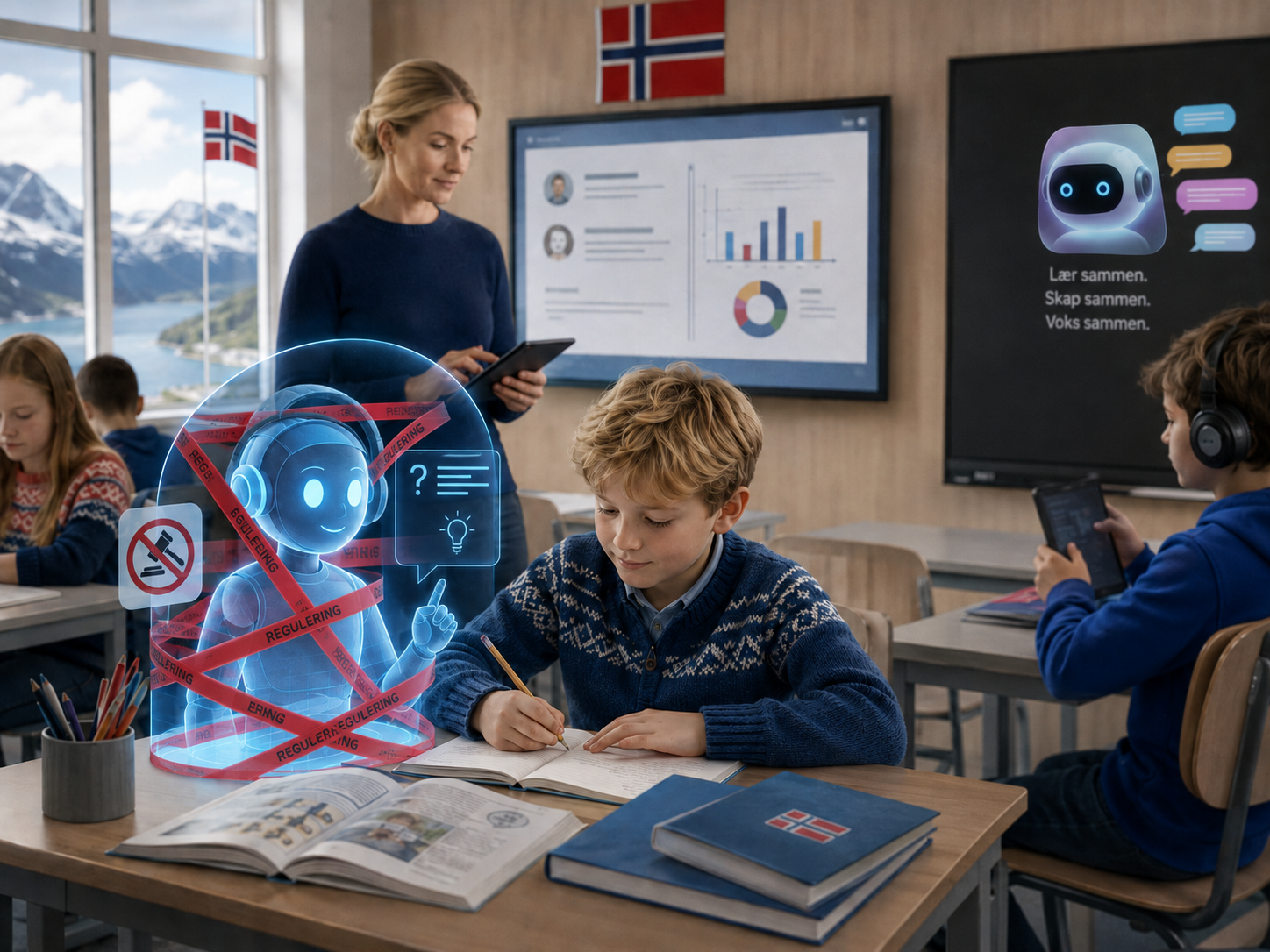
On 19 June 2026, Prime Minister Jonas Gahr Støre announced that Norway will impose a near-total ban on generative AI for children in grades one through seven, ages six to thirteen. Students aged 14 to 16 may use the tools only under direct teacher supervision; only by ages 17 to 19 are students expected to learn to use AI on their own. The government paired the announcement with a plan to fund more printed books and walk back two decades of drift toward classroom tablets. The stated reason is simple and, on its face, hard to argue with: the most important thing in school is that children learn to read, write, and do mathematics, and AI lets them skip the steps where that learning actually happens.
I think the worry is real and the policy is the wrong answer to it. Norway has correctly diagnosed a danger and then reached for the one instrument guaranteed to forfeit the upside along with it. The problem is not that children have access to AI. The problem is that they have access to uncontrolled AI. Those are very different things, and conflating them is how you end up banning the most powerful individualized teaching tool ever built because its consumer version happens to also be good at writing essays for lazy teenagers.
Take the concern seriously first #
It would be cheap to wave the ban away as technophobia, so let me not do that. The Norwegian government is not acting on a hunch. Its 2024 smartphone ban produced measurable results — one study of more than 400 middle schools found reduced bullying, improved grades, and a sharp drop in visits to psychological services, with the largest effects among girls and among students from lower-income homes. That is a serious record, and it earns the government the benefit of the doubt that it is trying to protect something worth protecting.
And the specific fear about AI is grounded in evidence too. A recurring finding in the research on generative AI in classrooms is what one set of authors bluntly called "metacognitive laziness": when a chatbot will hand over a finished answer, a meaningful share of students stop doing the cognitive work the assignment was designed to make them do. A 2025 systematic review of AI in programming education found overreliance producing superficial learning in roughly two-thirds of the studies it examined. A six-year-old who asks a model to write her sentences does not learn to write sentences. This is not a fantasy risk. It is the default outcome of dropping a powerful, unsupervised completion engine into the hands of a child who has not yet built the skills the tool is short-circuiting.
So the question is not whether unsupervised consumer AI can harm foundational learning. It can. The question is whether a ban is the right response, and here is where Norway goes wrong.
A ban optimizes for the failure mode and discards the cure #
Notice what the danger actually is. The harm comes from AI that finishes the task for the student — it answers, it completes, it removes the struggle. But that is one mode of AI, not the only one, and crucially it is the mode you get when there is no control over how the tool behaves. The same underlying technology, pointed in the opposite direction, does the thing education has wanted and never been able to afford at scale: it gives every single child a patient, individual tutor.
The evidence on that second mode is not speculative either. Across quasi-experimental studies, students working with well-designed AI tutoring and adaptive systems have outperformed their peers by something in the range of 15 to 35 percent on assessments, with gains in engagement and retention alongside. Intelligent tutoring systems — adaptive software that adjusts to the individual learner — have repeatedly shown effects on student performance approaching those of one-on-one human tutoring, the single most effective intervention education research has ever identified and the single least scalable. The mechanism is exactly the one a classroom of thirty children cannot provide: an AI tutor can detect in real time when a task is too easy, because the student races through error-free, or too hard, because of repeated mistakes and long s, and adjust the difficulty to keep that student in the narrow band where learning actually happens. One teacher cannot do this for thirty children at thirty different levels simultaneously. The technology can.
This is the part the ban throws away. Benjamin Bloom's old finding — that one-to-one tutoring moves the average student roughly two standard deviations above classroom instruction — has haunted education for forty years precisely because nobody could pay for a tutor per child. For the first time there is a plausible route to that, and it is a route that helps exactly the students Norway says it cares about most: the ones who are behind, the ones from lower-income homes who don't have a parent able to sit with them through their maths homework. A blanket ban for ages six to thirteen doesn't protect those children from a danger. It denies them the one tool that could close the gap, and leaves the children who already have private tutors and educated parents exactly where they were.
The real variable is control, not access #
Here is the cleaner way to see it. The Norwegian smartphone ban worked because a smartphone in a classroom is, by design, an uncontrolled device: it connects a child to social media, games, and group chats that the school does not run and cannot shape. There is no "supervised mode" of TikTok that teaches fractions. Banning it removes a distraction and gives nothing up, because the device was never a teaching instrument in the first place.
AI is not like that, and treating it as if it were is the category error at the heart of this policy. AI's behavior is configurable. A school can deploy a tutor that is explicitly built never to give the answer — one that asks the Socratic follow-up, that requires the child to show the next step, that reports back to the teacher which concepts the class is stuck on. That is not the same artifact as a consumer chatbot with a "write my essay" button, even though the same model sits underneath both. The difference between the harmful version and the helpful version is entirely a matter of how the environment is controlled: what the tool is permitted to do, what it is instructed to withhold, what the teacher can see.
Norway's own age tiers quietly concede this. By 17 to 19, students are expected to use AI well, because they will need it for work and university. But the skill of using AI well is not something that materializes at seventeen. It is built the same way reading and arithmetic are built — gradually, under supervision, starting young, with controls that match the child's stage. A child who first meets AI as an unsupervised tool at seventeen is in a worse position than one who grew up with a tutor that modeled how the tool should be used. The ban doesn't delay the risk. It delays the literacy and lets the risk arrive all at once, later, with no scaffolding.
What the better policy looks like #
The instinct behind the ban — protect foundational learning, keep the struggle that makes learning real — is correct. The instrument is wrong. A policy that took both the danger and the opportunity seriously would not ban AI for young children; it would ban uncontrolled AI for them, which is a much more precise and much more defensible thing to do. Concretely:
Distinguish the completion engine from the tutor. Prohibit the consumer chatbot that does the child's work. Procure and deploy the adaptive tutor that won't. These are different tools and the policy should name them differently.Make "won't give the answer" a procurement requirement. A classroom AI for a nine-year-old should be configured to elicit, scaffold, and withhold — to make the child do the step — and that behavior should be a condition of the contract, not an afterthought.Put the teacher above the tool, not beside it. The most valuable thing an AI tutor produces is not the answer to the child; it is the dashboard to the teacher showing who is stuck on what. Keep the human in charge and let the AI do the thing humans can't: attend to thirty individual trajectories at once.Build AI literacy from the start, gradually. Teach children to treat the tool as something to interrogate rather than obey, at every age, in a form appropriate to that age — rather than withholding it for a decade and then handing over the keys at seventeen.
Norway has done something genuinely useful here, which is to refuse the lazy assumption that more technology is automatically better. That refusal is healthy and most of the world's school systems could use more of it. But the lesson of the smartphone ban is being misapplied. Smartphones had to go because they could not be made into teaching tools. AI is the opposite case: it is the rare technology whose entire value in a classroom depends on how tightly it is controlled, and that is precisely the argument for controlling it well — not for banning it and waiting until the children are nearly grown to admit it was useful all along.
The goal Norway names — children who can read, write, and do mathematics — is exactly the goal a well-built, controlled, individualized AI tutor is best in the world at advancing. It is a strange kind of victory to protect that goal by outlawing the best means of reaching it.