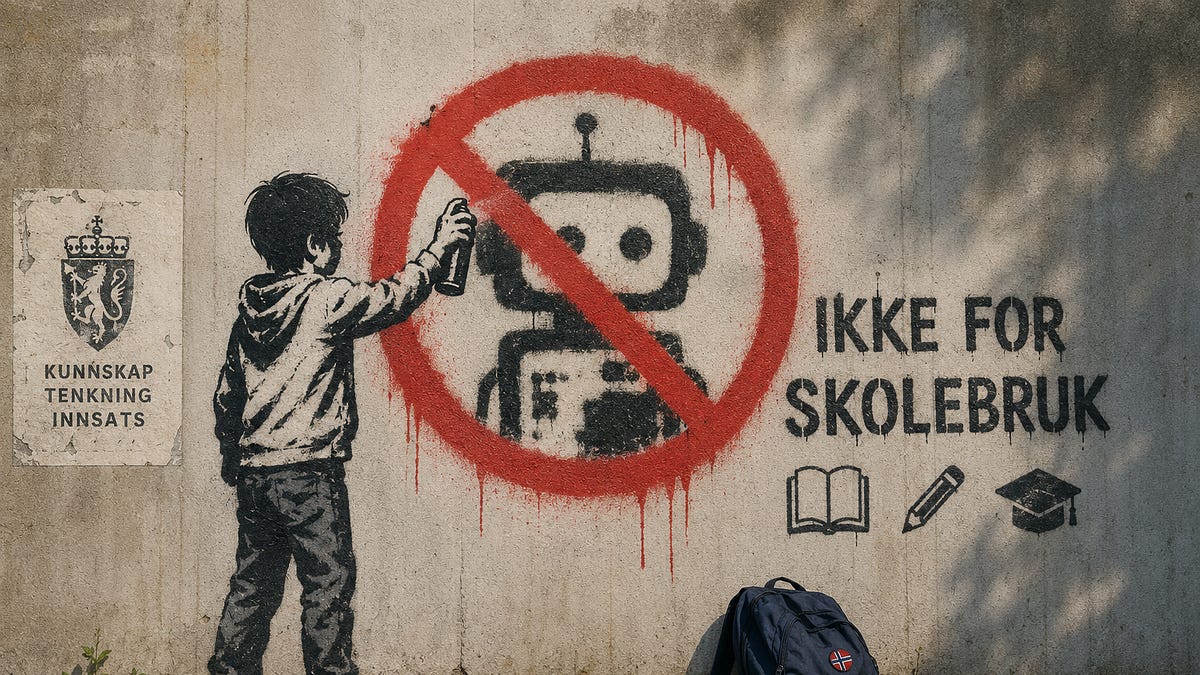
Norway has near banned AI for its primary school students while the world moves on
AI literacy is going to be one of the most important skills a young person can develop in the next decade. That makes what Norway just announced both understandable and deeply frustrating, because they’ve correctly diagnosed a real problem and responded with the wrong medicine.
Norway is restricting AI use in schools starting in autumn 2026. Grades 1 through 7 will be largely cut off. Grades 8 through 10 (middle school) get cautious, limited access only after teachers have been trained. Upper secondary students (high school) can use AI to prepare for work and further education. The government cited falling PISA and PIRLS scores, noted that one in four Norwegian students reads below the OECD minimum threshold for further schooling, and concluded that students need to learn reading, writing, and mathematics before touching AI.
They are not wrong about the scores. They are wrong about what caused them and catastrophically wrong about how to fix it.
A Chinese study shows the two possible paths #
A new working paper from David Strömberg, Victor Lei, and Yanhui Wu (CEPR Discussion Paper DP21577, June 2026) gives us the clearest data yet on what AI is actually doing to student learning in a real-world setting. The researchers tracked 26,811 Chinese students in grades 7 through 12 over 30 months using monthly closed-book exams, high-stakes entrance exams, homework scores, and homework completion time across nine subjects.
AI adoption raised homework scores by 18% and cut homework completion time by 30%, but lowered monthly exam scores by 20% within six months. On high-stakes entrance exams (that determine your future in China), scores fell 18% to 24%, with the full penalty only emerging after roughly two years.
Losses were largest in social sciences, then STEM, then languages. Critically, about 80% of AI users showed a pattern the researchers called “homework outsourcing”: unusually short homework time paired with suspiciously high homework scores. Students who kept putting in similar time to their non-AI peers had only small learning losses.
Read that last sentence again. The problem wasn’t AI per se. The problem was basically outsourcing your student brain to AI. Students who used AI as a shortcut to skip the work suffered. Students who used AI while still doing the cognitive work largely didn’t.
Wait, how do we measure student success again? #
This rehydrates that age-old question we keep asking ourselves in education: why are standardized test scores the proxy for learning?
The Chinese study shows AI hurts performance on closed-book exams and college entrance tests. Norway cites PISA and PIRLS declines. The implicit assumption in both cases is that standardized test scores equal actual learning and that the goal of education is to perform well on these tests.
That assumption was quite questionable before AI. Now it’s a real liability.
Closed-book exams measure a student’s ability to recall and apply information in an artificial, AI-free, Google-free environment. They were designed for a world where knowledge was scarce, and instant retrieval was the bottleneck. In that world, teaching students to memorize and apply was useful, as was the discipline required.
We no longer live in that world. AI has made knowledge retrieval and many forms of execution (like drafting papers) nearly free. There are very few situations where a competent student will find themselves in which they won’t be able to look up the information they need to solve a problem. Ahem, phones. The bottleneck has shifted to judgment, synthesis, critical evaluation, and knowing what questions to ask. The skills that AI can’t yet do reliably are exactly the skills that classroom instruction, designed for the factory age, consistently fails to develop.
The Chinese entrance exam and the Norwegian PISA score are measuring something. They’re just not measuring what we actually need young people to be good at in 2026 and beyond.
You really can’t tell students to turn it off #
Not if you also tell them their future depends on passing those tests. You also cannot tell a 13-year-old to turn off AI for eight hours a day at school and then immerse them in it every other waking hour through every digital service they touch.
The cognitive dissonance alone is damaging. You’re essentially telling students that the tool the entire adult world uses constantly is forbidden in the place where they’re supposedly being prepared for that adult world.
What actually happens when you ban something teenagers find useful? They use it anyway and get good at hiding it. The Chinese study’s 80% outsourcing rate wasn’t from students being malicious. It was from students rationally responding to incentives. Homework is unpleasant. AI makes it fast. The school never redesigned the homework to make the AI shortcut produce a bad outcome, and students took the shortcut.
Banning AI in Norwegian classrooms doesn’t eliminate that dynamic. It just relocates the conflict. Students will still use AI at home, will still outsource homework, and the school will have even less visibility into how it’s being used because AI will now be associated with rule-breaking rather than learning.
By the way, bans exacerbate inequality #
Even worse, restrictions like these will make inequality worse. This matters less in Norway, given its relative cultural homogeneity and extraordinary oil wealth, but in the US, where states are beginning to ban screens for younger students, this is a serious problem. Students are only in school about a quarter of their waking hours, and parents with means will supplement with AI exposure, learning, and education outside the classroom. They will pass along the AI experience they have in their own workplaces. Less well-off children won’t have that access or those role models, and they will fall further behind.
This is sadly ironic because, as we’ve said before, AI has the potential to be a great equalizer in the same way the internet was. Restricting it in the one institution designed to level the playing field does the opposite.
K-12 education badly needs a redesign with our modern tools #
The Chinese researchers gave us the real finding buried in their data: students who used AI while maintaining their time investment in homework had small learning losses. Students who outsourced had large ones.
This tells us the intervention that would actually work is not restriction. It is redesign.
Schools need to rethink what AI-era learning looks like from the ground up. That means changing what homework is, changing what tests measure, changing what classroom time is for, and changing how teachers interact with AI before they can guide students on it. Norway’s own policy admits teachers aren’t ready, which is exactly right. But the answer to “our teachers aren’t ready” is to prepare the teachers, not to ban the tools.
As Ted says in his TEDx talk, the first reaction to new cognitive tools is to call them cheating out of fear that they will weaken us. This goes back to Socrates (and further!), who said that writing was cheating rather than memorizing long essays. This gut reaction is wrong because the world isn’t static. Writing enabled the sharing of knowledge and collaboration at an unprecedented level.
Most schools are still operating with lesson designs built for a pre-AI world, the same way most schools never genuinely redesigned instruction post-COVID. They added video calls and called it distance learning. They are now adding an AI policy and calling it digital readiness. Neither is an actual transformation. Both are institutions minimally adapting to maintain the existing structure while the world changes radically.
The factory-age classroom, where a teacher delivers content to rows of students who memorize and reproduce it on tests, was designed for a labor market that needed workers who could follow instructions reliably. That market is being automated away, and that skill of following instructions can become a big liability in an era of high-judgment orchestrators
Norway is trying to protect that model. China’s data shows the model was already struggling before AI showed up to expose the weakness.
What good learning with AI can look like #
The Chinese study’s key insight is about cognitive engagement. When students stay cognitively engaged while using AI, they learn. When they disengage and let AI do all the thinking, they don’t. That’s not an AI problem. That’s a pedagogy problem.
Good AI-era learning means using AI to go deeper, not to go faster. For example, using AI to generate a first draft and then critically improving it. Or using AI to explain a concept three different ways until one clicks. Or using AI as your Devil’s Advocate to challenge your reasoning rather than producing your answer and submitting it.
None of this requires banning AI from younger students. It requires redesigning what students do with it. A grade 5 student who uses AI to brainstorm and then writes their own essay has done more cognitive work than a grade 5 student who copies from a book. The tool doesn’t determine the learning. The task design does.
Norway isn’t there yet. Most countries aren’t. The subtext of Norway’s policy is an admission that they don’t know how to teach with AI, their teachers aren’t trained, and rather than do the hard work of redesigning instruction, they’re buying time with restrictions.
Banning AI doesn’t fix the classroom. It just puts the canary back in the cage and calls it progress.
🔍 Are you a builder or a technology leader?
Check out our books BUILDING ROCKETSHIPS 🚀 and the new Ageless Peak Performance. Continue this and other conversations in our 💬 ProductMind Slack community and our LinkedIn community.