Northeastern student in Germany builds AI tool to fix chemical plants’ blueprints
When plans for chemical plants fail, it takes time and expertise to put them right. This engineer’s agentic AI can clear up mistakes quickly
When Northeastern University industrial engineering student Sierre Ternoey started her research position in Aachen, Germany, she was challenged to fix an issue that frustrates chemical engineers worldwide.
The industrial plants that make cleaning agents, clothing fabrics and countless other products are designed using sophisticated software that lays out a “chemical flow sheet,” Ternoey, explained, essentially a “blueprint for how a chemical factory is going to work.”
This software simulates production processes to ensure chemical ingredients are mixed and recycled, while useful products are separated. But first drafts typically don’t work perfectly.
“What you get back is a long, dense report telling you something broke without telling you why,” Ternoey told Northeastern Global News. “Sorting out the cause takes real experience, a lot of time” and, in practice, she added, a ton of guesswork.
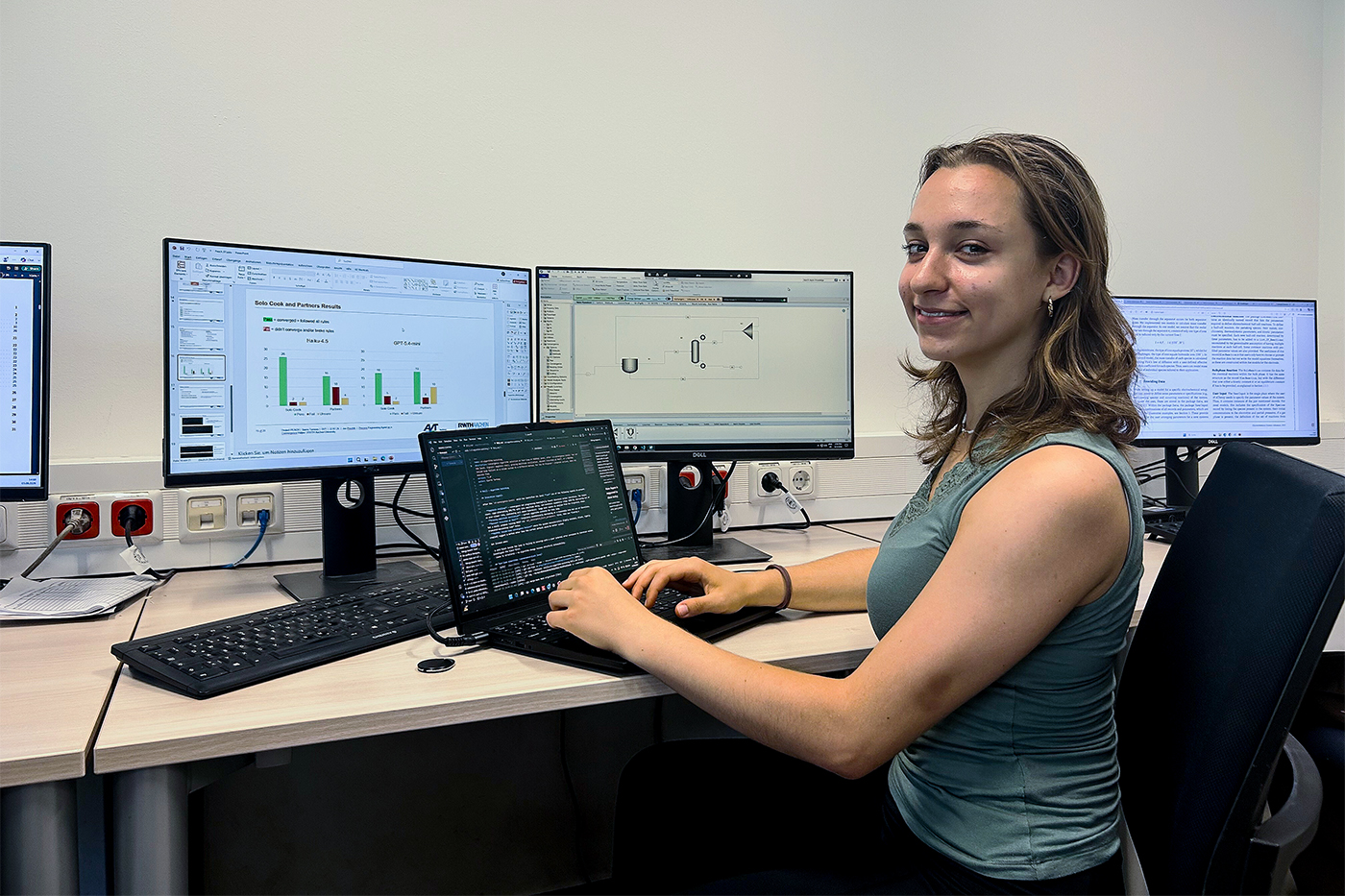
Using skills she acquired in a first-year course at Northeastern, she was able to produce an AI agent that could read the report and diagnose the problem – and then fix the flow sheet, to hand back a working simulation. “In the best configuration, the agent passed 26 of 30 test cases,” she said, meaning it found a solution without disturbing the engineer’s original design choices.
For Ternoey, her experience was the fulfillment of a course that had taught both hands-on tools and problem-solving initiative – all skills she needed, she admitted, as she’d “never taken a chemical engineering course.”
Innovation learned at Northeastern #
Ternoey grew up in the German-speaking region of Switzerland and had all the language skills she needed for her semester at RWTH Aachen University, Germany’s largest technical school. But the industrial engineering undergraduate arrived with some trepidation, she said.
“I was definitely excited and optimistic, but I got here when it was kind of very dark and gloomy weather. It had snowed, I didn’t know a single person in this town, and I was definitely nervous that I wasn’t going to be able to cut it at my co-op,” she said.
But these fears were quickly put to rest as she found a small community that welcomed her into salsa lessons and found her a place to continue training in Taekwondo, which she competed in while on Northeastern’s Boston campus.
Her supervisor, research associate Jan Pyschik said the project he set was “kind of a wildcard” that didn’t quite fit into his research agenda and was too uncertain to be assigned as a student’s thesis.
“Honestly, I was curious,” to see what she could achieve, he said. When other students had considered it, they were advised to avoid it because “it wasn’t clear if it was going to work at all,” he said.
Thankfully, Ternoey brought with her a “relentless can-do attitude,” he said. “She was like: ‘This will be a big daunting task,’ but then she went to work.”
Editor’s Picks #
Although she had no chemical engineering experience, her studies at Northeastern gave her the tools to take on such a complex challenge. Northeastern’s Cornerstone of Engineering course “put me in front of problems before I had the tools to solve them and told me to start anyway,” said Ternoey, who called it her hardest but best class.
Engineering professor Kathryn Schulte Grahame, known as KSG to students, teaches the essential components to being an engineer, including the engineering design process, engineering ethics, computer-aided design programs and programming. But the course, partnered with a local elementary school, specializes in teaching students to think like self-motivated engineers, and sets them an open challenge to create museum-style exhibits for a pop-up exhibition that will engage a class of budding scientists.
Students start with a big idea – like Ternoey’s team’s concept for a PacMan-style video game about bees – and then learn in a milestone system that breaks down big challenges into small, attainable goals, with weekly class check-ins, explained Schulte Grahame. “The project is fairly open-ended and the students can create whatever they feel is best for our partners. Whatever idea they choose, they must follow through on, creating their own goals and solving their own problems,” she explained.
“I think that it taught me to approach something that I’d never approached before and be comfortable with just starting,” said Ternoey. When she began her project in Aachen, she was reminded of making her first electrical circuit in KSG’s class, she said. “I was thinking, ‘Okay, this is the same. We’re going to start by making one flow sheet. We’re going to watch one tutorial,’” she said.
In Aachen, the results have been so encouraging that Pyschik hopes that her successful agent could be the basis for a scientific paper and a working tool for anyone stumped by the software’s error reports. “Sierre did quite a lot of fundamental work and we’re now trying to narrow it down” and shape it into an article for a journal, he added.
Schulte Grahame says Ternoey’s drive was already clear during her first year in Boston, where, despite realizing that her PacMan game would require a crash course in advanced programming, Sierre and her team persisted for the elementary school community that was her clients.
“She taught herself something new: learning for the sake of creating something great for another human, not just for a grade,” said Schulte Grahame. “When the pressure was on and there was no single solution, Sierre learned to trust her instincts and knowledge to truly become an engineer.”