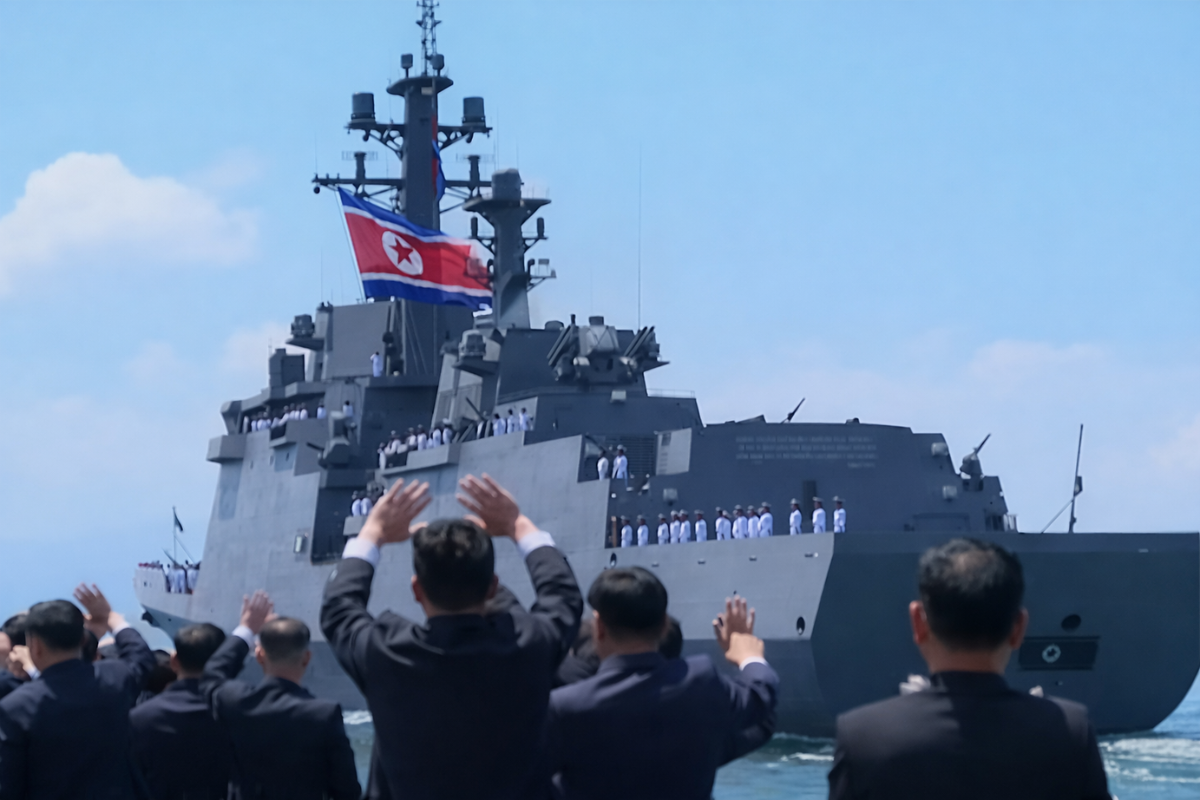
North Korea's Choe Hyon destroyer marks a shift in naval strategy, with potential Russian technological support #
North Korea formally commissioned its largest warship in history on 23 June, in a ceremony at Nampho Shipyard where Kim Jong Un declared that his navy had 'put an end to over 70 years of its stagnation.' The 5,000-tonne destroyer, named the Choe Hyon, was presented to the world as a triumph of domestic engineering. South Korean officials and defence analysts who have examined its weapons systems say the picture is more complicated.
The military relationship between Pyongyang and Moscow has moved well past the transactional. South Korean and Western officials say North Korea has sent troops and ammunition to support Russia's war in Ukraine. In return, South Korean officials and defence analysts say, it has been receiving something far more durable: technology that is now being built into warships designed to operate in the Indo-Pacific for decades to come.
The Russia Connection #
South Korean officials and experts have said the Choe Hyon was likely built with Russian assistance amid deepening military ties between the two countries, though some analysts have questioned whether the vessel is ready for active service. Lee Illwoo, an expert with the Korea Defence Network, stated that the Choe Hyon's anti-air radar, weapons systems and engine were likely acquired from Russia, based on analysis of photos released by state media. The South Korean Joint Chiefs of Staff also said a thorough analysis was under way to examine the ship's systems, as they too believed Russia had provided assistance.
Leif-Eric Easley, a professor at Ewha University in Seoul, said the pace of North Korea's shipbuilding suggested the country 'may be receiving significant material and technological assistance from Russia.' Moon Seong Mook, an analyst with the Seoul-based Korea Research Institute for National Strategy, was more direct, saying: 'there is a strong possibility that Russia is sharing certain technologies, equipment, expertise and know-how with North Korea.'
Kim, for his part, insisted at the commissioning ceremony that the Choe Hyon was an entirely domestic product. 'Things have changed obviously now,' he said. 'The combat capability of our navy will grow to be admirable beyond imagination.'
A Threat That Outlasts Ukraine #
The technology transfer matters beyond the battlefield in Ukraine. The weapons systems and shipbuilding expertise being transferred are being embedded into platforms that will operate in North Asian waters for a generation. Yu Ji-hoon, a research fellow at the Korea Institute for Defense Analyses, said the Choe Hyon signals a deliberate shift in Pyongyang's strategic posture. 'The North Korean navy is moving away from its existing coastal-defence-centred structure towards extending its nuclear and missile threat into the maritime domain,' he said.
North Korea's naval expansion has taken place alongside closer military cooperation with Russia following Pyongyang's support for Moscow's war in Ukraine. Under North Korea's naval construction plan for 2026 to 2030, Pyongyang aims to build two major surface warships every year. Kim said at the ceremony that he wanted North Korean shipyards producing cruisers double the size of the Choe Hyon.
Carl Schuster, a former director of the US Pacific Command's Joint Intelligence Centre, pointed to a complication that goes beyond battlefield threat assessments. The Choe Hyon is North Korea's first true ocean-going warship, which introduces new difficulties for enforcing United Nations arms sanctions on Pyongyang. A 'warship escorting a maritime arms shipment complicates an intercept and boarding operation,' Schuster said. 'North Korea has potentially forced the US, Japan and South Korea to expand their monitoring of North Korea's navy.'
Seoul Cannot Afford to Look Away #
Even analysts sceptical of the Choe Hyon's immediate battlefield impact acknowledge the longer arc of the problem. Schuster said he did not think the ship 'directly adds a new threat to South Korea' and noted that 'the ship's survivability is limited during a conflict.' Yu offered a sharper caution. 'Even if it falls short of being a fully modern destroyer, it could still pose a real burden to South Korean security if it's used as a missile-launch platform or a means of escalating crises,' he said.
Pyongyang's support for Russia's war in Ukraine has, according to South Korean and Western officials, helped it gain valuable technology and resources that could advance its arsenal, at a moment of growing confidence for Kim, whose weapons programme has seen North Korea conduct multiple nuclear tests and declare itself a nuclear-armed state.
The Choe Hyon is, by North Korea's own admission, only the beginning. Kim said at the commissioning that the naval buildup 'is never plain sailing' — a nod to the capsizing of the Choe Hyon's sister ship, the Kang Kon, during its launch at Chongjin Shipyard on 21 May 2025. The Kang Kon has since been refloated and is now in sea trials, with Kim saying it would be commissioned 'soon.' A third destroyer is already under construction. Yu Ji-hoon's assessment cuts to the heart of what that means for the region: 'Even if it falls short of being a fully modern destroyer, it could still pose a real burden to South Korean security if it's used as a missile-launch platform or a means of escalating crises.'
© Copyright IBTimes 2025. All rights reserved.