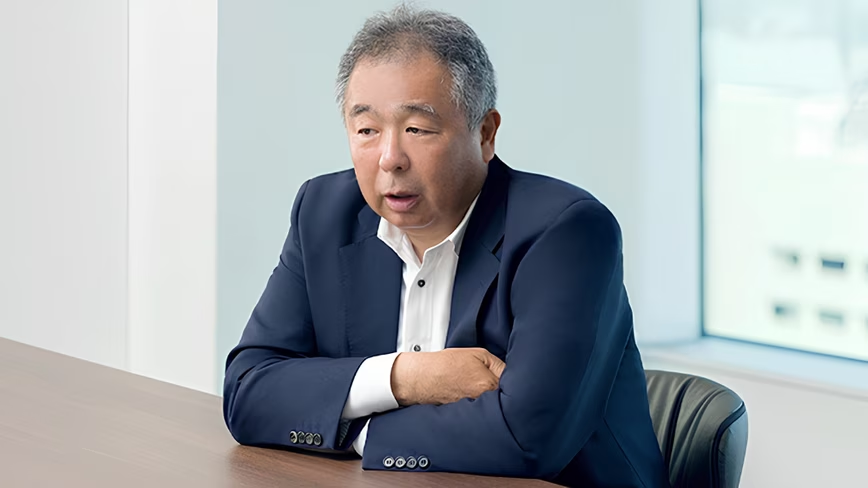
Hironobu Tamba spent years inside SoftBank building large language models, the kind of software that answers questions and drafts emails. He has now walked away from that work to bet on machines that move.
Tamba is president and chief executive of Noetra, a Tokyo company that began full-scale research in July on a home-grown foundation model aimed not at chatbots but at robots, and in an interview with Reuters he framed the venture in unusually stark terms.
This, he said, is a last chance for Japan to matter in the coming wave of artificial intelligence.
The country is putting real money behind that anxiety. Noetra sits at the centre of a state-backed programme whose compute will run on a 140MW AI factory, and the company has enlisted much of the Japanese robotics establishment to build it.
Sony Group, SoftBank, NEC, and Honda Motor anchor the effort as core members, with a further 44 companies and organisations investing as shareholders, most of them drawn from manufacturing.
The public commitment is large. Japan’s Ministry of Economy, Trade and Industry has pledged ¥387.3 billion, roughly $2.4bn, for the current fiscal year, part of up to ¥1 trillion (around $6bn) promised across five years and drawn from the country’s green transition bonds.
It is one of the biggest single bets any government has placed on domestic AI, and it rests, for now, on a company barely out of the gate.
Noetra’s plan is staged rather than sudden. According to a joint announcement from its partners, the company aims to ship a reasoning model with Japanese-language understanding by fiscal 2027, an omni-modal system that handles text, images, video, and audio by fiscal 2028, and what it calls “Real-world Native AI”, capable of grasping physical properties, by fiscal 2030.
The compute to train all of it is the FRONTia data centre, built around 27,500 Nvidia Rubin GPUs and 13,750 Vera CPUs, with construction due to start in April 2027 and operations in June 2028.
The choice of robots over chatbots is deliberate, and it plays to a genuine strength. Japan already controls close to 70% of the global market for industrial robotics, and the government’s wager is that the next contest will be decided in factories and warehouses rather than in browser tabs.
That is the terrain where humanoid robots and physical AI are supposed to meet, and where Tamba believes his country can still lead.
The ambition scales accordingly. METI has set a target of deploying 10 million AI-powered robots across 18 fields by 2040, and of capturing more than 30% of the global market for physical AI, a slice of an industry it values at tens of trillions of yen.
The framing is explicitly one of technological sovereignty, of not renting the intelligence that will run the country’s machines from firms in California or Shenzhen.
Behind the numbers sits a quieter argument about time. Japan largely watched the language-model race from the sidelines while American and Chinese labs set the pace, and its own attempts at a national chatbot never found much of an audience at home or abroad.
Tamba’s “last chance’ phrasing reads as a reckoning with that. His bet is that the robotics wave has not yet crested, that Japan’s decades of hardware craft still count for something, and that a foundation model built at home can turn manufacturing muscle into software advantage before the window closes.
Whether it works is a question for the back half of the decade. The first model is more than a year away, the data centre longer still, and the gap between a well-funded consortium and a working product is where plenty of national AI schemes have quietly foundered.
Nvidia, whose chips will do the heavy lifting, has every reason to talk the project up. For now, Tamba has the money, the partners, and a deadline of his own making.
Get the TNW newsletter #
Get the most important tech news in your inbox each week.