Humanoid robotics and physical AI developers are not only raising billions of dollars; they’re also getting acquired by big technology companies. This has implications for industrial adoption, according to Jenny Shern, general manager of NexCOBOT.
For instance, Mobileye acquired Mentee Robotics for $900 million in January, Amazon bought Fauna Robotics in March, and Meta picked up Assured Robot Intelligence in May. “Beginning last year, our team got lots of requests from companies building legged robots, including quadrupeds and humanoids, as well as mobile manipulators,” Shern told The Robot Report. “Our controllers support traditional robots and these newer kinds of systems.”
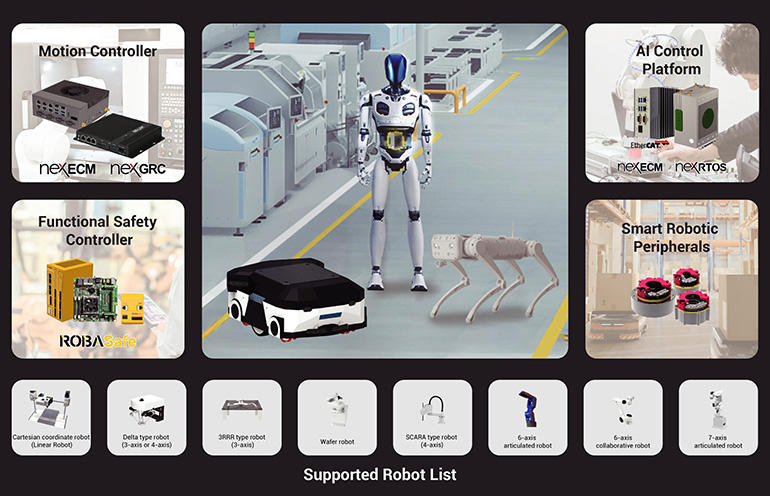
NexCOBOT spun out of NEXCOM Group‘s IoT Automation Solutions business unit in 2018. The New Taipei City, Taiwan-based company offers motion controllers, functional safety controllers, peripheral components, and design verification consulting services to robotics developers and manufacturers.
Shern shared her perspective on how the physical AI market is evolving.
Big Tech finds acquisition a fast path to innovation #
Do you expect to see more acquisitions?
**Shern: **Acquisitions will certainly continue as robotics becomes increasingly important to major tech companies. Smaller robotics companies and startups have strong expertise in areas such as robot learning, perception, or autonomous control, while larger companies have the computing infrastructure, data resources and capital needed to scale those innovations.
As AI models continue to improve, acquiring these companies offers a faster path for “Big Tech” firms to streamline development and establish a position in what many see as the next phase of intelligent systems.
How is NexCOBOT doing in terms of its own funding?
**Shern: **Due to company policy, we do not disclose details around specific internal finances or independent funding. However, we can share that NexCOBOT is in a highly stable financial position.
Our priorities are entirely focused on scaling our open, functional safety robotic controllers, and fulfilling our strong backlog of global orders as we head into mass production.
AI-native robots must still prove reliability and safety #
While U.S. funding for physical AI and large rounds has increased, overall VC investment in early-stage companies has reportedly fallen. What does that mean for robotics developers and innovation?
**Shern: **This creates a more selective funding environment for robotics developers. Capital is still available for companies that demonstrate strong technical differentiation and a clear path to commercialization, but early-stage startups may experience greater pressure to validate their business models sooner. While that could slow the number of new entrants, it may also encourage more focused robotics innovation aimed at solving real operational challenges.
Additionally, the industry may see increased collaboration between startups, industrial companies, and larger technology firms as developers look for alternative paths to scale development and bring new technologies to market.
You’ve referred to “AI-native robots.” What do you mean by that term, and how quickly are they maturing?
**Shern: **AI-native robots are robots that were originally structured to incorporate AI as a core part of how they perceive, make decisions, and interact with their environment. Traditional robots typically follow predefined instructions in structured settings, while AI-native robots are designed to adapt to changing conditions and learn from new inputs.
We are seeing rapid progress, especially in perception, motion planning, and human-robot interaction. However, for industrial applications, reliability and safety remain critical requirements, so adoption will continue to advance in stages as the technology proves itself in real-world environments.
Software can enable physical AI to scale, says NexCOBOT #
Since software and AI development typically move faster than robotics hardware, how can Big Tech combine the strengths of each?
**Shern: **Big Tech can help bridge this speed disparity while leveraging the strengths of both industries by separating software innovation from hardware development wherever possible.
AI models and software can be updated and improved continuously, while robotics hardware typically requires longer design, testing and deployment cycles to meet reliability and safety requirements.
By building on modular platforms and standardized interfaces, new AI capabilities can be deployed onto existing robotic systems without waiting for entirely new hardware generations. This allows robotics developers to take advantage of the pace of AI advancement while maintaining the stability and durability that industrial applications demand.
Can you give an example of where open ecosystems have benefitted both the tech suppliers and the users?
**Shern: **One recent example is the growing adoption of open robot control platforms, which allows manufacturers to integrate components from different vendors versus relying on a single proprietary ecosystem. This gives users greater flexibility to choose the technologies that best fit their applications while reducing integration complexity.
Take a recent client case, for instance: By deploying our certified functional safety controller based on an open system, we helped the client shorten its development cycle from an estimated three to five years down to just two years.
For suppliers, open ecosystems expand market opportunities because their products can work across a wider range of platforms and industries. We are also seeing them drive increased collaboration around AI frameworks and software tools, which helps accelerate development while lowering barriers to adoption.
NexCOBOT sees physical AI expanding #
Are there particular segments where you see big tech companies moving into with physical AI – will it be in established industries or new applications for robots and automation?
**Shern: **I expect activity in both segments. Established industries like manufacturing, logistics, and warehousing already have clear business use cases for automation, which makes them attractive opportunities for scaling physical AI.
At the same time, advances in AI are opening possibilities in less structured environments where robotics traditionally struggle, including service applications and healthcare support. The most immediate adoption will likely happen where there is already strong demand, but the long-term impact could extend far beyond traditional industrial settings.
Are there certain types of robots that are more likely to get picked up by Big Tech – or not?
**Shern: **Robots that generate large amounts of operational data and can benefit directly from advances in AI are likely to attract the most attention from Big Tech. Humanoid robots, mobile robots, and systems designed for dynamic environments align closely with large technology companies’ strengths in AI, computing infrastructure and software development.
Highly specialized robots built for a narrow industrial process may be less attractive unless they provide unique intellectual property or address a particularly large market opportunity. Ultimately, companies will look for robotics technologies that can scale across multiple applications and create long-term business advantages.