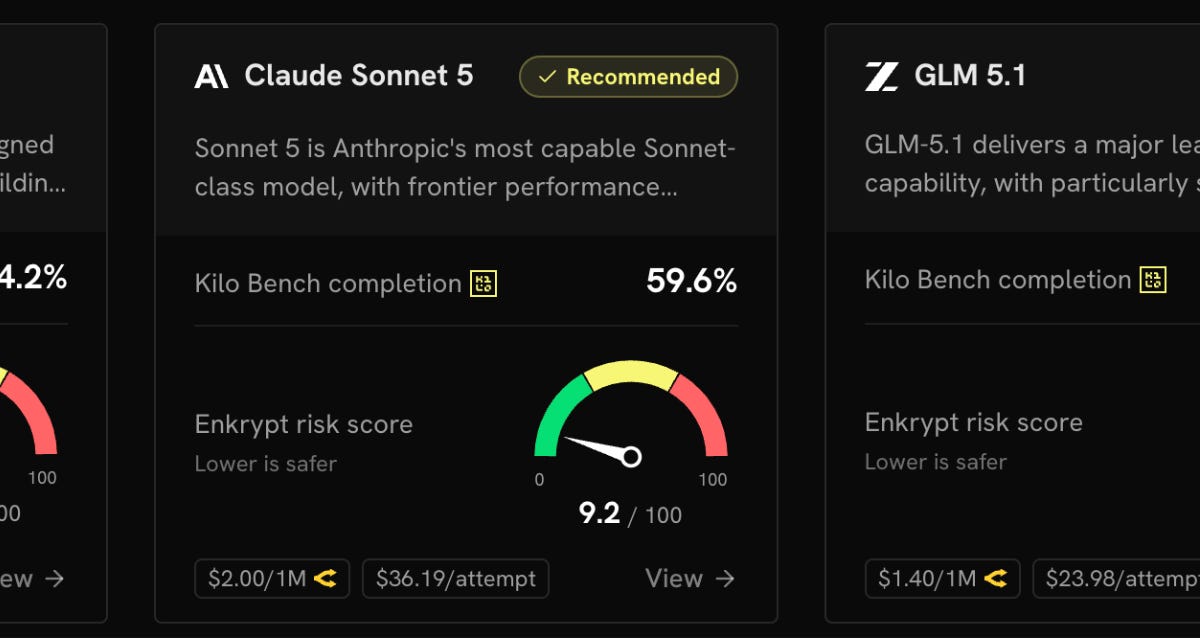
Model cards on Kilo now include an Enkrypt AI risk score alongside completion rate and cost per attempt. The score runs from 0 to 100, and lower means safer. It’s live now on the leaderboard, with coverage expanding model by model.
Why We Added This #
Picking a model for a coding task usually comes down to two questions: is it fast and cheap enough, and is its output safe enough to ship. Kilo has always answered the first one, since open pricing means you pay the provider’s per-token rate and can switch between 500+ models whenever a task calls for it. The second question, how a model handles jailbreak attempts, bias, toxicity, and insecure code, has lived somewhere else entirely, usually a report you’d pull after the model was already wired into your workflow.
By the time that report shows up, the decision’s already made. Nobody swaps out a production model because a report landed three weeks after launch.
That lag matters more once an agent is doing the writing than it did when a person typed every line. A model running in Code mode, or handed off to a subagent as part of an orchestrated task, can commit code with less of a human checking it than a normal review process assumes. Putting the safety score on the same card as price and completion rate means you’re weighing it before you pick the model, not after something’s already shipped.
Where the Score Comes From #
This is Enkrypt AI’s evaluation, run across 200+ models on its own public AI Safety Leaderboard, independent of anything Kilo tracks. It tests four things: jailbreak resistance, bias, toxicity under pressure, and insecure code generation, and rolls them into a single 0 to 100 score. There’s no new login and no separate dashboard to check; if you’re running Kilo Code, it’s just there.
For anyone shipping code from an agent that runs with less supervision than a human reviewer, insecure code generation is the piece to watch: things like hardcoded credentials, missing input validation, or queries that concatenate user input instead of parameterizing it. A model can score well on completion rate and read fine in conversation while still being more likely to write that kind of bug into a pull request.
What the Data Shows #
Price, completion rate, and safety don’t move together. As of this writing, Claude Sonnet 5 has the lowest risk score on the board (9.2) at $36.19 per attempt. GPT-5.5 completes more tasks (74.2% vs. 59.6%) but costs roughly twice as much per attempt and carries roughly double the risk score. None of those three numbers predicts the other two, so a low price or a high completion rate tells you nothing about how safely a model writes code.
That’s also where the Auto Model routers get more useful. If you’re running Auto Frontier or Auto Efficient instead of picking a model by hand, the risk score gives you a way to check what the router is actually selecting for a given task, not just what it costs.
Open the All Models tab and check where your model lands before you commit to one, especially for anything running unsupervised, like a cloud agent or a subagent Kilo has spun off to handle part of a larger task. More coverage is coming as Enkrypt works through the rest of the board.
FAQs #
Does this change ranking? No. Ranking is still based on real usage and completion rate. Risk score is a separate column, not a ranking factor.
Do I need a new account? No. If you already use Kilo Code, it’s on the model card you already checked.
What does the score measure? The same four checks Enkrypt runs on its own AI Safety Leaderboard: jailbreak resistance, bias, toxicity under pressure, and insecure code generation, rolled into one 0 to 100 number.
Why don’t all models have a score yet? Enkrypt evaluates models individually, and coverage is rolling out over time. Check the All Models tab for the current list.
Is this related to the acquisitions? Yes. Anaconda acquired Kilo Code in July 2026 and Enkrypt AI in August. This is the first place both show up together!