All bus service operations will now be controlled from the Mobility Command and Control Centre in Gali Batu Bus Depot near Yew Tee
[SINGAPORE] A new S$6 million command centre that functions like an air traffic control tower for buses will monitor the SMRT fleet in real time and help make services safer, more reliable and more efficient.
Fleet managers at the command centre will keep an eye on issues such as buses bunching together, and raise fatigue alerts when bus drivers are tired, said SMRT chairman Seah Moon Ming.
It will also help the operator mount a faster response when there are incidents such as train breakdowns or traffic snarls, he added.
All bus service operations under public transport operator SMRT will now be controlled from the Mobility Command and Control Centre in Gali Batu Bus Depot near Yew Tee.
The centre, also called the Intelligent Operations Control Centre, consolidates fleet operations that in the past were handled by the SMRT Woodlands and Soon Lee depots.
Opened by Transport Minister Jeffrey Siow on Aug 28, it brings together all information on fleet deployment, live bus movements, vehicle health, electric bus charging, road traffic and safe-driving alerts into a single frame.
The information allows fleet managers to spot safety and operational risks early, and jump in before commuters are affected.
The centre, which has been up and running since June, operates with a team of nearly 50 officers managing more than 1,200 buses across about 75 services.
About 20 officers – also called service controllers – are on duty at any one time, and each one monitors about 60 buses, focusing on fleet deployment, bus scheduling and recalls, as well as incident response.
In the past, service controllers had to monitor multiple systems, including CCTV feeds and bus locations, while relying on updates from bus drivers on the ground.
Now, artificial intelligence flags potential problems such as driver fatigue, unsafe driving and bus bunching. That means service controllers can focus on assessing situations, coordinating responses and supporting bus drivers on the ground.
Each alert is linked to predefined benchmarks that guide controllers on when to intervene and what action to take.
Seah said: “This is the shift: from watching everything, to knowing where to look, and when to act.”
Installing technology, he added, does not transform operations on its own. For instance, a fatigue monitoring system can raise an alert for a tired bus driver but “if no one responds, this alert is only a sound”, he said.
Bus 4.0 closes this loop. “Now, the alert goes directly to our control centre, so the service controller can step in at the right time.”
Bus 4.0 is a digital transformation initiative for SMRT bus operations in Singapore.
SMRT Buses managing director Tan Peng Kuan said the new system marked a shift from responding to problems after they occur to identifying risks earlier.
He said: “Bus 4.0 helps our people see more, make better decisions and act faster.
“Just as pilots have an air traffic control tower to guide them, our bus drivers now have service controllers as safety buddies who look out for them on the road.”
The Gali Batu command centre now handles bus services under the Choa Chu Kang-Bukit Panjang, Woodlands and Jurong bus packages.
When SMRT takes over the Serangoon-Eunos bus package in June 2027, the service controllers overseeing its 26 routes will be based at the command centre.
The centre is also home to teams from Strides Digital, which manages SMRT’s digital advertising panels at bus stops and its taxi and private-hire vehicle operations. During major train disruptions, resources can be pulled together faster, SMRT said.
In addition, it has space set aside for future autonomous vehicle operations.
The command centre is one of four key planks under Bus 4.0. The other three are Intelligent Bus (iBUS), Intelligent Workforce (iWorkforce) and Intelligent Depot (iDepot).
Driver fatigue, bunching and breakdown risks
Under iBUS, SMRT has expanded the use of AI and telematics – the use of telecommunications and informatics using computers to process and analyse data – to monitor buses and driving behaviour.
The fatigue monitoring system detects signs such as prolonged eye closure, repeated yawning and head nodding. Alerts are sent directly to the centre, and service controllers assess how serious the issue is and intervene if needed.
SMRT said more than 1,500 fatigue interventions have been made from February 2025 to August 2026.
The number of fatigue alerts has fallen from hundreds a day when the system was first introduced to about 10 to 20 a day, which SMRT said reflected improvements in driving habits.
Seah said: “We cannot place a supervisor beside every driver. But technology can give every driver a ‘safety buddy’ who watches out for warning signs humans may miss.”
SMRT has more than 2,000 bus drivers.
Seah also said the aim is not to catch bus drivers doing something wrong but to help them do their jobs safely.
SMRT has also developed an AI-powered system to detect bus bunching, where buses on the same route arrive together, followed by longer gaps.
One feature of the new system is to continuously analyse bus locations, speeds and stop times, and alert controllers when bunching is likely.
It can also detect early signs that something is not right, and flag buses that need to be recalled for inspection before a breakdown. SMRT said this has contributed to a 20 per cent reduction in bus breakdowns since November 2024.
The technology is also being extended to electric buses. It currently monitors 80 of SMRT’s electric buses, including battery health, and will cover the full fleet of 217 by the end of October 2026.
AI-enabled cameras on buses can detect vehicles entering bus lanes and automatically record details such as licence plate numbers, locations and timestamps.
The cameras can also identify road hazards, send a report to the control centre, and help speed up their removal.
Another system detects wheelchair users as they board, and shows the live CCTV footage on the service controller’s screen. The controller can then check if the wheelchair is properly secured and alert the bus driver if needed. The technology could eventually be extended to cover passengers with prams, SMRT said.
There is also an app for bus drivers to track their driving performance, including harsh braking, harsh acceleration and fatigue alerts.
Bus driver Jayrius Ong, 23, said the system has helped him become more aware of his driving patterns.
He used to drive too close to vehicles ahead of him in the past, but now keeps an eye on his driving score and keeps a safe distance from other vehicles.
Robot dog patrols #
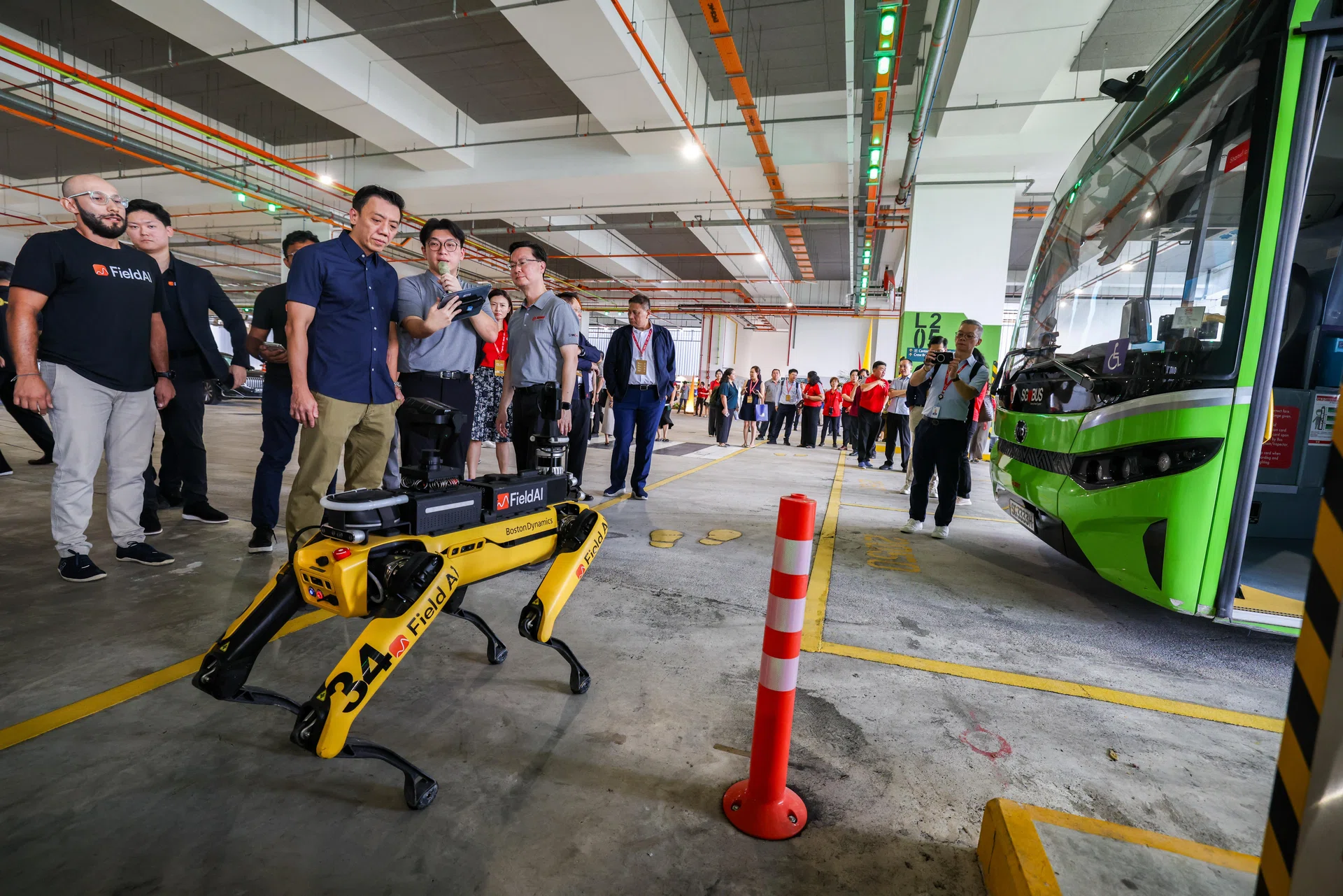
The iDepot tool uses an autonomous survedillance robot equipped with infrared sensors to patrol Gali Batu Bus Depot and monitor buses and electric-bus charging areas for abnormal heat.
The robot can provide early warning when there is a risk of overheating, and alert safety teams.
There is now one robot, but SMRT plans to deploy two more after successful trials – one for each level in the depot.
Gali Batu Bus Depot can take about 500 buses and 240 electric-bus charging units.
Decoding Asia newsletter: your guide to navigating Asia in a new global order. Sign up here to get Decoding Asia newsletter. Delivered to your inbox. Free.
Copyright SPH Media. All rights reserved.