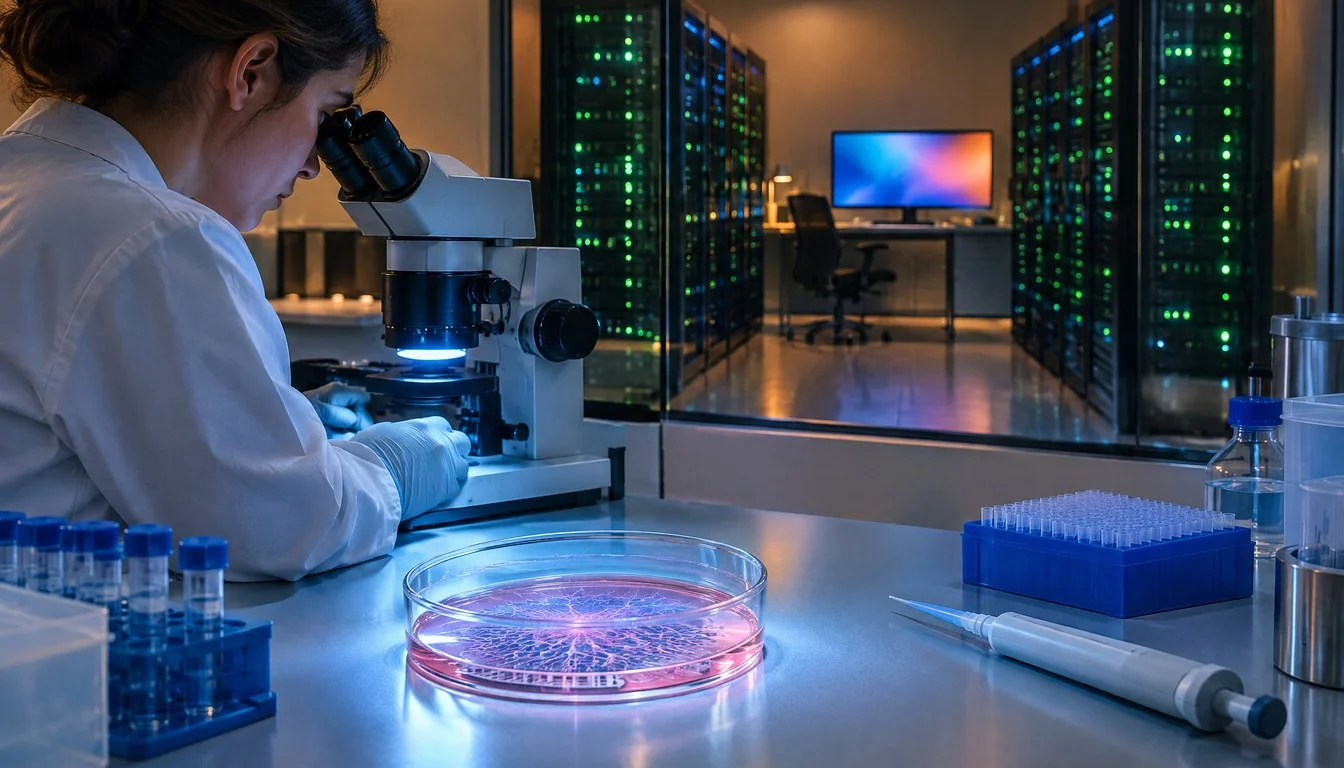
The Biological Computing Co., a San Francisco startup better known as TBC, released an image-to-video model called TBC mischief 1 on October 30, 2026. According to the company’s PR Newswire announcement, it is the world’s first publicly available neuron-derived AI video model. The pitch is simple: living neurons grown in a lab taught TBC’s researchers some efficiency tricks, and those tricks now run as a thin software layer on top of an existing open-weight video model.
The headline numbers are aggressive. TBC says mischief 1 generates video about five times faster than its base model, Wan 2.2, at comparable quality, with pricing that starts at half a cent per second of output. If those claims hold up under independent testing, they would put real pressure on a crowded field. Our ranking of AI video generators shows how fast that field has been moving, and cost per clip is now one of the few levers left that buyers can compare directly.
This analysis walks through what TBC actually announced, what the neurons did and did not do, the pricing math for production teams, and where the evidence stops. TNW (The Next Web) pointed out that the company has not published independent tests backing the speed claim, and that gap shapes almost everything below. We also include a claims-versus-evidence table, a competitive read, and five predictions.
Don't miss new tech stories on Google
Add Shattered once in the Google app and our stories show up in your news suggestions.
What TBC Mischief 1 Is and What Shipped on October 30 #
Mischief 1 is an image-to-video model. A user supplies a starting image and a text prompt, and the model returns a short clip. Per the TBC release, it is built on Wan 2.2, an open-weight video model that TNW describes as Alibaba’s. TBC does not claim to have trained a new foundation model from scratch. It claims to have added an optimization layer that makes the existing one faster and cheaper to run.
The model went live on two AI marketplaces, fal and OpenRouter. TBC says it is the lowest-priced image-to-video model on both. Reporting from Tao Media adds that an AWS Marketplace listing is marked as coming soon, which fits with the AWS partnership TBC announced on September 22, 2026.
Tao Media also lists the output specs. Clips run 3 or 5 seconds, at 480p or 720p in landscape, at 16 frames per second, delivered as MP4. Those are modest numbers next to the cinematic-length, high-resolution clips that top-tier closed models advertise. The product is aimed at volume and price, not at maximum visual ambition.
The company’s leadership is small and named. Alex Ksendzovsky is co-founder and CEO, and Jon Pomeraniec is co-founder and COO. TBC describes itself as an applied biological computing company with a team of neuroscientists, biologists, AI researchers and engineers. No funding amount or investor list appears in the launch release, the AWS announcement, or the coverage we reviewed.
How a Neuron-Derived AI Video Model Actually Works #
The phrase neuron-derived invites a wrong mental picture. Nobody is running video generation on a dish of brain cells. TBC and the outlets covering the launch are consistent on this point, so it is worth stating plainly before going further.
What the neurons did in the lab
TBC grows living neurons in laboratory conditions and studies how those cells process information. The goal is to identify computational principles, meaning patterns in how biological networks handle signals efficiently. Pulse 2.0 reports the company’s framing as researchers who grow neurons and study their information processing. Tao Media goes further and says the work drew on rat brain cells and human stem cells on multi-electrode arrays, using 3Brain equipment.
That cell-type detail comes from a single outlet. TBC’s own release and the other coverage we read describe the neurons only as living neurons grown in a lab, without naming the source. We treat the rat-and-stem-cell detail as reported by Tao Media and unconfirmed elsewhere.
What actually runs in production
The deployed product contains no biology. Per Pulse 2.0, the biological neurons are not part of the shipped model. TNW adds that the physical neurons stay in TBC’s laboratory, and the findings get converted into software add-ons for standard AI chips. TBC says the software layer adds less than 0.1% to the base model’s parameter count.
So the neuron-derived label describes where the ideas came from, not what executes at inference time. A customer calling the model through fal or OpenRouter gets an ordinary GPU workload. Whether the lab work is the true source of the speedup, or whether a conventional optimization effort would have found the same gains, is a question the public materials do not answer.
The Numbers: Speed, Cost and Specs #
TBC and its AWS announcement cite three core performance claims. Video generates about 5x faster than the base model. Inference costs come in 80% lower. Output quality stays comparable. The table below collects every spec and figure attributed to a named outlet in the launch coverage.
| Item | Reported value | Source |
|---|---|---|
| Release date | October 30, 2026 | PR Newswire |
| Model type | Image-to-video | TNW |
| Base model | Wan 2.2 (open-weight) | PR Newswire, TNW |
| Speed vs base | About 5x faster | PR Newswire, AWS announcement | | Inference cost vs base | 80% lower | AWS announcement, Tao Media | | Added parameters | Under 0.1% of base | PR Newswire | | Price, 480p | $0.005 per second | Tao Media | | Price, 720p | $0.01 per second | Tao Media | | Clip length | 3 or 5 seconds | Tao Media | | Frame rate | 16 fps, MP4 | Tao Media | | Marketplaces | fal, OpenRouter (AWS Marketplace coming soon) | PR Newswire, Tao Media |
One number needs a flag. Tao Media cites a GPU benchmark example of 142 seconds for Wan 2.2 versus 12 seconds for mischief 1. That ratio works out to roughly 12x, not 5x. TBC’s PR Newswire release gives only the 5x figure and no GPU seconds. When sources conflict we use the most conservative figure, so this article uses 5x. The larger gap may reflect a specific hardware setup or a best-case run, but nothing in the public record explains it.
Pricing Math for Real Production Workloads #
Per PR Newswire, a five-second clip costs 2.5 cents, and 100 five-second clips cost $2.50. That matches the 480p rate from Tao Media. The 720p rate doubles the per-second price. The table below extends those published rates to larger workloads. These are our own calculations from the reported per-second prices, not figures TBC published.
| Workload | 480p at $0.005/sec | 720p at $0.01/sec |
|---|---|---|
| One 3-second clip | $0.015 | $0.03 |
| One 5-second clip | $0.025 | $0.05 |
| 100 five-second clips | $2.50 | $5.00 |
| 1,000 five-second clips | $25 | $50 |
| 10,000 five-second clips | $250 | $500 |
| One hour of finished footage | $18 | $36 |
At these rates, a team can generate 10,000 five-second variations for a few hundred dollars. That changes how people work. Instead of crafting a handful of careful generations, a studio can brute-force dozens of takes per shot and pick winners. Justin Hackney, co-founder of Wonder Studios, said the model’s speed and low cost let his team push their work much further within the same time.
The caveat is that cheap generations only help if the quality clears the bar. A 480p, 16 fps, five-second clip suits storyboards, previsualization, social loops and rapid concept testing. It does not suit a finished 4K commercial. Buyers should price the whole pipeline, including upscaling and the human review time that sorting through thousands of takes demands.
Claims Versus Evidence: What Is Verified and What Is Not #
Launch coverage mostly repeats TBC’s own numbers. That is normal for a product announcement, but it leaves a gap between what is stated and what is proven. The table sorts the main claims by who made them and whether anyone outside the company has tested them.
| Claim | Made by | Independent check found? |
|---|---|---|
| World’s first publicly available neuron-derived AI video model | TBC | No, a self-description |
| About 5x faster than Wan 2.2 | TBC | No, TNW says none published |
| Comparable quality to the base model | TBC | No third-party quality benchmark seen |
| 80% lower inference cost | TBC, AWS announcement | No |
| Lowest-priced image-to-video model on fal and OpenRouter | TBC | Checkable on the marketplaces, we did not audit rival listings |
| Optimization layer adds under 0.1% parameters | TBC | No, the code is proprietary |
| Neurons not part of the deployed product | TBC, Pulse 2.0 | Consistent across sources |
| Peer-reviewed validation of the method | None claimed | Pulse 2.0 reports none mentioned |
The pattern is clear. Everything performance-related traces back to TBC. The one claim that corroborates across independent outlets is the structural one: the product is software, and the neurons stay in the lab. That is useful for buyers, since it means no exotic hardware risk, but it does not validate the speed or quality figures.
The Wan 2.2 Foundation and the Open-Weight Angle #
Building on Wan 2.2 is a strategic choice. Open-weight models let outside companies modify, fine-tune and wrap them without negotiating access. TBC took an existing model, attached its optimization layer, and sold the faster result. That route skips the enormous cost of pretraining a video foundation model, and it lets TBC compete on price rather than on raw capability.
It also ties TBC’s fortunes to someone else’s release cycle. If the open-weight base improves, TBC must re-apply its layer to stay current. If a new open model arrives with built-in speed gains, the pitch narrows. Our guide to open-weight model families and their licenses covers why license terms matter for exactly this kind of commercial wrapper, and readers evaluating TBC should check the Wan 2.2 license terms for themselves.
The optimization layer is described as proprietary. TBC has not said whether it will release weights, a paper, or technical documentation. Until it does, the community cannot reproduce the 5x claim or test whether the same technique transfers to other models. That is the clearest way TBC could convert marketing into evidence.
The AWS Partnership: Trainium, SageMaker and Marketplace #
On September 22, 2026, AWS announced a partnership to bring TBC’s technology to enterprise customers. The collaboration covers AWS Trainium deployment, Amazon SageMaker AI integration, and distribution through AWS Marketplace. The announcement disclosed no financial terms, equity stakes or exclusivity arrangements.
Jason Bennett, AWS’s VP and Global Head of Startups and Venture Capital, framed the deal around efficiency, saying nature solved the computing efficiency problem billions of years ago. Pomeraniec said compute is becoming one of the biggest constraints on AI. Ksendzovsky said the partnership takes neuron-derived optimization to commercial scale. All three statements appear in the AWS announcement.
The Trainium mention matters. It signals that TBC’s layer is meant to work beyond Nvidia GPUs, which would widen its appeal to cloud buyers looking to cut inference bills on AWS silicon. We have not seen published performance numbers on Trainium, so that remains a plan rather than a result. The same applies to the Marketplace listing, which Tao Media says is still coming.
Wonder Studios and the Production Use Case #
The only named customer in the launch materials is Wonder Studios, which tested mischief 1 in production workflows for film and commercial work, per Tao Media and the TBC release. Hackney’s comments focus on throughput. Faster, cheaper generation meant more iterations in the same schedule.
One testimonial from a co-founder who is quoted in the vendor’s own press release is a weak form of evidence. It tells us a real studio tried the product. It does not tell us how mischief 1 compares with alternatives on the same shots, how many generations ended up in final cuts, or what the studio paid in total. Treat it as a signal of early traction, not as a benchmark.
The workflow it implies is still valuable. Previsualization and rapid concept exploration are the places where cheap, fast, merely good clips earn their keep. Directors and agencies burn a lot of time waiting on renders. A model that returns a clip in a fraction of the time, even at lower resolution, shortens the loop between idea and review.
How Mischief 1 Stacks Up Against the AI Video Field #
Mischief 1 does not compete head-on with the best closed video models on visual quality. It competes on price and speed against its own base model and against other low-cost image-to-video options. That distinction keeps the comparison honest. TBC itself only claims comparable quality to Wan 2.2, not parity with premium systems.
The premium end is well funded. We reported that Kuaishou’s video unit raised $2.98 billion at an $18 billion valuation, which shows how much capital sits behind the leading quality-focused players. Google, for its part, shipped Genie 4 with native audio on October 27, extending the competition from clips toward interactive world models. TBC cannot match that scale, and does not try to.
The fair framing is a two-tier market. At the top, well-capitalized labs fight over realism, length and audio. In the lower tier, providers fight over cost per second and latency. TBC is betting that a meaningful slice of buyers, from ad agencies to app developers, cares more about the lower tier than the top. The sheer volume of cheap clips a developer might need for a consumer app supports that bet.
Why Compute Costs Make This Launch Matter #
Video is the most compute-hungry mainstream AI workload. Every extra second of footage multiplies the processing, and providers pay that bill whether or not users do. That is why an efficiency claim lands with more weight in video than in text. A real 80% cut in inference cost would change margins for any provider that could adopt it.
The macro backdrop sharpens the point. We covered how three of four Big Tech giants now post negative free cash flow as AI spending climbs, and how the power side of that spending is pushing companies toward drastic measures like the nuclear buildout we examined. In that environment, any method that gets the same output from fewer chips draws attention fast.
The honest limit is that TBC’s gains apply to one model family and one task so far. Pulse 2.0 notes that video generation is the only commercialized application. Extending the approach to text models, audio, or larger video systems would be a bigger story, and the company has not announced such plans.
Market Impact: Who Gains and Who Should Worry #
Marketplace aggregators gain first. Fal and OpenRouter both get a new low-price listing that attracts developers who shop by cost. Small studios and indie creators gain next, since half-cent seconds make experimentation affordable. Cloud platforms like AWS gain if TBC’s layer lowers the cost of serving video on their silicon.
Providers that serve Wan 2.2 at standard speeds face the most direct pressure. If a faster, cheaper variant of the same base model sits next to them on the same marketplace, they must either match the price or justify the difference. Premium closed-model vendors feel less heat, because their buyers pay for quality that a 480p, 16 fps clip cannot deliver.
There is also a signaling effect. The biological-computing framing is novel enough to draw attention and, likely, investor interest. TBC has not disclosed funding, so any capital story remains speculation. What the launch does show is that small teams can now find commercial angles by optimizing open models rather than competing on raw training budgets.
Historical Context: Five Weeks From Partnership to Product #
The timeline is tight. AWS announced the TBC partnership on September 22, 2026. The model reached public marketplaces on October 30, about five weeks later, as the TBC release itself notes. That pace suggests the product was largely built before the partnership went public, with the AWS announcement serving as a credibility anchor ahead of launch.
The broader pattern is familiar. When training frontier models became too expensive for most companies, a wave of startups shifted to building on open weights and selling speed, specialization or price. Biology-inspired computing has long been an academic curiosity. TBC’s contribution is packaging it into a priced API that anyone can call, which is a different milestone from a lab demo. Our earlier coverage of AI-designed phages reaching a first patient shows another case where AI and biology blur, though the mechanisms differ entirely.
Risks, Caveats and Open Questions #
Evidence risk
The speed and cost claims lack independent verification. The 5x versus roughly 12x discrepancy shows how much the real number could vary with setup. No third party has published a quality comparison against Wan 2.2, so the comparable-quality claim is currently a company assertion.
Business risk
TBC depends on a base model it does not control, sells into a price-sensitive tier, and has disclosed no funding. If a competitor reproduces the optimization or the base model’s owner ships faster versions, the moat shrinks. The AWS tie-up helps distribution but, per the announcement, carries no exclusivity.
Open questions remain. What exactly did the neuron experiments reveal, and how did researchers turn those findings into code? Will TBC publish methods or results for peer review? Do the gains hold on other open models, or only on Wan 2.2? How does the model behave at the edges, for instance with complex motion or faces? None of these has a public answer yet.
Five Predictions for the Next 12 Months #
These are our judgments, not reported facts. We label them as such because the evidence base is thin.
- Independent benchmarks will land first. Marketplace users and researchers will test the speed claim within weeks, and the result will likely sit somewhere between the 5x headline and the higher figure Tao Media cited.
- Rivals will copy the price point. Other hosts of Wan-family models will cut rates or add faster tiers, which narrows TBC’s price edge.
- TBC will extend to another task or model. A single-product company with a lab behind it needs a second act, and text-to-video or a larger base model is the obvious candidate.
- The AWS Marketplace listing will go live. Tao Media already marks it as coming soon, so a Trainium-backed offering is the most likely next announcement.
- A funding disclosure will follow. Companies that gain this much press usually raise or reveal capital soon after, though TBC has said nothing on the subject so far.
For more coverage of model launches and pricing shifts, see the AI and machine learning section of this site.
What Developers and Buyers Should Do Now #
Run your own test before committing. Pick 20 representative images, generate clips with mischief 1 and with the same base model on a standard provider, and compare timing, cost and visual quality side by side. That takes an afternoon and costs pennies at these rates, since 100 five-second clips run $2.50 at 480p.
Keep the use case matched to the specs. Storyboards, previsualization, social loops and prototype features fit 480p and 720p at 16 fps. Final-delivery video does not. Track whether TBC publishes methods, because that will determine whether the neuron-derived label turns into a durable technical advantage or stays a marketing hook.
FAQ: TBC Mischief 1 and the Neuron-Derived AI Video Model #
What is the neuron-derived AI video model?
It is TBC mischief 1, an image-to-video model released by The Biological Computing Co. on October 30, 2026. It runs as a software layer on top of the open-weight Wan 2.2 model, informed by lab research on living neurons.
Does the model run on real brain cells?
No. Pulse 2.0 and TNW both report that the neurons stay in TBC’s laboratory. Customers run ordinary software on standard AI hardware.
How much does mischief 1 cost?
Pricing starts at $0.005 per second, which is 2.5 cents for a five-second clip and $2.50 for 100 such clips. Tao Media lists 720p at $0.01 per second.
Where can I use it?
On fal and OpenRouter today. Tao Media reports an AWS Marketplace listing as coming soon.
Is the 5x speed claim proven?
Not independently. TNW noted that TBC has not published independent tests, and Tao Media’s GPU example implies a larger gap than 5x, so the real figure is uncertain.
Who founded The Biological Computing Co.?
Alex Ksendzovsky is co-founder and CEO, and Jon Pomeraniec is co-founder and COO. The company is based in San Francisco and has not disclosed funding.
What is the AWS connection?
AWS announced a partnership on September 22, 2026, covering Trainium deployment, SageMaker AI integration and AWS Marketplace distribution. No financial terms were disclosed.
Is it good enough for professional video?
For previsualization and rapid iteration, possibly. Wonder Studios tested it in production workflows. With 480p or 720p output at 16 fps, it does not target final-delivery quality.