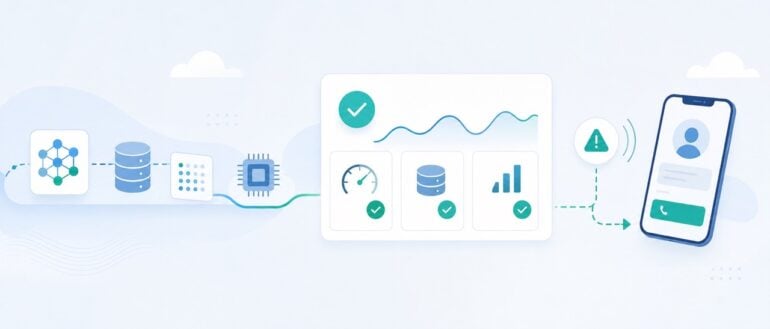
Specialized AI observability and evaluation tools now track GPU memory pressure, vector database latency, and data pipeline freshness with high precision. Yet, a critical gap has emerged in modern operations. While the ability to detect complex, degraded system states has become highly sophisticated, the methods used to mobilize humans to fix them have often remained primitive.
The fundamental problem with running production AI stacks is that they break in ways that do not map to the traditional question, “Is the site up?” APIs may report that everything is fine, containers stay healthy, and dashboards remain mostly green, while answer quality or response speed has already degraded enough to break the user experience.
When a system is technically live but operationally failing, the challenge is no longer just spotting the anomaly. The real bottleneck is mobilization. True operational efficiency relies on instantly converting a complex AI alert into a coordinated response, bridging the gap between the moment a failure is detected and the moment the right engineer begins resolving it.
The Failure Mode Many Teams Underestimate
Traditional incidents often announce themselves with obvious signals: spikes in server error codes, timeouts, or workload crashes. AI systems fail that way sometimes, but a meaningful share of production pain comes from a different category: the system remains available while output quality, relevance, or responsiveness degrades.
Examples of these silent degradations include:
Data freshness falls behind after an upstream system change.
GPU memory pressure increases the likelihood of slow responses without causing outright failure.
An orchestration step succeeds technically but introduces retries and latency.
These incidents are uniquely challenging not because signals are missing, but because they fail to prompt action. The practical question for modern operations is not just “Did detection occur?” but rather, “How is the right responder immediately mobilized before the issue compounds?”
The Critical Gap: Detection vs. Mobilization
Most mature teams already have more system data than they can productively absorb: GPU metrics, queue depth monitors, and system traces. However, the bottleneck is rarely visibility; it is the friction of the handoff.
When complex AI incidents strike, traditional notification methods often fall short for several reasons:
The Shared Channel Trap: Alerts land in a noisy, shared chat channel or email inbox where everyone assumes someone else is handling it.
Lack of Persistence: A single SMS or email notification is easily missed, ignored, or buried under non-urgent notifications.
The Ownership Maze: The signal might be visible to the infrastructure team, but the likely cause sits with data engineering or search infrastructure. Without intelligent routing, the alert goes to the wrong person.
To shrink the Mean Time to Resolution (MTTR), organizations must treat the bridge between detection and response as a first-class engineering problem.
What Better Mobilization Looks Like
For complex AI systems, incident response must assume ambiguity early and route accordingly. Mobilizing a response team effectively requires an intelligent, automated communication layer that prioritizes critical events and acts with the urgency of a traditional pager, while leveraging modern mobile functionality. To successfully bridge the detection-to-response gap, engineering teams should look for solutions that provide:
Persistent, High-Priority Alerting: Critical alerts must override silences, bypass “Do Not Disturb” modes on mobile devices, and continue to sound until a human actively acknowledges them.
Automated On-Call Scheduling & Escalation: Incidents do not follow a 9-to-5 schedule. Systems must feature automated “follow-the-sun” scheduling and multi-tier escalation policies. If the primary on-call engineer does not respond within a set window, the alert should automatically route to the next engineer.
Bi-Directional Chat Integration: Responders should not have to leave their preferred environments to act. Incident management should integrate seamlessly with collaboration tools such as Slack and Microsoft Teams, allowing engineers to acknowledge alerts and coordinate directly within the platforms they already use.
Actionable Context: An alert without context is just noise. High-fidelity alerts should include automated summaries of recent deploys, provider changes, and affected workflows so the engineer can start troubleshooting immediately.
Reliability Now Includes Output Integrity
For AI products, reliability can no longer be defined narrowly as service availability. A system that is reachable but stale, erratic, or operationally inconsistent is still failing in production terms. Resolution is no longer just about restoring server health; it means restoring output integrity to an acceptable operating range.
The ultimate operational advantage belongs to teams that can recognize when a product is failing before the infrastructure declares an outage, and instantly connect the problem to the exact engineer who can fix it.