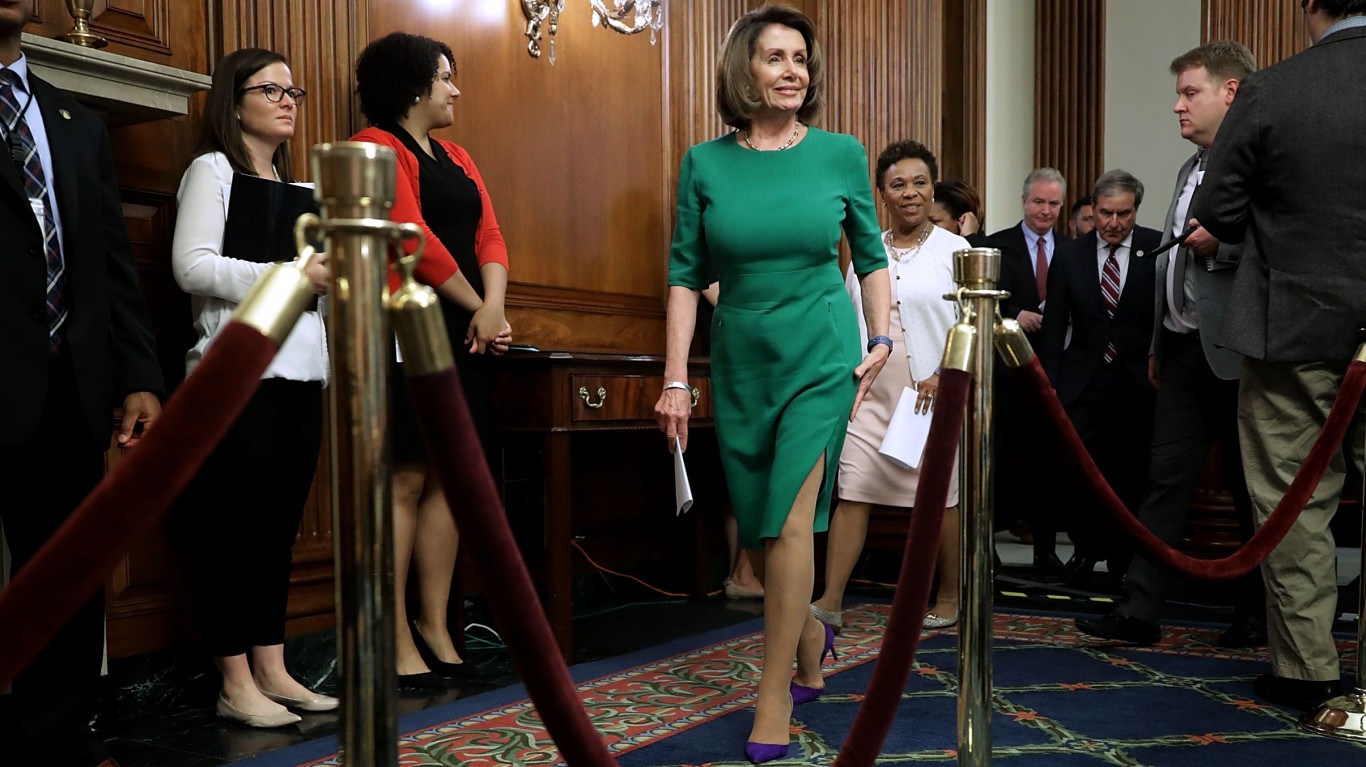
A periodic transaction report filed with the House Clerk on Aug. 21, 2026 disclosed a new position in Bloom Energy (NYSE:BE) inside Nancy Pelosi’s household. The purchases were made by her spouse, Paul Pelosi, and reported under House rules on spousal transactions. Congressional stock disclosures use broad dollar bands, so the widely circulated “$3 million” figure is the sum of the four low ends of those bands. The true commitment could reach roughly $12 million for Bloom Energy alone.
What Was Disclosed #
The filing shows two tranches of Bloom Energy purchases. On July 24, 2026, the household acquired 10,000 BE shares (disclosed $1,000,001 to $5,000,000) and 100 call options at a $100 strike expiring June 17, 2027 (also disclosed $1,000,001 to $5,000,000). A second tranche added another 100 calls at the same $100 strike expiring June 17, 2027, plus roughly 5,000 shares, each disclosed at $500,001 to $1,000,000. The date of this second tranche is unresolved: Barron’s reports July 26, 2026, while Yahoo Finance, Stocktwits and TipRanks report July 28, 2026. Combined, the disclosure covers 15,000 shares plus 200 calls representing 20,000 underlying shares. It is the first BE trade ever disclosed by the Pelosi household. The same filing added to an existing Intel (NASDAQ:INTC | INTC Price Prediction) position with 10,000 shares plus 50 calls at a $50 strike expiring June 17, 2027, bringing the total disclosed across both names as high as $13.5 million.
Bloom Energy, the AI Onsite-Power Trade #
Bloom’s solid-oxide fuel cells generate electricity on customer sites without grid interconnection, positioning the company as a direct beneficiary of AI data centers’ power demand (the same power, cooling and networking angle we broke out across seven suppliers in a free report here: 7 Stocks Powering the AI Boom). On the Q2 2026 call, CEO KR Sridhar said “all the major US hyperscalers and over a dozen US neoclouds, AI labs, and colocation data center operators have validated and approved our power solutions for their AI factories,” adding “Bloom is now a standard for AI onsite power.”
The reported quarter, filed July 28, 2026, delivered revenue of $1.065 billion, Bloom’s first quarter above $1 billion and up 165.5% year over year from $401.2 million. Product revenue rose 215.4% to $935.4 million. Operating income swung to a positive $182.2 million from a $3.5 million loss. Full-year 2026 guidance was raised to $3.9 billion to $4.2 billion. Details are in the Q2 8-K exhibit and on Bloom’s investor relations site.
Stock Performance and Valuation #
BE closed Monday, Aug. 24 at $204.02, up 1.28% on the session. The stock is up 134.8% year to date and 320.31% over one year, with a 52-week range of $48.87 to $351.28. Over the past week, shares fell 12.12% from $232.16 on Aug. 17. Analyst consensus target sits at $275.08, with 5 strong buy, 10 buy, 12 hold, 1 sell and 1 strong sell ratings. Beta is 3.832 and market cap is roughly $59.3 billion. The trade was disclosed roughly a month after execution, and shares have already given back a meaningful portion of the run.
A Familiar NVIDIA Playbook #
The Bloom structure mirrors the household’s NVIDIA (NASDAQ:NVDA) approach: large, long-dated, in-the-money calls layered with common shares. Every gain figure below is an estimate derived from disclosed bands.
On Nov. 22, 2023, the household bought 50 NVDA calls at a $120 strike expiring Dec. 20, 2024, disclosed $1 million to $5 million, estimated cost around $1.8 million. The 10-for-1 split in June 2024 converted the position to 500 calls at an effective $12 strike. On Dec. 20, 2024, all 500 were exercised for roughly $600,000, bringing total position cost to roughly $2.4 million. On Dec. 31, 2024, 10,000 shares were sold (disclosed $1 million to $5 million). This came shortly before Nvidia’s decline in late January 2025, when the stock lost more than 15% in one day and over $500 billion in market value. No evidence ties the sale to advance knowledge.
The household rotated into 50 new $80-strike calls expiring Jan. 16, 2026 on Jan. 14, 2025, then by April 2026 had exercised those, sold 20,000 shares (disclosed $1 million to $5 million), and rotated into 20 calls at a $100 strike expiring late January 2027. Reporting dated July 10, 2025 valued remaining shares at roughly $8.2 million and framed a net gain of roughly $5.8 million against the roughly $2.4 million cost.
Legislative and Political Backdrop #
Family stock holdings are estimated at roughly $30 million or more, with broader net worth estimates of $278 million to $280 million. Pelosi will not seek re-election; her term ends Jan. 3, 2027, placing this among her last trades as a sitting member. On July 22, 2026, the House passed the Stop Insider Trading Act (H.R. 7008) 232-198. It would bar future individual-stock purchases by members, spouses and dependent children and require 7 to 14 days public notice before a sale, but explicitly grandfathers existing holdings and faces a 60-vote Senate threshold. Pelosi voted no; reporting attributes Democratic opposition to an unrelated voter-ID provision. Separately, on July 30, 2025, Pelosi backed the HONEST Act, stating “I strongly support this legislation and look forward to voting for it on the Floor of the House.” For deeper background, see our Aug. 5 piece.
A member in her final term is repeating a documented playbook in a new corner of the AI buildout. The trade is legal and fully disclosed. Bloom’s Q2 numbers, hyperscaler validation and raised guidance frame the position. The one-week pullback frames why the picture is less tidy than the headline suggests.
Contact [email protected] for any questions or corrections.