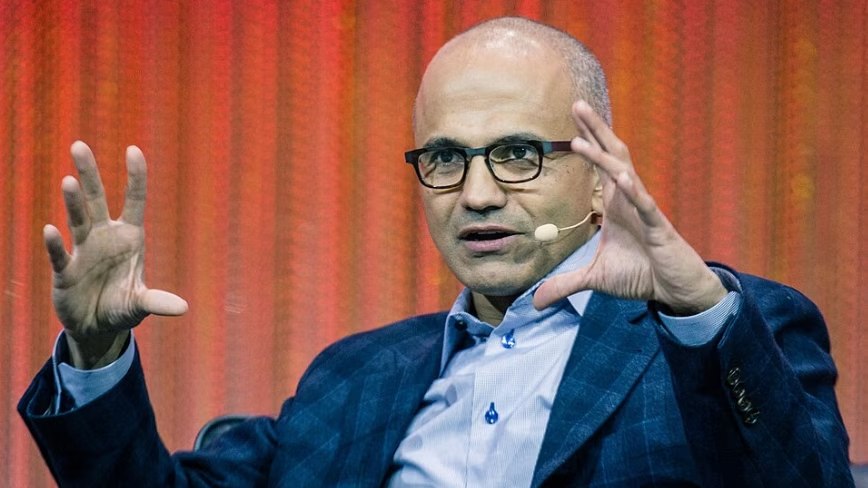
Fareed Zakaria opened with the question everyone is circling. Are we in an AI bubble, and has it begun to deflate? OpenAI has promised to spend hundreds of billions while making a fraction of that, he noted. The maths does not add up.
Nadella did not push back. He reframed the question as a test AI has to pass.
“This is a new general-purpose technology that is going to drive productivity,” he said on CNN’s GPS. “That productivity has to translate into very broad-based economic growth that is economy-wide in terms of GDP growth.”
Then the condition. “If we don’t see that, then we are going to have a problem. So unless we see that broad economic growth, we’re not going to have this movie end well.”
It is a striking thing for the man who spent $190bn this year to say two days before his earnings call.
Who gets the chips #
The other Nadella showed up the same weekend, in his own executives’ account of the company. Microsoft cannot build capacity fast enough. The shortfall has forced it into triage, Business Insider’s Ashley Stewart reported. Its own AI products eat first. Azure customers get the remainder.
Chief financial officer Amy Hood said as much on January’s earnings call. Microsoft solves first for M365 Copilot and GitHub Copilot, then for research and development.
“Then what you end up with is the remainder going towards serving the Azure capacity that continues to grow in terms of demand,” she said. Had those chips gone to Azure instead, she added, growth would have topped 40% rather than 39%.
That admission is not new to readers here. A Michigan pension fund sued Microsoft in June over precisely this. The suit alleges the company hid the diversion before a January drop erased $357bn of market value.
What is new is that insiders say it has got worse. “All of the supply is gone once you solve for frontier labs and our internal businesses like M365 and Microsoft AI,” one executive told Business Insider.
Selling what you cannot deliver #
Here is the part that reads oddly. Microsoft is raising quotas for its Azure salespeople despite the crunch. Some quotas rise by 30% this year, according to people familiar with the change.
Meanwhile it is buying capacity from its rivals. Amazon bailed Microsoft out after a run of GitHub outages. It explored leasing Oracle cloud infrastructure and walked away over security and compliance concerns. It is now evaluating Amazon and Google.
“We are shopping for capacity everywhere,” one person familiar with the talks said.
Inside the company, the logic is understood and the messaging is not. One executive framed the trade-off bluntly: why would Nadella prioritise growing Adobe, an Azure customer, over growing M365?
“I have no idea how we’re going to land that message with customers,” the person added.
The trap Microsoft is actually in #
The dilemma is real, and Microsoft is not obviously handling it wrongly. Serving Azure customers lifts revenue now. Serving its own products is a bet that they eventually win.
Starve the first and Azure growth disappoints, which hits the share price immediately. Starve the second and Microsoft slips further behind in the race that justified the spending in the first place.
What makes the choice urgent is that customers have somewhere else to go. Google Cloud keeps posting large numbers. Meta and SpaceX are now selling compute too. Microsoft’s customers may not wait to find out what it decides.
The ecosystem argument #
Zakaria’s second question was about China. Most firms are not using AI to solve Fermat’s theorem, he pointed out. They are rationalising inventory systems. So will the world simply take the cheaper Chinese open-weight models, like Moonshot’s Kimi?
Nadella’s answer was that provenance matters less than plumbing. “Even take the Chinese models. Guess where these models run? They run on a lot of the hyperscalers that are American, all over the world.”
Because the weights are open, he argued, American firms can monitor, test and post-train them. If a US lab post-trains a Chinese base model and ships it, he asked, whose model is that?
“As long as that remains, we will absolutely be competitive and we will win,” he said. China will have a role, he added, but this is not a zero-sum game.
He has been making a version of this case all week. His pinned post asks how to ensure “frontier benefits are diffused across the entire ecosystem” now that software has real marginal cost for the first time. Diffusion is the theory. Triage is the practice.
Three businesses in the blast radius #
The strain is not only physical. Three core businesses now sit in AI’s path at once.
Microsoft 365 is the first. Knowledge workers used to open Word, Excel and PowerPoint to start the day. Increasingly they start inside an AI tool instead. Gartner predicted this year that AI would threaten to dethrone traditional productivity suites in a $58bn shakeup.
GitHub is the second. It had its best month ever, an executive told staff. It has also suffered dozens of major outages this year as AI usage surged. Cursor and Claude Code have taken millions of engineers in the meantime.
Azure is the third, and it is the one being asked to wait its turn.
The billy club #
Nadella has pushed the pressure downwards. He has dismantled the senior leadership team structure and handed the commercial business to Judson Althoff. He also put a 33-year-old ex-Snap executive in charge of Copilot.
The churn continues. Rajesh Jha has retired, Yusuf Mehdi is preparing to leave, and Charlie Bell has moved to an individual contributor role. Hayete Gallot, recruited back from Google, is seen internally as Althoff’s long-term successor.
Microsoft also overhauled performance reviews this year, cutting ratings to five categories and sharpening the distinctions between them. Executives say it feels like a return to the stack ranking of the Ballmer era. Managers have been told to thin out the higher-level engineering ranks.
“It’s almost like the old era of Microsoft is back,” one former executive said. “The old Windows era where you lead with a lot of fear and a billy club in your hand.”
Wednesday’s test #
Microsoft reports fourth-quarter results on Wednesday. Amazon follows on Thursday. Between them the two will spend roughly $400bn on data centres this year, Fortune reported, with Microsoft near $190bn.
Investors are already twitchy. Alphabet’s stock fell 7% last Thursday after it raised capital-expenditure guidance and posted negative free cash flow. Microsoft shares are down about 19% this year, and roughly 25% over twelve months. That is the worst of the Magnificent 7 by some distance. Meta is next, down almost 17%.
The underlying business is not weak. Microsoft disclosed nearly $627bn of remaining performance obligations, almost double a year earlier. It is funding roughly $35bn of building a quarter from operating cash flow rather than new debt. Azure and other cloud services are forecast to reach $148.9bn in fiscal 2027.
Nadella has heard doubts before. “I remember when I became CEO, everybody said, oh my God, isn’t it too late man?” he recalled at a Morgan Stanley conference in March. Microsoft built anyway, and the public cloud turned out to be multiplayer.
At that same conference he described the plan. “We have OpenAI book, we have Anthropic book, but we want to also have the long tail of enterprise IT,” he said. The long tail is the part now waiting at the back of the queue.
Get the TNW newsletter #
Get the most important tech news in your inbox each week.