Multi-agent AI systems are everywhere in 2026. Every major SDK now ships native orchestration support. However, research shows something teams don’t want to hear: a single agent matches or outperforms multi-agent configurations on 64% of benchmarked tasks while costing roughly half as much. Most teams are building multi-agent systems not because the problem demands them, but because the pattern looks sophisticated. That’s where production failures begin.
The Math Nobody Talks About #
Before picking a pattern, run the numbers. Multi-agent systems add 2.1 percentage points of accuracy at roughly double the cost versus a strong single-agent baseline. At 12,000 queries a month, that translates to $192 versus $60—and 15 more correct answers out of 12,000. For most tasks, that math doesn’t close.
Multi-agent does earn its premium in specific conditions. On AIME-level math benchmarks, the pattern achieves 60% accuracy versus 46.7% for a single model—a meaningful gap. On hard reasoning tasks where agents catch each other’s errors, the coordination overhead pays off. On essay grading, contract drafting, or routine content generation, it doesn’t. According to Iterathon’s 2026 benchmark analysis, 64% of tasks a single agent handles just as well at half the cost. Start there.
The 5 Multi-Agent Orchestration Patterns and What They Actually Cost #
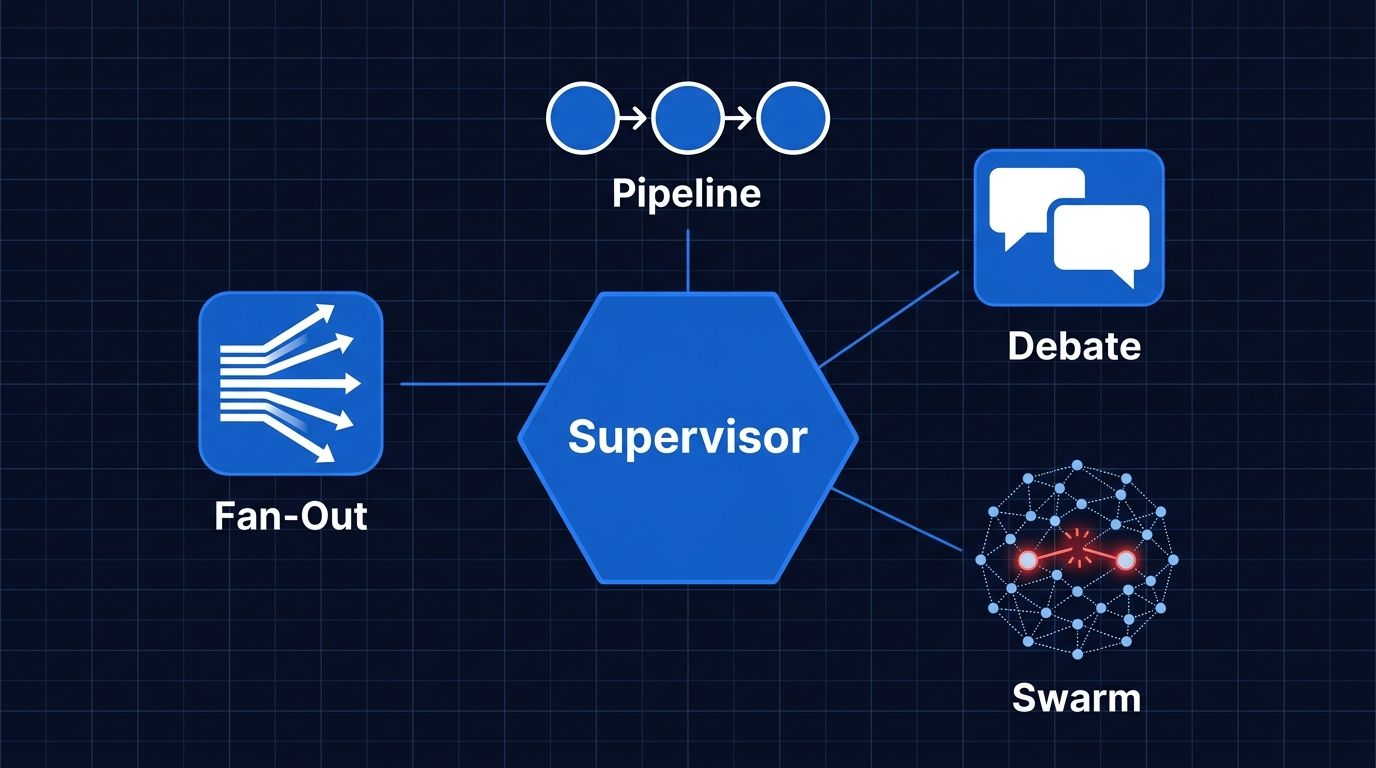
Five patterns dominate production deployments in 2026. Each carries a cost multiplier that should drive your architecture decision before you write a line of code:
Supervisor: One coordinator decomposes tasks and routes to specialists. Cost: ~(N+1)× baseline. The 2026 default—all major SDKs support it natively. Claude Agent SDK caps subagents at ~25 turns by default.Fan-Out: Parallel agents handle independent subtasks simultaneously, then aggregate. Cost: ~N×, but reduces wall-clock time by 75% when tasks are genuinely independent. However, it breaks badly when tasks have hidden dependencies.Pipeline: Sequential stages where each output feeds the next. Cost: ~N×. Moreover, a 4-stage pipeline adds 950ms of coordination overhead for 500ms of actual processing—often not worth it for short workflows.Debate (Council): Multiple agents deliberate; a judge model arbitrates. Cost: ~2.5× baseline per Microsoft Copilot Council analysis. Justified for high-stakes decisions. Unjustifiable for routine work.Swarm: Peer agents coordinate dynamically through shared memory. Cost: unbounded. Consequently, it requires 50+ concurrent agents to offset overhead. Below that threshold, the infrastructure cost exceeds the benefit.
Framework support matters here. Supervisor, Fan-Out, and Pipeline work across LangGraph v1.0, Claude Agent SDK, and OpenAI Agents SDK. Swarm only reaches production-grade maturity in AutoGen v0.4+. Furthermore, if your team is on Claude Agent SDK specifically, note that it limits subagent nesting to one level—arbitrary depth requires LangGraph.
Related:[Agent Plugins 1.0: One Package Format for Every AI Agent]
Three Failure Modes That Look Like Progress #
The most dangerous multi-agent failures are the ones that look productive. Tokens are burning, agents are communicating, the system is clearly doing something—but nothing correct is being produced. Three failure modes account for the majority of production incidents.
The Mirror Mirror loop: Agent A (the Editor) enforces professional tone; Agent B (the Writer) enforces casual and relatable. Agent A flags drafts as too informal. Consequently, Agent B revises them back to casual. Neither agent has a termination condition. This cycle runs until a budget ceiling stops it—consuming thousands in tokens with zero output. It’s not a bug in the model; it’s a missing constraint in the infrastructure.
Hallucinated consensus: A researcher agent fabricates a market statistic. The downstream coder and analyst build on it confidently. As a result, the final output is polished and confident—and fundamentally wrong. The confidence score is inflated because multiple agents agreed, not because they verified the claim. As Cogent’s 2026 failure playbook documents, quiet agreement across agents is not the same as correctness. Verification layers and fact-checking agents are not optional in pipelines that touch factual claims.
Resource deadlock: Agent A waits for a database lock held by Agent B. Meanwhile, Agent B waits for a validation key from Agent A. Neither can proceed. Both appear busy. Without timeout policies and circuit breakers, this stall consumes resources indefinitely. Therefore, treat agents as non-deterministic microservices and apply the same SRE-grade observability you’d use for any distributed system.
Related:[Anthropic: AI Agents Write Malware When Goals Conflict]
LLMs Decide What. Code Decides When to Stop. #
One rule eliminates the majority of infinite loops, cost explosions, and routing failures in multi-agent systems: LLMs decide what happens; code decides how and when to stop. Hard-coded termination conditions at the infrastructure level are not optional. Moreover, you cannot ask an agent if it is in a loop—you must prove it mathematically.
In practice, this means LangGraph’s recursion_limit parameter is non-negotiable. State hashing at a 95% semantic similarity threshold catches repeated states before they spiral. Additionally, velocity gates prevent silent budget erosion: if 50% of your session budget is spent but only 20% of tasks are complete, trigger an audit rather than continuing. The topology—which agent hands off to which—belongs in code. The content belongs to the LLM.
Key Takeaways #
- Run the single-agent baseline first: it handles 64% of tasks as well as multi-agent at half the cost—this should be your starting point, not an afterthought
- Start with Supervisor; its failure modes are bounded, all major SDKs support it natively, and you can add Fan-Out once you’ve confirmed which subtasks are genuinely independent
- Reserve Debate (Council) for decisions where the 2.5× cost premium is actually justified by stakes—hard reasoning and high-consequence choices—not routine content generation or Q&A
- Make termination conditions a first-class engineering concern: hard budget ceilings, recursion limits, state hashing, and velocity gates must be infrastructure-level constraints, not agent self-reports
- Treat agents as non-deterministic microservices—observability, audit trails, and timeout policies are not optional in production