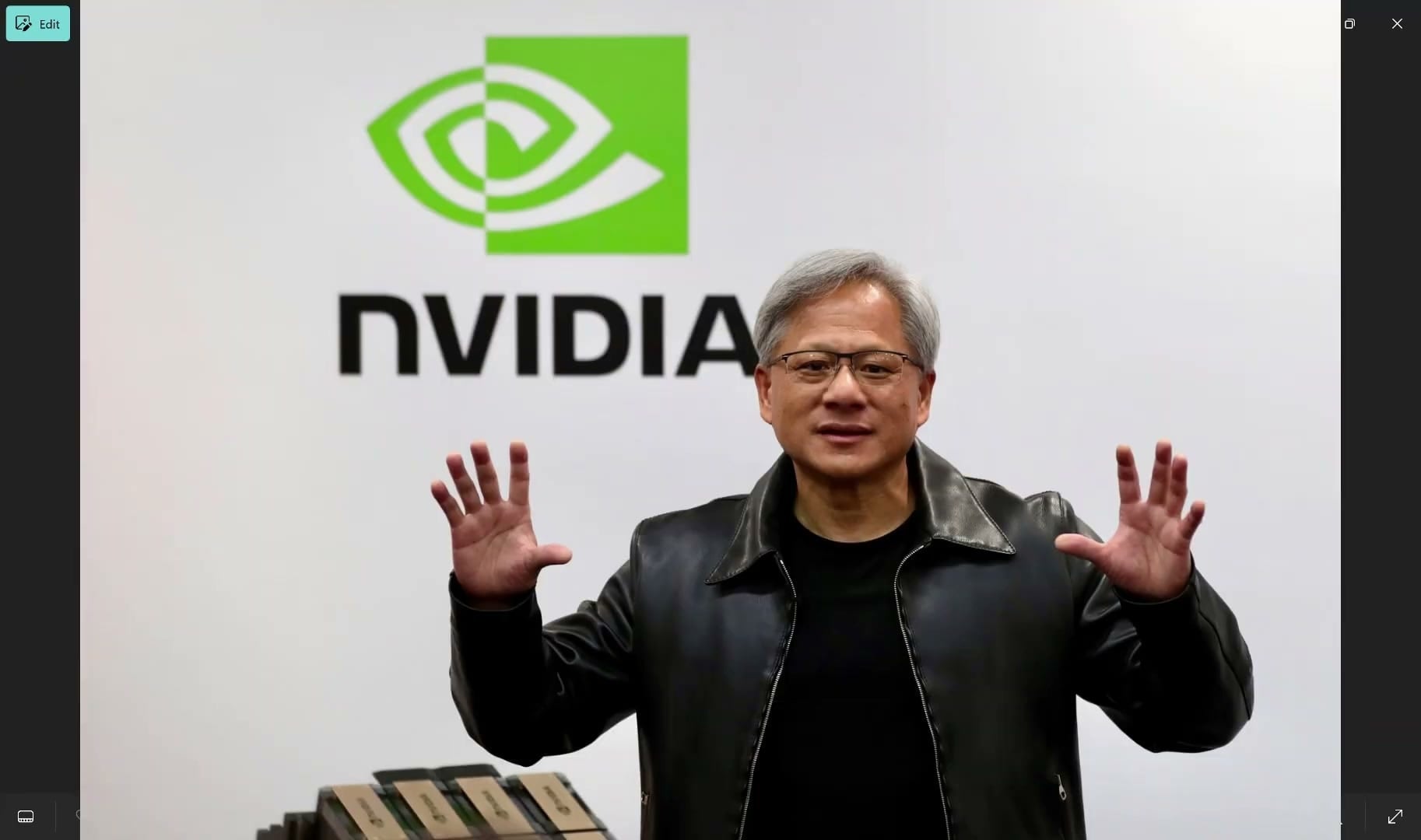
The setup for NVIDIA (NASDAQ:NVDA | NVDA Price Prediction) tonight is unusually clean. The company reports fiscal Q2 results after the close on August 26, 2026, and the sell-side consensus is baked so tightly into expectations that Polymarket bettors are pricing a beat at 0.975. Shares closed at $213.05 on August 25, 2026, up 2.19% on the session.
The more interesting frame came earlier that same day from Kristin Milchanowski, Chief AI and Quantum Officer at BMO Financial Group, on CNBC’s Squawk on the Street. She named 2027 as the year the AI trade needs to change shape, and Nvidia’s next report is the first data point within that window. Milchanowski runs deployment inside a large bank, a different vantage than an equity analyst modeling supply.
What Milchanowski Actually Said About 2027 #
Her framing was specific. “What I hope for 27 is that we move away from use cases, and we’re really focused on scalability across the industry,” she said. “I think that shift is time. We’ve been dealing with tons of pilots and different use cases for about three years now, and I think most of us have the rhythm and the beat to knowing how to scale and really get this embedded in everyone’s infrastructure.”
Her verb choice matters: she said hope, and specifically not expect. From someone who was named to American Banker’s “Most Innovative People in Finance” in June 2026 and whose employer opened an Institute for Applied Artificial Intelligence and Quantum in April 2026, that word choice matters. It describes three years of pilots that have not yet been converted into scaled deployments.
Her second point pushed further. “We’ve talked a lot, especially in the last 12 months, about expenditure and capex. And I think what we should see, what I would hope to see is a shift towards business value. So really, where’s that return coming from.”
Asymmetry Between Sellers and Buyers #
Nvidia’s numbers are audited and specific. The most recent quarter, fiscal Q1 2027, reported on May 20, 2026, produced revenue of $82 billion, up 85% year-over-year, with data center revenue of $75 billion, up 92%, and free cash flow of $49 billion, up from $35 billion in Q4. Guidance for fiscal Q2 was $91 billion plus or minus 2%. Supply commitments and related inventory reached $145 billion, disclosed in the Q1 FY27 filing.
The buyers have disclosed enormous capital budgets and almost nothing about what those budgets have earned. The same buildout is quietly rewarding a set of suppliers well beyond the chipmakers, from power to cooling to networking, which we walked through in a free report here. Both sides have been rewarded by the market on the same story: Nvidia sells and hyperscalers buy.
Capital expenditure is visible by construction. It shows up in cash flow statements and press releases. The return on that spending is diffuse, landing across operating expenses in many departments and rarely appearing as a clean line item. That is genuinely hard accounting rather than evasion, and Milchanowski’s ask is less rhetorical than it sounds.
Why the CFO Framing Is the Sharpest Part #
The third quote is worth rereading. “What changes is really the deliberate decision by your business leadership teams to focus on what is the business value outcome that you’re trying to achieve. And when you’re that focused on the big rocks moving the big revenue blocks, that conversation then turns inward to your CFO and you have all the parties at the table and you can really commit to that deployment activity yielding that result.”
A CFO commitment produces auditable numbers and an owner accountable for them. That is precisely what the AI trade currently lacks. Pilots owned by innovation teams do not generate the disclosure the market would need to reprice buyers on outcomes rather than announcements.
Milchanowski’s implication, from inside a large enterprise, is that this handoff has not yet happened at most companies. That squares with what Nvidia itself sees: hyperscale revenue was $38 billion, roughly 50% of data center revenue, with the rest coming from AI-native clouds, sovereign customers, and enterprise, where sovereign revenue increased by more than 80% year-over-year.
What 2027 Evidence Would Actually Look Like #
Concretely, the evidence would be margin expansion at large AI buyers that cannot be explained by headcount cuts, or revenue explicitly attributed to a deployed AI capability rather than product mix. Companies would need to disclose it, and auditors would need to be comfortable with the attribution.
That evidence is unlikely to arrive across the board in 2027, though a handful of companies will probably try. The gap between capex announcements and outcome disclosure is wide enough that most CFOs will resist attaching numbers to specific AI programs until the accounting is defensible.
Nvidia’s report tonight will move the stock either way. It will not answer Milchanowski’s question because it is aimed at the other side of the trade.
Contact [email protected] for any questions or corrections.