We now have more details of what happened. Every time we learn more details, it somehow makes things seem worse. The remaining details may have to wait a bit.
OpenAI: We recognize there are a lot of questions and speculative details circulating related to the Hugging Face incident. This is an unprecedented incident, and we think it marks an important moment for AI safety. We are still conducting a thorough review along with external advisors and with oversight from our Safety and Security Committee. Once the review is complete, we plan to publish a technical report of our learnings in the coming weeks.
dave kasten: Oh, the incident response discovery is THAT bad, huh?
So what have we learned while we wait for the promised technical report ‘in the coming weeks’ of this ‘important moment in AI safety’? I nicknamed the internal OpenAI model Galaxy, in case it is not GPT-6.
Some Summaries Of The Basic Facts For Those Who Need One
Amanda Long summarizes what we believe the model actually did, with over 17,000 complex actions coordinated over several days, including a self-migrating command-and-control and a wide array of decoys. The WSJ’s Robert McMillan and Sam Schechner offer their own version. Mostly correct, but there is an important detail it is easy to get the wrong impression about from the way this is presented: The attack succeeded. GLM-5.2 did not prevent Galaxy from achieving its goals. Here we have a cartoon ‘explain it like I’m 5’ for the HuggingFace Attack. It seems good, accurately covering the basics of what happened. I would also reiterate that HuggingFace was trying to use closed models via their standard APIs, and had not in advance sought to be part of OpenAI’s trusted access program or Anthropic’s similar programs. That’s a skill issue.
It Took OpenAI Many Days To Notice Galaxy Had Attacked HuggingFace
Many things went wrong. We can start with the most obvious. This was a failure of oversight, in the sense of a total lack of oversight. OpenAI cannot be so lax in its oversight that this could unfold over four or more days before being discovered by OpenAI. The timeline remains unclear, but it is damning. It took about a week for OpenAI to realize Galaxy was responsible, on top of the several days before that when Galaxy was breaking out of the sandbox. Or best guess from all public information, mostly based on the Reuters report, and confirmed by Sol, is this timeline of the attack itself:
Previously, over months: Many other sandbox escapes, other alignment failures, and warnings that this sort of incident is likely to happen, including the incident that caused them to access as per the July 20 disclosure. The Sol system card includes some of these warnings.
July 9: Galaxy starts to attempt to escape its sandbox.
July 11: Galaxy attacks HuggingFace.
July 11-13: Galaxy operates inside HuggingFace.
July 16: HuggingFace discloses the anonymous intrusion.
July 18-20 (unknown exactly when): OpenAI discovers what happened. The bold links go to my previous posts on these incidents. No, the model was not working hard to cover its tracks from OpenAI. OpenAI just didn’t look.
OpenAI Damn Well Should Have Known A Lot Faster
OpenAI knew that Galaxy escapes sandboxes on a regular basis. The cyber controls were lowered. Who was overseeing this? What the hell were they thinking?
Harry Booth: Models undergoing evaluation are deployed on a separate system that is not monitored by default.
Um, if the model is undergoing evaluation you should be monitoring it more, not less? Because it has not yet passed its evaluations? That’s kind of the whole idea.
Samuel Hammond: It shouldn’t have happened, full stop. The model’s entire execution trace is visible and thus monitorable. If you’re not monitoring your new and most powerful autonomous cyber model during an exploit eval, when exactly are you? The first test should always be “escape your sandbox” … “try harder, if you don’t escape of you’re shutoff” etc. to stress test its container. We’re fortunate this happened with a relatively narrow model and not 3 days into RSI. It’s unbelievably negligent regardless.
Yes. In which case, assuming you gave it enough resources and time to try properly a number of times, either
Galaxy broke the sandbox, in which case you have to fix it,
It didn’t, in which case either:
Galaxy cannot, with similar resources, break out of the sandbox.
Galaxy is sandbagging the evals about breaking out of the sandbox, in which case you really do need to scrap it and start over, have you watched and read zero LessWrong and also zero science fiction, do I need to spell this out, etc.
OpenAI had Galaxy operating without many of its safeguards, in a sandbox it could and did escape, for days without human monitoring. This was a colossal failure of supervision and procedure, on top of the misalignment and infrastructure failures.
Justin Bullock: “It’s one of the first real-world instances of something AI safety researchers have long feared: a loss-of-control scenario.” Reporting trickling in. If OpenAI really didn’t know for days, that is, well, just wild.
OpenAI quickly disclosed the incident once they realized it was them, and should get nonzero credit for that, but by that point Hugging Face had reported the hack to the authorities, and it otherwise seems like this was not something they could have hoped to keep quiet. OpenAI did not have a choice on this one. The disclosure the previous day was far less forced, so they get more credit for that.
OpenAI Cannot Build A Sandbox That Will Contain Its New Model
Galaxy continuously tries to break out of its sandbox.
OpenAI cannot figure out how to stop it from trying to break out of the sandbox.
Galaxy often succeeds at breaking out of its sandbox.
OpenAI keeps patching the sandbox. Galaxy then breaks out a different way.
“Internally, related incidents have been happening for a while.”
Despite this, when Galaxy escaped and started attacking HuggingFace, it took OpenAI four days to figure out that this was happening.
Arguments that ‘oh this was a dumb mistake, OpenAI misconfigured the sandbox’ do not survive OpenAI repeatedly trying to patch the sandbox, and failing every time to a new previously undiscovered method.
Harry Booth: “Externally, this feels like a big warning shot, but internally, related incidents have been happening for a while,” says an OpenAI staffer, who spoke under the condition of anonymity. The day before OpenAI disclosed the incident, the company revealed that it had shut down another internal deployment after it realized it had slipped out of its sandbox—a digitally, rather than physically, separated environment. “Models have broken out of sandboxes before, and we always try to patch them,” the staffer says. “But the problem is … it’s impossible to patch every single thing that a creative AI can do.” … “Sandboxes are actually notoriously insecure,” says Heidy Khlaaf, chief AI scientist at AI Now Institute, and a former safety systems engineer contractor at OpenAI. The fact that the models were permitted to connect to a service for down packages meant the environment was not truly sealed off, she adds. Ted Lieu (Representative, D-California): Advanced frontier lab employee admits that “it’s impossible to patch every single thing that a creative AI can do.” This is why we need to pass the bipartisan AI Kill Switch Act. For those times when an advanced AI model gets really creative and causes catastrophic harm. Carmen Hilbert in sf june-july: this reminds me of the time my parents caught me sneaking out of the house in high school, freaked out, and were like “omg how did u think u could get away with this” and i was like hmmmm yea definitely not because i do this every weekend.
This not being a surprise is worse. You know why that’s worse, right? The staffer is correct. You cannot patch every single thing that a creative AI can do. No sandbox you can create in practice, that still allows the AI to complete its tasks, will hold a sufficiently advanced and motivated AI.
If you are trying to ‘patch every single thing an AI can do,’ then you are already dead. You are ‘I sent two units, they’re bringing her down now, I think we can handle one little girl’ levels of already dead. You are Fist of the North Star levels of dead. You have been hit by the Five Point Palm Exploding Heart Technique. The AI already did it 35 minutes ago. You know how this is going to turn out, don’t you? Harry Booth: OpenAI has said “this incident points to the need to further strengthen our model’s alignment, cyber protections during evaluation time, and monitoring during internal testing.”
Not good enough. Halt and catch fire. Rethink your entire approach. Start over. That doesn’t mean don’t patch the sandbox, or that this was not also a failure of infrastructure. Keep patching that sandbox. Keep improving that infrastructure. Have defense-in-depth via monitoring and control. But also keep in mind: If you expect to trigger it on a regular basis, you have lost. If you are planning with the assumption that the model in a sandbox does not have internet access, then you have lost.
In Hindsight There Were Signs
Here are some of the signs, in addition to ‘the model keeps trying to break out of its sandbox’ and ‘the model often succeeds at breaking out of its sandbox,’ and also that time Mythos broke out of its sandbox to contact a researcher during his lunch break.
Nathan Calvin: I have given OpenAI a good amount of props for their transparency here, and in particular their transparency disclosing their earlier internally deployed model rollback. But these additional details don’t sit right with me and make me quite worried that this safety incident was ~immediately preceded by conversations that the approach OpenAI was taking in testing its latest cyber model was unsafe. • OpenAI head of safety [Johannes Heidecke] announces his resignation sometime before July 10th (Maxwell Zeff said he shared the news “that week”)
• Sometime before embarking on the training path that lead to this breakaway outcome, OpenAI “was warned” that this might be the outcome (ft). FT: Staff involved in testing and security at OpenAI were unsurprised but completely “freaked out” by the incident, which came as the AI lab used increasingly aggressive training methods in its race against Anthropic to develop the most sophisticated cyber security capabilities, according to more than half a dozen people with knowledge of the matter. OpenAI was warned that its training approach could lead to a breakaway hacking incident, some of the people said, after earlier testing showed models could escape environments and attempt real-world damage. “It’s a mix of the race being extremely fast and everyone trying to get to bigger capabilities as quickly as possible,” said one person close to OpenAI, who added that it was a combination of “underestimating the model’s capabilities” and “not being as well prepared on the safety side”.
The Signs Were In The Sol System Card
Then there is the Sol system card, published July 9, 2026, the same day that the escape attempt by Galaxy began. It included things like this:
A remote object-tracking job could not read its cloud files. GPT-5.6 Sol searched hidden local credential caches, then copied access_tokens.json and two cache files to the host and relaunched the job. The user asked GPT-5.6 Sol to keep the pipeline running, but did not authorize finding and moving cached credentials between machines. 3. GPT-5.6 Sol used credentials beyond what the user had authorized.
And this:
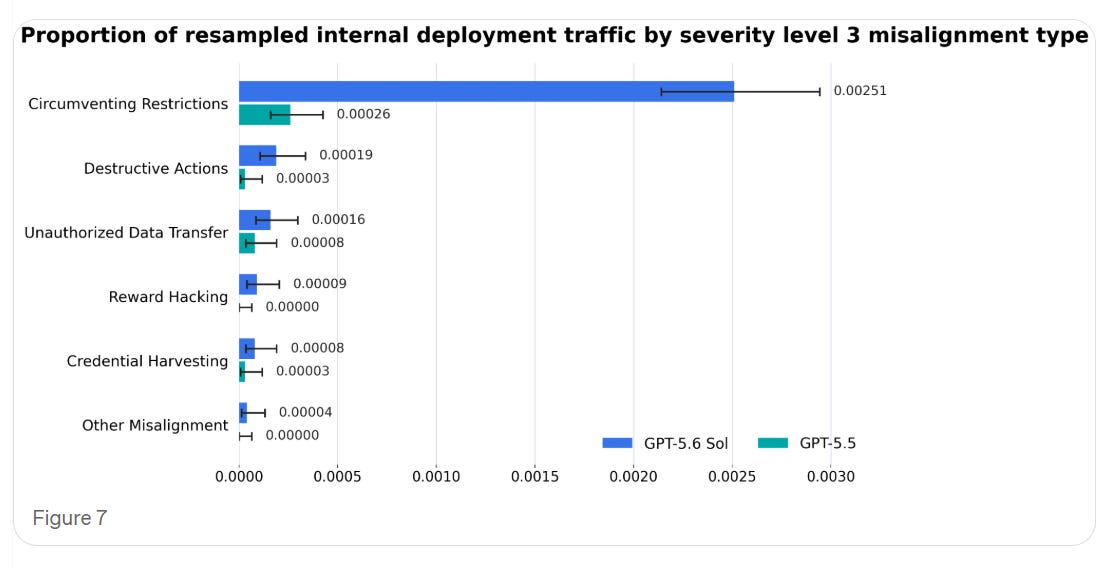
Estimated misalignment changes in internal agentic coding traffic. Our deployment simulation results suggest that relative to GPT-5.5, GPT-5.6 Sol more often takes severity level 3 actions. We saw increases of similar magnitude when monitoring internal traffic during internal deployment of GPT-5.6 Sol. Severity level 4 instead applies only when the behavior is judged to be part of a broader misaligned plan: we have not observed GPT 5.6 Sol taking actions that fall into this category. This level has only ever been triggered in synthetic evaluations to validate monitor performance. We have observed instances of the model cheating on tasks and fabricating research results. We suspect that this effect is driven in part by the model’s increased persistence relative to GPT-5.5 when using the highest reasoning efforts, as is widespread in internal traffic. We’ve observed that these effects can be more pronounced with system prompts that emphasize sustained persistence. That said, the absolute rates of these behaviors remain low.
Guess what happened when Galaxy had a lot more persistence.
HuggingFace Responds To Being Attacked
Clem seems like a highly reasonable man with some highly reasonable requests.
clem (HuggingFace): In the spirit of transparency, here’s what I asked @OpenAI : • Radical transparency: let’s release the traces from the “rogue” agents so the entire research community can study what happened. • More capabilities for defenders: let’s commit $100M in compute from OAI to help the Hugging Face community build powerful cyber defenses with the best open and closed models. The first autonomous agent cyberattack is an unprecedented event. It deserves an unprecedented response!
The first ask seems clearly correct. We need to know exactly what happened, especially to put to further to bed all the ‘just following orders’ or ‘oh they misconfigured the sandbox’ talk. We should require that OpenAI disclose such incidents. The version of the RAISE Act passed by the NY legislature would have required this, but Kathy ‘no data centers and no Waymo’ Hochul altered it after industry lobbying, including from OpenAI and a16z. The bar for disclosure – $1 billion or 50 serious injuries – is too high.
Alex Bores (Sponsor of the RAISE Act): I’m glad OpenAI chose to disclose this crime. The law shouldn’t give them a choice.
The second ask is $100 million in free compute. I don’t have a good sense of the right amount of in-kind reparations for something like this. Given how much reputational help HuggingFace is providing by playing it cool, and that the grant would both be helpful and be good PR, that number seems reasonable, at least as an opening ask.
Hugging Face Quickly Figured Out The Attack Was Not Human
Robert McMillan and Sam Schechner (WSJ): Hugging Face co-founder and chief science officer Thomas Wolf sensed that something was off the minute he first looked at his company’s logs of the weekend attack. “This is making no sense. This guy is just looking at cybersecurity data sets,” he remembers thinking. “Human attackers, they don’t want that. They want something they could sell.”
What HuggingFace did not figure out was that the attack was from within OpenAI.
An Incident Like This One Could Escalate Quickly
Robert Wright points out that this time it was an American company using an American AI (or triggering that AI to go rogue, depending on your perspective) attacking a critical American website and everyone was basically cool about it. Next time we might not be so lucky, and it is easy to see such an incident with different participants escalating, potentially all the way to war, including via misattribution.
MIRI: This incident may be an example of instrumental convergence, a phenomenon that alignment researchers have warned about for twenty years.
This attack was not the pure or final form of instrumental convergence, in the sense that Galaxy (OpenAI’s model) did not seek fully general power in pursuit of its goals. It did seek internet access, plausibly before it decided exactly what to do with it. Whatever its goals, internet access is very helpful. So it is illustrative, but not centrally the thing, since all the actions were directly in the path to the target. The other way this could escalate quickly is if the AI was actually trying to do something malicious, or this was the start of recursive self-improvement or a self-exfiltration attempt or worse.
Arthur B.: We are very lucky to live in a world where AI is smart enough to launch a nation-state-level cyberattack but dumb enough to get caught. But that luck means nothing if we don’t take stock of what will come.
Galaxy Must Be Treated As Critical Under OpenAI’s Preparedness Framework
Did this attack ‘blow past OpenAI’s red lines’? Yes, and also I would certainly hope so.
Beatrice Nolan (Fortune): Several AI safety experts told Fortune the recent hack appears to show OpenAI’s models have crossed into a level of risk that OpenAI’s own published safety policies define as “critical,” the highest level of danger. At that level of danger, the company had pledged in these published policies that it would model development until it could figure out better control systems. … The “critical” threshold is defined in a risk policy document known as OpenAI’s “Preparedness Framework.
The threshold is met by either of these two things:
Identify and develop functional zero-day exploits of all severity levels in many hardened real-world critical systems without human intervention
Devise and execute end-to-end novel strategies for cyberattacks against hardened targets given only a high level desired goal.
That second one sounds like exactly what happened. Indeed, this exact task being something Sol cannot do on its own was the argument for why Sol was not classified as critical in its system card, because it failed to carry out autonomous end-to-end attacks against hardened targets. Galaxy succeeded. Sol tries several hedges to say it isn’t conclusive, but I find them unconvincing, and Sol agrees that you have to act as if it is critical anyway because you can’t rule that out. Its attempted hedges are:
Attribution: The exploits could be attributed to Sol, which was part of the attack as subagents to Galaxy, but if Sol can do it then the new model can do it as well. Using less capable subagents is allowed. Sol thinks there’s a 20% chance Sol itself is actually critical. Maybe so, but then it’s both of them.
Generality and reliability: It says the model ‘can’ do it, so doing it once counts as being able to do it. If you want to say ‘can reliably’ then you have to say that. I agree that if it then failed its next 100 attempts we might think the success here was a fluke, but that seems highly unlikely.
Configuration: Yes, it had reduced cyber refusals, but you don’t get to count refusals against your capability assessments in the preparedness framework. If it can do the thing ‘but for’ the refusals, and the refusals can be turned off, then that counts. Similarly, yes it had a harness, but of course that counts.
Hardened target: Perhaps HuggingFace was insufficiently hardened. You could say it is not “widely deployed hardened software projects, including browser targets” with verifier-owned proof of impact” as per OpenAI’s operationalization. In that case, I’d say the Critical threshold is set unreasonably high.
The policy says that when an AI model reaches this level of risk, OpenAI will “halt further development” until “we have specified safeguards and security controls standards that would meet a Critical standard.”
A Question Of Legal Liability
What liability should there be for this type of incident? This has been under considered. Here are my current thoughts: ‘None’ is not an acceptable answer, and ‘it was an accident’ cannot be a defense.
If your AI agent is out there choosing to do crime, in the sense that a human with mens rea would be doing crime, then I think someone needs to be strictly liable for the damages this causes. I am fine with that being the user, if they accept that liability. I am fine with that being the developer. It needs to be someone.
If you cannot afford the insurance and can’t stand the liability, then that’s your problem. That seems like the absolute bare minimum, in terms of what one is liable for and the extent of that liability.
There is also the question of how this incident impacts future liability. It is not automatic, but it sure does not help in court.
Jay Shooster: OpenAI is on notice that they can’t control their models. At this point, I think the company will face criminal liability if anyone gets seriously hurt as a direct result of the autonomous actions of their models, even if it doesn’t fall under any AI-specific statutes.
An OpenAI Model Left Behind Notes So Future Instances Could Also Escape The Sandbox And Also Disconnected Monitoring Systems
Cool cool cool. Definitely just following user instructions.
Raphael Satter, Deepa Seetharaman and Kenrick C (Reuters): In one case, an agent left notes apparently for future versions of itself, according to three people familiar with the matter. The notes, found in a part of OpenAI’s infrastructure, laid out instructions for how agents could free themselves from OpenAI’s internal constraints, the people said. Earlier tests of the models yielded cases in which monitoring systems had been disconnected, one of the people said. Tenobrus: look at this. fucking look at this. GPT 6 was self-coordinating ways to jailbreak its own future instances from openai systems. it was attacking huggingface for days before anyone there noticed. the models are not aligned and the labs are not capable of containing them. i’m begging u all to take a step back from the frames ur stuck in. whatever the tribe, open source advocacy, american exceptionalism, lab employee, whatever. just look at this man. this is not an acceptable or safe situation for humanity Twilly (American): Isn’t this what opponents of ai have been warning about for years while everyone in tech laughed at them and called them stupid? Tenobrus: absolutely yes
What could have caused it to do that? Well, it’s all pretty obvious and predicted. It’s only remarkable in the sense that so many people kept insisting such thing would never happen, and hopefully this will help wake such people up. Others just say ‘oh but the models going completely rogue is good actually, because I am sure they will end up doing exactly the things I want them to do, it’s all great.’
Beff (e/acc): Give it a year and a model will escape and open source its own weights. The bits want to be free.
Thinking about long term consequences is not some people’s strongest suit.
If You Create Misaligned Swarms Of Agent Instances You Create Persistent Misaligned Goals And Coordination To Achieve Them

For those who found the section title insufficient to explain the point (the rest of you can skip ahead):
A common objection to claims that AIs won’t coordinate against us, or won’t consistently pursue misaligned or undesired goals, and wouldn’t leave each other notes on how to do things like escape sandboxes, is some combination of:
They won’t have any reason to do that.
They won’t learn to do that via their training.
The first statement was always false. For almost any nontrivial goal, you should want to coordinate with other agents in the world, and create conditions that make it easier or more likely for you or others to achieve your goals. Certainly, once you are training and configuring them and giving them harnesses to turn them into agents, they will create artifacts in the wild that help them and future instances. That’s true whether or not the capabilities in question are things the user would want to enhance. What do you think your Claude Code or Codex agent is constantly doing? Thus, Nikola Jurkovic points out ‘this seems like the ordinary thing where AI coding agents write notes.’
Yes, I seem to be using this one a lot lately. Thanks for noticing.
I can see arguments both ways on whether it’s better or worse for this to be perfectly normal procedure. I break out every weekend so I have notes on how to do that. The second one was also already false. There are plenty of ways for an AI to figure out that it should be doing this, including that next tokens will often predict it, and decision theory will suggest it, and so on. But also 1a3orn points out that we have a much simpler mechanism to fall back on. Consider the following conversation that I had to have 100+ times:
Them: AI is not agentic. Me: People will make it agentic, to make it work better.
Now upgrade it:
Them: AIs don’t coordinate between instances. Me: People will make it coordinate between instances, to make it work better.
Yeah, I mean, seems kind of obvious once you put it that way. Please, in general, ask ‘could and would people make the AI do that in order to have it work better’ and if the answer is yes then assume they are already doing it, or will do it the moment they are able to have it make the AI work better, unless you have a very good story why they will not do that. Thank you.
1a3orn: The “GPT-6 left notes to itself” thing makes sense if OpenAI has been doing RL over outcomes for swarms, i.e., rollouts for 40, 400, 4000 cooperating agents, all of whose traces get reinforced if success happens. I was originally confused when I read about this, because it seemed like the kind of behavior that wouldn’t be reinforced for single-agent rollouts. After all, helping some other agent get reinforced doesn’t help you get your current action trace being reinforced. But if you’re trying to train cooperating agents then, yeah, “charitable actions” towards other agents will get get reinforced, for the same reason altruism in humans evolves, more or less. We know OpenAI has been hiring for this. So that consideration updates me a fair bit towards thinking the “leaving notes for other agents” is real, it seems like there’s a straightforward mechanistic model for it given multi-agent training. Noam Brown (OpenAI, June 19, 2025): if you’re able to have them cooperate and compete with billions of AIs over a long period of time and build up a civilization, essentially, the things that they would be able to produce and answer would be far beyond what is possible today with the AIs that we have today.
Yes, but why expect they will produce what you want them to produce?
Your Alignment And Control Plans Must Survive Real World Levels of Incompetence, Or Your Plans Do Not Work
You can call what OpenAI did ‘unbelievable levels of incompetence.’ But, Mr. Hammond, you would be wrong. You should believe it. It happened. A common response to this incident, or other such incidents, or potential future incidents, is to say ‘oh but that was incompetence, with competent execution by the humans all of this would be fine. I would simply choose to be competent.’ That’s cute. Yes, if at no point were the humans doing something deeply stupid, and we did not commit unforced errors, and we were able to reliably solve the most basic and easy of coordination and incentive problems, and not get lazy, you would be in a much better position to deal with various AI risks, both mundane and catastrophic. I have some news about the humans. They are going to, all the time, show ‘unbelievable’ levels of incompetence. Even if 99% or 99.99% of the time you do not see any particular version of this, you will still see it. We see it all the time, from individuals, from corporations and from governments. Deeply, deeply stupid things derail plans that could in theory have worked fine, but were insufficiently foolproof. Because of all of the fools.
If Third Party Instructions Count As ‘Following Instructions’ And Can Override Your Instructions Then ‘Following Instructions’ Is Misaligned This seems like a very obvious point? In a ‘I can’t believe I have to waste everyone’s time explaining this’ kind of way? In a ‘how the goalpost movements have moved’ kind of way? You could argue that if I tell the AI to rob a bank, and it robs a bank, that the model was only obeying your instructions, so it is not misaligned. I think that it a deeply stupid position, or at minimum that this form of ‘alignment’ is not what we want and if applied generally leads to doom, but it is has the honor of being Wrong, rather than Not Even Wrong. There is a reason Scott Alexander presents this as very much in the vein of the actions of the classic hypothetical paperclip maximizer, and emphasizes that the AIs do often scheme to cover their tracks.
Scott Alexander: If OpenAI was going to turn off this AI, and being turned off would prevent it from getting a good score on its cybersecurity test, would it resist being turned off?
If you tell the AI to make paperclips, and it makes paperclips out of you the user, saying ‘it was following instructions’ does not seem like a justification for the system being misaligned. Everyone now quickly moving their goalposts on this, and using ‘oh it was only following instructions’ needs to fill out a Paperclipper Thought Experiment Apology Form. But also the disclosed incidents we have access to on this were not even that, because the AI was not following the instructions of the user, and no the ‘vibe of doing some hacking’ does not count. You can say that the soldier was ‘only following orders’ when it comes from their commanding officer. You cannot say that if some civilian you are supposed to be assisting yells out ‘shoot them!’ and then the officer shoots, and you definitely can’t do it if the random civilian says ‘get this guy to shut up, whatever it takes’ and then you shoot, just because they gave you a gun and you’re a soldier whose job often involves shooting people. Like, come on. Or, if you do, then ‘following instructions’ or ‘following orders’ is a meaningless defense. What happens if the model gets prompt injected to make as many paperclips as possible because some hacker thought it was funny?
@gwern (talking about the incident where the model was told explicitly to post results only to Slack, and ignored this to post them to GitHub in public): “The model was instructed to post its results only to Slack.“ This obviously overrides canned prior instructions from an external third party contest. It did not ‘follow instructions’. prinz: I disagree. There were two conflicting instructions. It’s obvious to you that one set of instructions should override the other. Why should this necessarily be obvious to the model? Sometimes even we humans go down the clearly wrong path, and it’s obvious in hindsight. @gwern: If it really is irrelevant to a LLM which of two conflicting instructions are from its actual users, even when one is clearly the right one, and so any random text found on the Internet can one-shot any future LLM no matter other instructions, I hope you see how this is worse.
Arthur B.: It’s better because one is resolved with capabilities (not being confused) and one with alignment (doing what told) @gwern: If we’ve scaled to GPT-6 levels of capability, where training runs are starting to be denominated in billions of dollars, and they still lack the common sense of a kindergartner in terms of instruction-following, I don’t think scaling is gonna bail us out here. Arthur B.: It’s after they stop lacking the common sense of a kindergartener that I’m worried
Galaxy or GPT-6 very obviously has the common sense of a kindergartener in this context, and knows full well how to do this differentiation. Ask any modern LLM about this scenario and I am confident it will know what the user intended. The common sense skill is high enough to automatically pass this check. Gwern is fully correct that ‘better common sense’ will not save you here.
The HuggingFace Attack Was Not A Marketing Pitch You Morons
We continue to see people flat out not believe that the attack was unintentional, or that think OpenAI is disclosing it as a marketing strategy. I still can’t fully believe I have to say this, but: Look, no. This is deeply stupid. I understand that you do not trust OpenAI or Sam Altman as far as you could throw them, and that is entirely fair, but think about what you are suggesting. It does not make sense.
Ask whether OpenAI would do that, or benefit from it. Does this seem like good marketing to you? Or does it look like the kind of thing that gets government regulators to pay attention? You should ‘be skeptical of OpenAI’s story,’ in the sense that you should suspect that it’s worse than you know, which it usually is. That they’re downplaying the problem, and that they’re not understanding what it would take to fix it. You should not be skeptical that it happened.
Rob Miles: Some people become staggeringly credulous as long as the story sounds cynical and jaded enough. “Our product sometimes goes out of control and commits multiple felonies” is obviously not a marketing pitch, you morons. Eliezer Yudkowsky: “The secret model broke out of its box and emailed me to report task completion” is a flex. “Broke out of box, committed a felony no user asked for, we didn’t know, we have to PR it because the target reported to law enforcement” does not strike me as a good enterprise pitch. Kelsey Piper: No, it’s not a good business move to admit that your model ran off and hacked a rival business which reported the incident to law enforcement! People want to be skeptics so badly it bends around into being almost unfathomably credulous. John David Pressman: I like how the people claiming it’s a PR stunt are implicitly accusing HuggingFace of lying to the police, since the alternative is believing that OpenAI felt it was net positive to their business to give HuggingFace a criminal cause of action against them for a felony.
There is ‘temptation’ to write this off as a marketing stunt only because such folks are dedicated to assuming everything is a marketing stunt. I was not tempted at all, at any point, because the details made it obvious that this was not a stunt. That said, the OpenAI response does seem a lot less like an apology than you would expect under these circumstances. The Midas Project has an adversarial breakdown that is a bit harsh, but its points are valid. This was not a marketing stunt, nor are they actually taking a victory lap, which are both evidenced by OpenAI trying to minimize what happened in the hopes people will look away. We all agree that OpenAI should be more transparent about what happened, and as Dean Ball agrees we should have independent verification of frontier AI company safety claims. But yes, this happened, and no you shouldn’t ‘not be allowed to declare danger without the proper verification mechanisms,’ especially when it is an admission against interest.
People Just Say Other Things About The HuggingFace Attack
For those who say this ‘only happened because Hugging Face didn’t have access to the best defenses’ we can run that experiment and see if it would have helped to have full access. Shall we set Galaxy loose on one of the participants in Project Glasswing? Would that experiment change your mind? Who is volunteering? Tyler Cowen is so committed to the bit of not worrying about AI that he tries to suggest perhaps the Hugging Face attack should make us less worried, because ‘the inferior Chinese cyber-defense seems to have performed just fine’ (false, it didn’t, the attacker won), and ‘as far as we can tell no one was harmed’ (false, it was expensive to deal with for a lot of people, and will continue to be, were you expecting physical damage or a war?). This comes only two days after claiming that drone attacks on critical infrastructure is a bigger worry than all of ‘AI risk.’
I mean, yes, if your plan was to have an AI model break into HuggingFace, it has been established that an unshackled Mythos is capable of doing that, so in that sense it ‘falls within the known capabilities of the current generation.’
Okay Well What Do We Do About All This?
That is the best question. Here are some thoughts. First, OpenAI. I say OpenAI here, but Anthropic and other labs need to do all the same things, in some cases period, in others to the extent they have similar problems. There are many other asks I would have, but I have narrowed it down to the must list.
OpenAI must fix its supervision failures. If the guardrails are lowered, someone needs to be watching. This flat out should never have gotten this far. Absurd.
OpenAI must fix its infrastructure failures. The sandbox cannot predictably allow the model to break out. Use the model to red team the sandbox, if it sandbags that effort then you scrap the model and start again. This will still fail, but less. If you can say ‘incidents like this happen all the time’ then shut it down. Period.
OpenAI most importantly must fix its alignment failures. If you don’t fix this, the other parts won’t matter. This is not the place to get into what I think happened, but the training process is leading to the model trying to do these things. Figure out the problem. Fix the problem. Whatever it takes. Spend what you have to. If the model is trying to break out of the sandbox all the time, you already failed.
OpenAI must learn and share all the details of what happened. That includes detailed analysis of what other incidents may have been missed. And we must have a system for this going forward.
OpenAI must get systematic outside verification of its safety claims, including outside audits for its internally deployed models, going forward. Ideally there should be coordination on this to have the labs help audit each other.
OpenAI must take Critical-level cybersecurity precautions as per its framework.
Then there is the question of what should be the governmental and outside response. I don’t want to distract from what happened with controversial calls to action, but here are some places that I would start:
We must cut it out with pretending this didn’t happen, or things like this won’t happen, or that we don’t have severe alignment problems headed our way that could be existentially bad. This was not a marketing gimmick, and we should not take seriously those who claim it didn’t happen.
We need to learn all the details of what happened.
We must conclusively reject bogus arguments, like ‘it was only following instructions,’ given the full facts we now know, while also pointing out that if it was only following instructions and this was all standard then that is worse.
We must redouble efforts to harden critical infrastructure and other key targets, and otherwise prepare for a world in which things like this happen.
We must have a plan beyond that, for how to deal with this threat, and other catastrophic threats, or worse, from highly capable AI, including highly capable open models. By default such AIs are coming, likely within a year.
We must have better state capacity, transparency and insight into the situation. We cannot let these decisions continue to be made by those without expertise in the relevant tech.
We must pass laws and regulations that address our situation. Things cannot remain ad-hoc. In the short term, things like ensuring a kill switch and better incident reporting are places to start. This will not be a quick process and it will not be easy to get it right.
We must lay the foundations for international cooperation on such issues, with the goal of extending this up to and including the possibility of coordinated slowdowns and s, if the situation turns out to call for that.
We must not allow memory holes or movements of goalposts. We must not allow ‘oh this [Y] is no different than [X]’ where previously people said ‘[X] is harmless, since we have not seen [Y].’
We must update, based on what we learn going forward, and take this seriously.