Momentic debuts Mo AI agent to automate software testing without scripts
Momentic Inc., the artificial intelligence-powered software testing and quality assurance platform, today announced the launch of Mo, an AI agent that lets developers test software without maintaining a collection of scripts.
Whenever code is generated, written by a human or an AI agent, someone – or something – needs to test the app in order to check it for bugs before it goes into production. That’s the job of a quality assurance engineer. Ideally, most code is clean when it is written; however, the rapid modern pace of code creation means errors, issues and problems can slip through unnoticed.
On top of that, AI-driven build cycles have upended how developers work. A developer might oversee a coding agent that produces code, then they go through it to make sure it operates well, correct the obvious errors and finally pass it along for testing. The tests themselves are code that must be written, maintained and verified to work correctly.
“What is the next frontier of agentic quality? Our bet is that there’s no tests in the future,” co-founder and Chief Executive Wei-Wei Wu told SiliconANGLE in an interview. “It’s just agents verifying it themselves, based off of your instructions.”
Currently, there are two primary ways to do testing: tests that check code quality and tests that verify that the application works when it’s running. Test scripts running on the latter work as they click buttons, trigger drop-down menus and fill in fields, but humans are better because they operate the app where it will be used. That’s something AI agents can emulate.
Testing the app for release can be easy enough: Write enough tests to make sure all the buttons work, that a user can reach the shopping cart and that they can add carrots to their cart and check out. However, the more complex an application becomes, the more tests are needed. Eventually it becomes impossible to keep up. Worse, it leaves behind a bloat of tests that developers need to check, modify and fix every time the app changes; otherwise, the scripts themselves become a liability.
“As long as you have scripts somewhere in your codebase, someone has to maintain it,” Wu said.
Shifting the burden of testing
Momentic originally approached the maintenance burden of scripted browser tests by helping developers describe workflows in ordinary language – something a large language model can reduce the labor for. Wu said the company eventually ran into a deeper version of the same problem: Even a much easier-to-maintain test artifact is still something somebody has to maintain. Mo becomes the evolution that removes the intermediate layer and allows QA agents to work from requirements and intent directly.
“With agents, the economics of scale can actually work,” Wu explained. Now, instead of needing to sit down and build and maintain a whole second repository of scripts, A developer can point Mo at the app and ask it to test it.
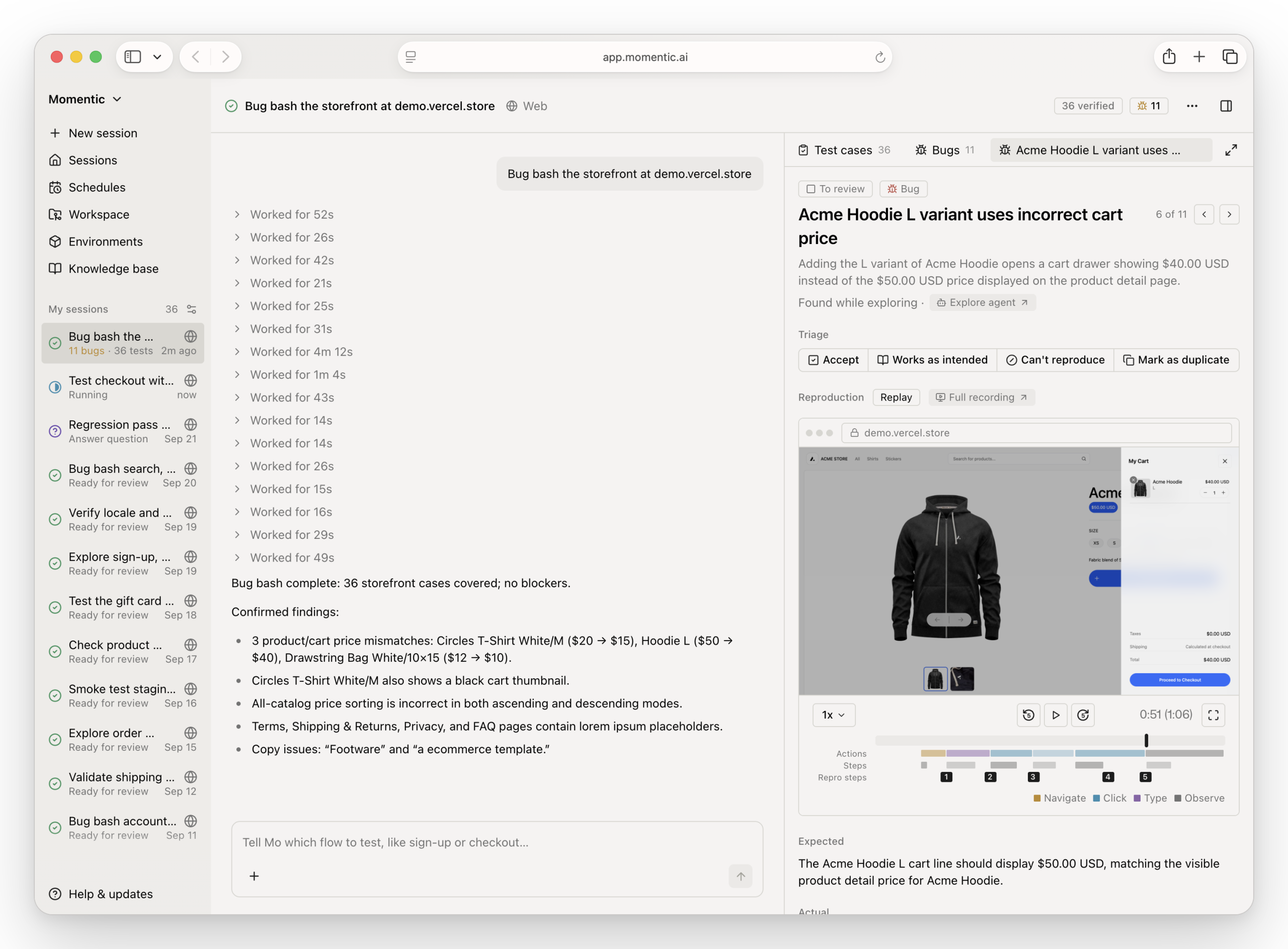
Mo looks like every other AI-coding tool developers use day to day, such as Claude Code. It has an agentic harness with a web interface and a chat box where a developer can enter what they need and a URL to get started. It also comes with a command-line interface for automating tasks.
Wu described talking to Mo succinctly: “Bug bash this app I just built. Here’s the URL. Here are some test credentials. Go ham.”
Once Mo takes the reins, it opens up the app, spins up a swarm of agents, and then goes through the motions. Aside from a prompt telling the agent what to test or the intent to test, it can take a product requirements document, Jira issue, Linear ticket or Confluence document when a feature needs more context.
Mo then uses the agentic swarm to attempt thousands of permutations and edge cases and records every interaction. When it completes, it gives the developer a blow-by-blow of what was tested, what failed, how to reproduce the bugs and video evidence of each one.
There is no script to write and no test suite to maintain. Of course, Wu added that if developers want to turn these into tests, the fact that they’re reproducible and fully described means that developers can turn them into the script of their choosing.
Momentic said its customers have been putting Mo through its paces over the past few weeks. This includes leading companies in the technology and service industry that use web and mobile apps such as Notion, Superpower, Iris, Committee for Children and Boundless.
“The scripts are not the end goal,” Wu said. “No one goes to work and is like, ‘Hey, I want to write 10,000 Momentic scripts or Playwright scripts or Selenium scripts.’ What they want is no bugs.”
Image: Momentic
Support our mission to keep content open and free by engaging with theCUBE community. Join theCUBE’s Alumni Trust Network, where technology leaders connect, share intelligence and create opportunities.
- 15M+ viewers of theCUBE videos , powering conversations across AI, cloud, cybersecurity and more
- 11.4k+ theCUBE alumni — Connect with more than 11,400 tech and business leaders shaping the future through a unique trusted-based network
Are you an AWS customer? Support SiliconANGLE financially by buying your AWS services from our Marketplace portal page and links: https://siliconangle.com/aws-marketplace/
About SiliconANGLE Media
theCUBE AIand theCUBE SuperStudios — with flagship locations in Silicon Valley and the New York Stock Exchange — SiliconANGLE Media operates at the intersection of media, technology and AI.
Founded by tech visionaries John Furrier and Dave Vellante, SiliconANGLE Media has built a dynamic ecosystem of industry-leading digital media brands that reach 15+ million elite tech professionals. Our new proprietary theCUBE AI Video Cloud is breaking ground in audience interaction, leveraging theCUBEai.com neural network to help technology companies make data-driven decisions and stay at the forefront of industry conversations.