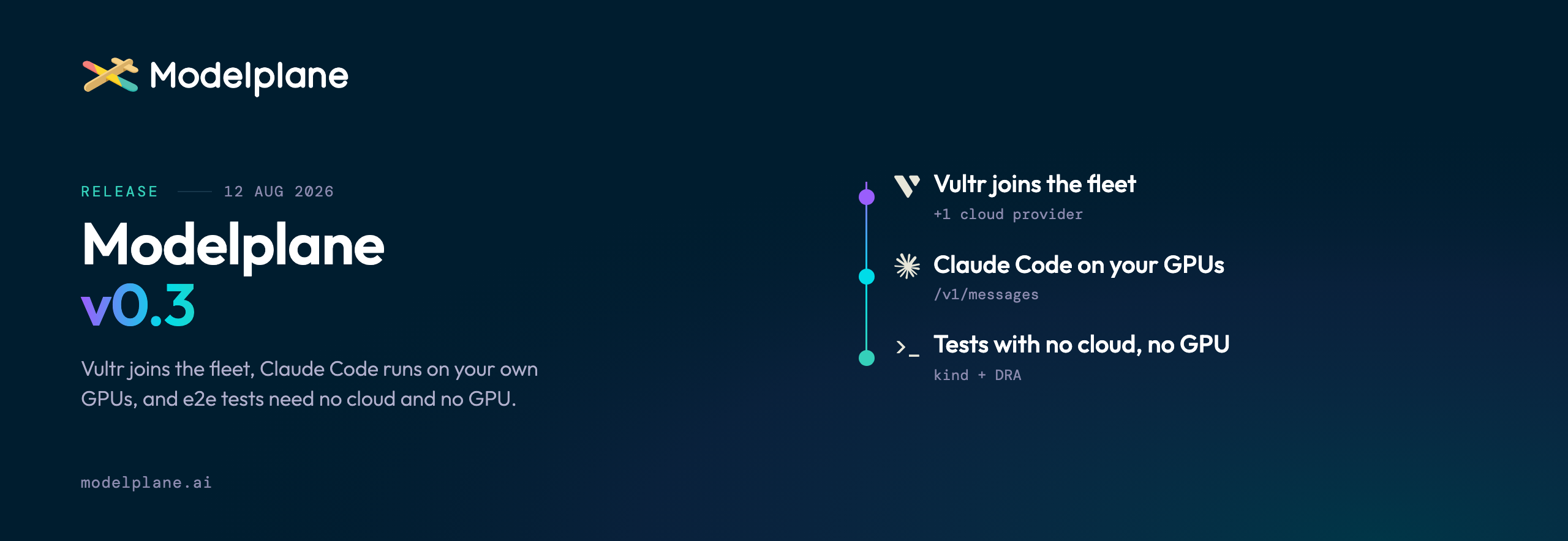
Modelplane v0.3 is out, our third release in the two months since we open sourced the project. Release by release, Modelplane is growing into its mission: bringing together the models, engines, clouds, and accelerators that make up the intelligence ecosystem so you can operate them as a single system under your control. And we are building it in the open.
This release adds Vultr as an inference cluster provider, serves the Anthropic Messages API end to end so tools like Claude Code can run against your own GPUs, improves multi-node scheduling, and ships three new model recipes. It also adds something for contributors: a local end-to-end test that exercises the whole system with no cloud account and no GPU. Here's what's new.
## Vultr joins the fleet[#](#vultr-joins-the-fleet)

[Vultr](https://www.vultr.com/) VKE is now an inference cluster provider,
alongside GKE, EKS, AKS, and Nebius. As with the others, Modelplane provisions the full cluster: VPC, control plane, system and GPU node pools and installs the inference stack on top:
A big thank you to the folks at Vultr, who worked with us on validating the integration and finding the right GPU plans. This is exactly the kind of collaboration we hope to repeat with other clouds, more on that below.
One control plane, many accounts# #
Until now, every InferenceCluster
authenticated through a single
ClusterProviderConfig
named default
, which quietly limited a fleet to one
AWS account, one GCP project, one Azure subscription per cloud. v0.3 lifts
that: every cluster type now takes a credentials
reference, so each
InferenceCluster
can name the ProviderConfig
or ClusterProviderConfig
it provisions through:
One control plane can now provision clusters across team accounts, projects, and
subscriptions, a production fleet in one account and experiments in another,
without running a second Modelplane. Omit credentials
and everything behaves
as before, using the ClusterProviderConfig
named default
.
Claude Code on your own GPUs# #
Modelplane now serves the Anthropic Messages API end to end. A vLLM server
registers /v1/messages
alongside its OpenAI routes, and Modelplane's routing
preserves the path below the /<namespace>/<service>/
prefix, so the same
ModelService
URL answers both /v1/chat/completions
and /v1/messages
:
Any client that speaks the Messages API works, including Claude Code: point
ANTHROPIC_BASE_URL
at the service address and map its model tiers onto the served model name:
The details that make this actually work, the tool-calling flags that let Claude Code's tool use function, and why you need to cap output tokens on a small model, are in the
[Anthropic Messages API recipe](https://docs.modelplane.ai/examples/anthropic-messages-api/).

## Multi-node scheduling improvements[#](#multi-node-scheduling-improvements)
Multi-node serving got two quality-of-life improvements. Modelplane now injects
MODELPLANE_RANK
into every pod of a multi-node gang, 0 on the leader,
1 through N on the workers, alongside the existing
MODELPLANE_LEADER_ADDRESS
, so a single worker template fans out to any number of nodes:
And labels and annotations on a member's pod template now propagate through the composed workloads to the pods themselves, which is what you need for cluster-level features like service mesh injection:
Malformed keys, and labels under the reserved modelplane.ai/
prefix, are rejected at admission rather than failing later on the workload cluster.
## Three new recipes[#](#three-new-recipes)

The [examples](https://docs.modelplane.ai/examples/) grew by three:
on a Nebius H100, the recipe behindNemotron-3.5-Lightningyesterday's day-zero post.Poolside's 118B code MoE (8B active) served FP8, tensor-parallel across a single 8x H100 node on Nebius.Laguna-S-2.1a 72B dense model from an AWQ INT4 quantization on a single 80 GB GPU per replica, with platform manifests for both an A100 on AKS and an H100 on Nebius. The ML side is the same manifest for both, and the recipe ends by using weighted routing to split traffic between the two GPUs and compare them.Qwen2.5-72B
Test Modelplane with no cloud and no GPU# #
v0.3 adds a local two-cluster end-to-end test that runs the full Modelplane
path, publish capacity, register a cluster, deploy a model, route a request
through the control-plane gateway, on two local kind
clusters. A fake DRA driver publishes GPUs that don't exist and a mock engine answers both the OpenAI and Anthropic APIs, so the real scheduling, allocation, and routing paths run with no cloud account and no GPU.
Alongside it, the Nix-based control plane setup is now complete, with failures
surfaced directly from nix run
. We're thrilled to see people starting to adopt Modelplane, and we want the first step to be as easy as possible: trying it out, validating a change, or building a contribution now takes an afternoon and a laptop with Docker, not a cloud bill.
Help us shape what's next# #
Modelplane now provisions inference clusters on five providers and runs on any
Kubernetes you bring. But the intelligence ecosystem is bigger than five
clouds, there's a long tail of clouds and neoclouds we haven't integrated yet,
and that's exactly where community contributions matter most. The provider
pattern is established: an InferenceClass
describes the hardware, an
InferenceCluster
provisions it, and the same nodePools
model applies everywhere. If your GPUs live somewhere Modelplane doesn't provision yet, upvote or open an issue or come talk to us about building the integration.
The same goes for testing. The local end-to-end setup means you can validate changes, chase bugs, and try Modelplane across multiple clusters without spending a cent on GPUs, so kicking the tires is now a real way to contribute. Run it, break it, and tell us what you find.
The full release notes are on
[GitHub](https://github.com/modelplaneai/modelplane/releases/tag/v0.3.0), the
[getting-started guide](https://docs.modelplane.ai/getting-started/) covers all
five providers, and questions and feedback are welcome in Slack.