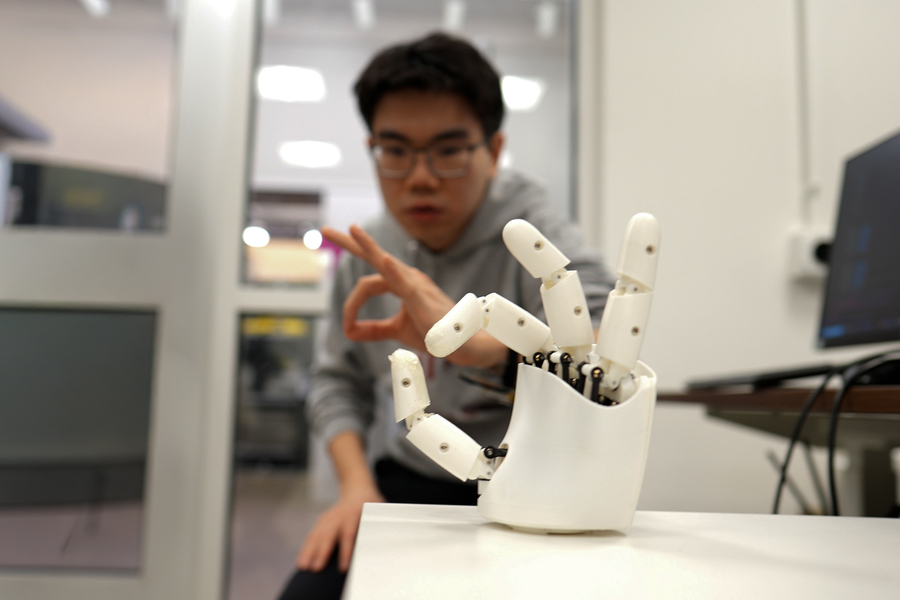
MIT engineers have developed an ultrasonic wristband that can track hand movements with precision. This innovation holds promise for virtual reality and robotics.
Our hands, with their intricate network of 34 muscles, 27 joints, and over 100 tendons and ligaments, are marvels of evolution. Yet, replicating their dexterity in machines has long been a robotics challenge. Enter MIT's latest breakthrough: an ultrasonic wristband designed to track hand movements in real-time.
Revolutionizing Hand Tracking #
The wristband works by capturing ultrasound images of the wrist's muscles and tendons. An AI algorithm then translates these images into specific hand and finger positions. In demonstration, this tech lets users control robotic hands, like a modern-day puppeteer manipulating a marionette.
Imagine wirelessly commanding a robot to play a piano tune or shoot hoops, all by gesturing. The implications are vast, from gaming to surgical robotics. It's not just about fun. it's about utility.
Not Just Another Gadget #
Current hand tracking methods, like camera systems and sensor gloves, have their drawbacks, complex setups and limited natural motion. MIT's solution sidesteps these issues, offering a wearable that's both intuitive and unobtrusive. And by amassing a diverse dataset of hand movements, this tech could soon rival or even replace existing systems.
But why should we care? Because this isn't merely about novelty. It's about revolutionizing how we interact with machines and digital environments.
Training Tomorrow's Dexterous Robots The potential applications stretch far beyond gaming. Picture humanoid robots deftly performing surgical tasks, all thanks to the data gathered from these wristbands. The court's reasoning hinges on accuracy, and this tech delivers just that.
With backing from organizations like the NIH and the Department of Defense, the development and future miniaturization of this wristband seem promising. The legal question is narrower than the headlines suggest, it's about transforming hand tracking from a cumbersome process to an everyday, wearable reality.
Here's what the ruling actually means: MIT is set on creating a universally adaptable hand tracker that could redefine interactions across sectors. The precedent here's important for future human-machine interactions.
Get AI news in your inbox
Daily digest of what matters in AI.