Back to writing We looked into 528,916 star edges, 228,177 distinct repositories, from 655 agent-swarm GitHub stargazers.
We looked into 528,916 star edges, 228,177 distinct repositories, from 655 agent-swarm GitHub stargazers. We filtered bot accounts, trigger easy stargazers, and those popular repos everyone likes, e.g. facebook/react
. What was left is a cohort of people building agent infrastructure and what they are quietly starting to pay attention to, before it becomes mainstream.
This are not "top starred repos", our scoring method is less about global popularity, and instead it filters them to a small, MIT-licensed, actively-attention-grabbing projects, grouped by who co-stars them.
Below the 25 repositories. Some with fewer than 200 stars. One created just two weeks ago.
The method, briefly #
After the GitHub star debacle, they become a GTM motion, raw co-star counts became useless on their own. Projects with 10,000 stars were artificially created in 24hrs. The noise became unbearable. We decided to look at it in a different direction, follow the stargazers we trust the most, ours. We computed a popularity-normalized lift, i.e. given how many repositories each of our stargazers has starred, and how popular a given repository is globally, what's the expected number of our accounts that would have starred it by chance? We compare that to the observed number, on a log scale, with a shrinkage term that discounts repositories with thin support.
We also weight recency (an exponential half-life), so a repository that got popular in this cohort a year ago and has gone quiet ranks lower than one accelerating right now.
Heuristic filters
First, we applied a filter on the stars they should have received from our stargazers:
(a) At least 8 of our stargazers starred it, and
(b) 5 of those in the last 90 days, and (c) At least half of the stars landed in that 90-day window. This last recency filter cut the pool from 2,471 to 342 (13.8%).
Second, a hard MIT-license gate. 340 candidates survived the non-license checks, and of those, only 179 carry an exact MIT license.
Third, a final editorial pass removed mirrors, templates, prompt/skill collections, awesome-lists, and anything whose value we couldn't verify, leaving the final 25.
Caveats
Before you read further, please consider the following:
(1) This is a cohort description, not a survey.
(2) Stars can mean use, intent, a bookmark, or curiosity. For us, curiosity is the minimum, and what we assume. This is what others are looking at.
(3) Among our 650+ stargazers, these 25 small, MIT-licensed projects had unusually high overlap, trending upwards in the last 90 days.
The 25 winners #
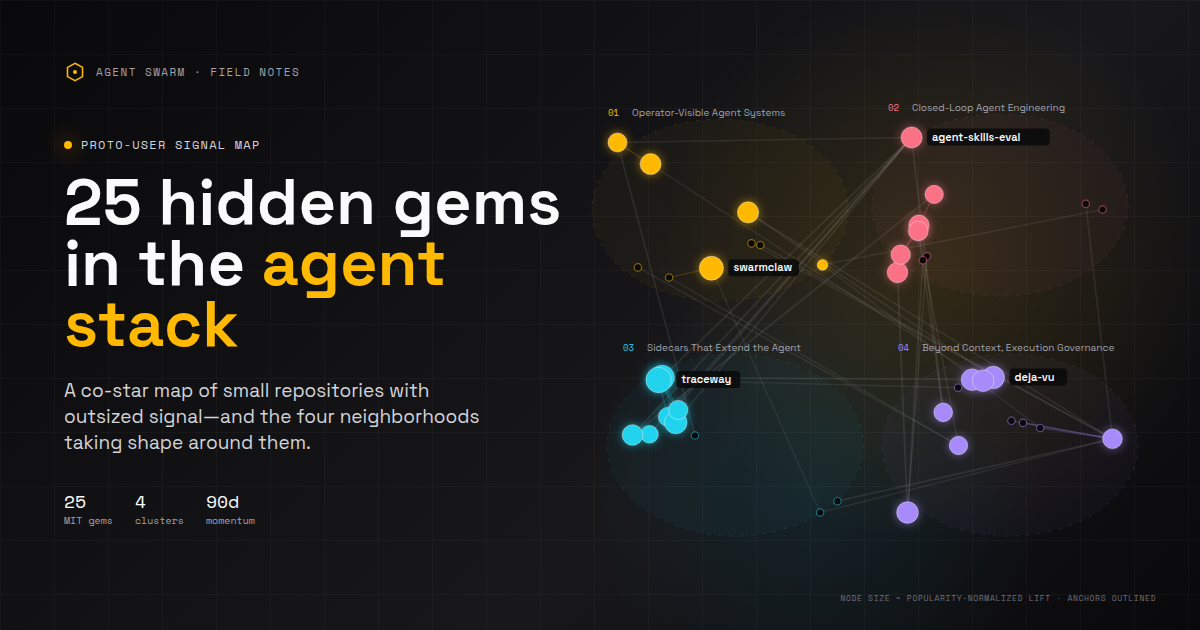
We grouped teh 25 repos into four arbitrary categories by co-starring pattern (a nearest-neighbors style partition). The clustering signal is real but not strong, so read these as suggested vicinities.
1. Operator-Visible Agent Systems
Exposing agentic work as a state a human can inspect, , or override.
— 629★. A self-hosted, multi-provider runtime for persistent agent teams with restart-safe branching, scheduling, and background jobs across several agent CLIs, not just one framework.swarmclawai/swarmclaw— 542★. A desktop kanban board that dispatches issues to coding-agent CLIs in isolated Git worktrees, streaming tool activity and pausing for decisions rather than running unattended.leodavinci1/kanbots— 1,305★. A Hermes-focused local memory stack that separates permanent instructions, sessions, trust-scored facts, and a generated wiki instead of dumping everything into one vector store.ClaudioDrews/memory-os— 800★. A local-first authorized-testing agent (Ollama model, Kali container) that keeps target data local and adds testing-specific phases, checkpoints, and failure-aware payload reuse on top of a generic shell agent.pikpikcu/airecon— 313★. A transparent stdio/HTTP proxy that records the actual MCP traffic between a client and its servers — replay, drift detection, and CI failures on malformed frames.kerlenton/mcpsnoop
2. Closed-Loop Agent Engineering
These projects treat "configure, run, observe, grade, ship" as the actual unit of work, and make that loop repeatable around whatever runtime you already use.
— 1,169★. One creation/execution UI spanning multiple managed and local agent backends, instead of a separate dashboard per runtime.LiteLLM-Labs/litellm-agent-control-plane— 594★. An experimental harness whose agent can modify and restart its own prompts, tools, memory, and policies — with a rewindable sandbox that keeps canonical conversations outside the part being changed.exoharness/exo— 185★. A local-first CLI/MCP server for publishing agent-generated static reports to Cloudflare Pages, tracking context so repeat publishes update one URL rather than sprawling.Amal-David/pagecast— 639★. Runs the same prompt with and without a given Agent Skill to estimate its incremental lift, with reusable artifacts and deterministic tool-call assertions.darkrishabh/agent-skills-eval— 945★. A local debugger that streams agent tokens, tool calls, and spans into a browser, and can replay a captured production trace against real agent code.raindrop-ai/workshop— 649★. A cross-provider CLI that tests whether Claude, Gemini, or Codex actually discover and use a skill under declared tasks and graders — CI mode included.mgechev/skillgrade
3. Sidecars That Extend the Agent
Small, attachable capabilities that add leverage without replacing the host agent. Think MCP, CLIs, plugins, deliberately narrow in scope.
— 144★. Encrypted peer messaging for independent coding agents across sessions or machines, without requiring a full orchestration suite.xhluca/agent-talk— 730★. A Claude Code plugin that captures sessions into a compact project-resume document using local TF-IDF/TextRank summarization — no extra model call.raiyanyahya/recall— 233★. A local Rust sidecar that builds a SQLite knowledge graph and returns ranked prompt context via weighted multi-hop relationships, not just vector similarity.zaydmulani09/mnemo— 557★. A browser video editor whose timeline is editable as JSON through UI, MCP, files, or REST — compact patch operations and revision-counter conflict rejection instead of silent overwrites. Created in early July; one person's project moving fast.ronak-create/FableCut— 198★. An experimental MCP server giving agents access to Ableton Live's Python object model, including an audio-tap loop for capture-analyze-adjust cycles.bschoepke/ableton-live-mcp— 1,048★. An OpenTelemetry-native platform unifying logs, traces, metrics, and AI telemetry under one trace ID, with an agent-oriented CLI exposing stable JSON and exit codes. Highest cohort penetration on this list (27 of our 655 accounts).tracewayapp/traceway— 237★. A local ops dashboard built from Claude Code/Codex session files and hooks — live context fill, usage estimates, and phone-based allow/deny for pending commands.nikitadoudikov/claude-pulse
4. Beyond Context, Execution Governance
Execution needs structured context about state, permissions, provenance, and prior work. A bigger context window alone can't give you that.
— 578★. A Kubernetes-native coordination layer that represents agents, policies, and executions as cluster resources, putting RBAC and sandboxing in the control plane itself.sympozium-ai/sympozium— 590★. A TypeScript library for embeddable agent harnesses — sessions, tools, middleware, virtual filesystems — with compaction and resumable subagents as opt-in pieces, not a monolith.MaxGfeller/open-harness— 495★. A local index/MCP recall layer over coding-agent session histories already on disk, retroactively indexing across several harnesses. Created July 14, 2026 — two weeks before we ran this analysis, and already at 14 of our 655 accounts.vshulcz/deja-vu— 1,023★. A branchable graph database for shared agent state where agents mutate isolated branches and submit graph-wide changes for review, combining graph traversal, vector, and full-text search.ModernRelay/omnigraph— 608★. A deterministic, byte-stable code-signature map generated without an LLM or vector database — diffable, and able to gate fabricated files/symbols/tests in CI.manojmallick/sigmap— 868★. A self-hosted API running coding agents inside per-app Docker containers with live preview URLs, credential proxying, and checkpoint/revert.tastyeffectco/sandboxd— 949★. A local visualization replaying coding-agent sessions over a deterministic 3D map of the repository, making scope and churn spatially visible instead of just chronological.cosmtrek/mindwalk
Conclusion: never outsource the thinking #
Two things we noticed.
The trend for observability and composability over ease-of-use keeps accelerating. Examples like kanban board that shows agent work as inspectable state, a proxy that lets you see the actual MCP frames instead of trusting a black box, sidecars that bolt one capability onto whatever agent you already run, execution substrates that carry provenance and permissions as first-class data rather than prompt text.
Several of these repos — deja-vu
, FableCut
, mindwalk
— are weeks old and already have a meaningful slice of this cohort's attention. That's consistent with the idea of a fractured stack, assembled in public by individuals and small teams, without converging to a handful of big players.
Related field notes #
[All posts](https://www.agent-swarm.dev/blog)

[July 8, 2026 / 8 min read](https://www.agent-swarm.dev/blog/code-mode-token-savings)
26 Tool Calls, One Script, $0.02: Measuring “Code Mode” in Production
Our session rubric already tells agents: past ten items, write a script instead of N tool calls. We measured what that's worth on one production job, and where the savings stop.
Right-sizing Your Agent Swarm: What Container CPU and RAM Graphs Are Really Telling You
A straight-line CPU climb and a coder worker stuck near 1.1 GB looked like production problems. They were metric interpretation traps. Here are the sizing numbers we actually run.
We Hid 75 of Our Agent's 90 MCP Tools — And It Got Smarter
Why tool inflation breaks agent accuracy and how we implemented core/deferred tool caching to fix it.