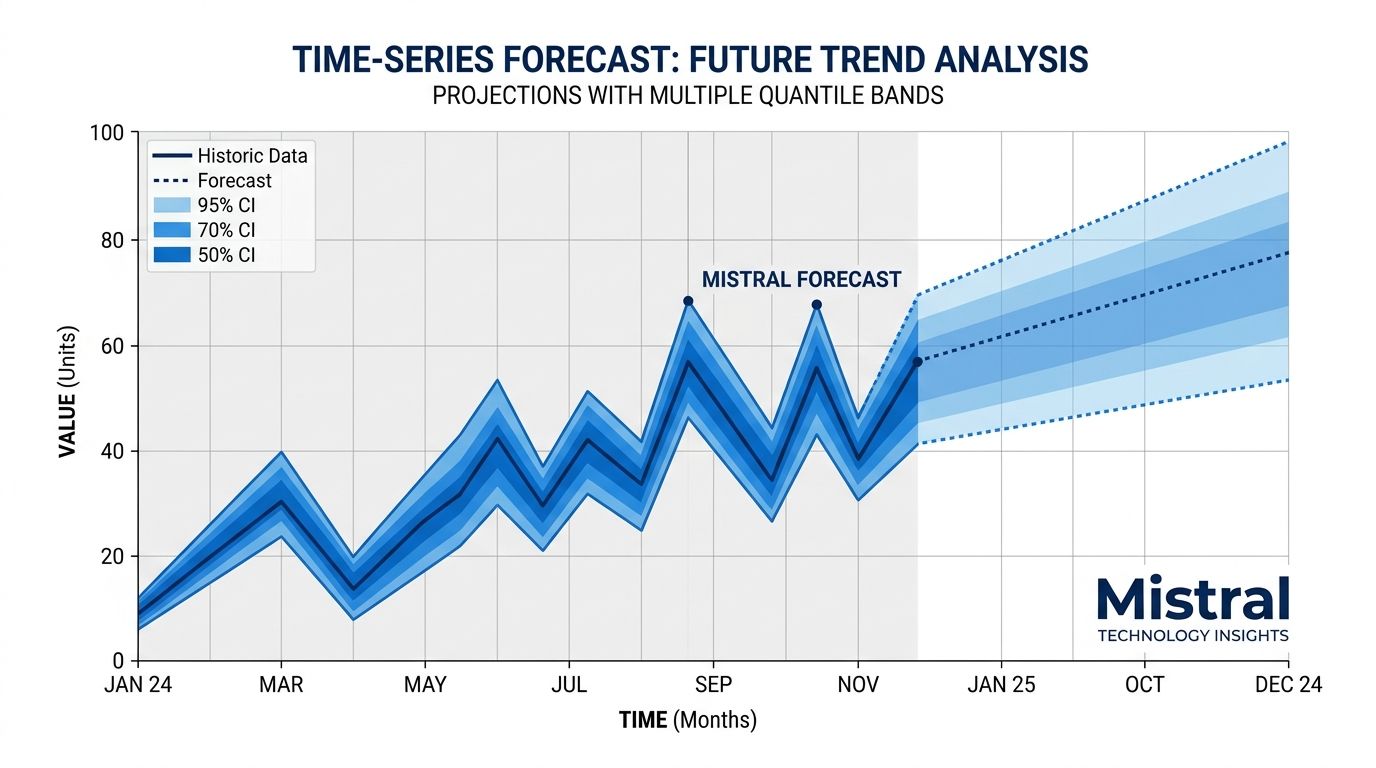
Mistral released Timestral on October 15 — not another chat model, not a reasoning LLM. A family of four time-series foundation models (5M to 209M parameters) that read sequences of numbers over time and return probabilistic forecasts. The 209M variant claims first place on all three major forecasting benchmarks, beating Google’s TimesFM-3 and Amazon’s Chronos-2 using fewer parameters. More practically: the entire family runs on a standard CPU, no GPU required, in under 140 milliseconds.
No GPU Required — That’s the Real Story #
The infrastructure angle matters more than the benchmarks. Developers running ops monitoring, IoT telemetry, or demand forecasting don’t want to spin up accelerator instances for auxiliary workloads. Timestral runs on an ordinary 8-thread server CPU: 10ms inference for the 5M model and 140ms for the 209M — measured against a one-day-ahead forecast from three weeks of 15-minute history. That latency profile fits inside existing monitoring pipelines without any GPU budget.
For teams running Timestral alongside Mistral’s language models in agentic workflows — Mistral’s explicit use case is flagging a pump anomaly and then triggering an LLM for root cause analysis — the CPU inference means the forecasting step doesn’t become the infrastructure bottleneck. The weights are downloadable from [Hugging Face](https://huggingface.co/mistralai/Timestral-209M), and the model supports on-premises, VPC, and air-gapped deployments out of the box.

**Related:** [Mistral Large 4: The Only 1T Open-Weight Model — Oct 31](https://byteiota.com/mistral-large-4-open-weights/)
What the Benchmarks Say (and What They Don’t) #
According to Mistral’s release, the 209M model ranks first among zero-shot pre-trained baselines on GIFT-Eval (83 entries), TIME (35 entries), and fev-bench (37 entries). The efficiency story is even more striking at smaller sizes: the 28M variant outperforms Chronos-2 despite being roughly four times smaller by parameter count. Chronos-2, Amazon’s open-weight forecaster at around 112M parameters, carries Apache 2.0 licensing — and Timestral still beats it at a quarter of the weight.
However, these results come with an important caveat. Mistral submitted results to the GIFT-Eval and TIME leaderboards rather than having them independently validated prior to release. The benchmarks used a single checkpoint with no ensembling. Independent confirmation is still pending. That doesn’t make the results wrong — it makes them unverified claims on a fresh release. The fair test is to backtest on a month of your own historical data before committing to a production migration.
The License Fine Print: “Modified MIT” Is Doing Heavy Lifting #
The code repository on GitHub is Apache 2.0. The model weights on Hugging Face are not. They ship under a “Modified MIT” license with one substantial modification: if your company’s global consolidated monthly revenue exceeded $20M in the preceding month, you’re not authorized to use the weights without a commercial license. That restriction applies to your employer’s revenue, not your team’s budget — a developer at a large company is technically out of compliance even if their individual project is tiny.
The business logic is straightforward: the enterprises most likely to want air-gapped forecasting at scale tend to be the ones above $20M per month. For them, Mistral wants a commercial conversation, not a free download. For developers at smaller companies or independent use cases, the weights are free. Check the full license text on Hugging Face before building production systems. Companies near the threshold should also note the license measures monthly revenue — volatility can flip compliance status month to month.
What Timestral Does #
All four model sizes share the same architecture and training. Each produces probabilistic forecasts across 21 quantile levels per time step — not a single point prediction but a distribution, which is what ops and inventory decisions actually require. The architecture uses Decoupled Horizon Forecasting (DHF), which separates masking targets from context preservation so forecast tokens see the full historical sequence. In practice, that means richer context versus models that mask prediction targets directly.
External covariates are natively supported: past-only signals (historical weather, past promotions) and known-future signals (scheduled maintenance windows, upcoming holidays) can be incorporated without data leakage. The context window handles up to 32,768 time steps. Fine-tuning on proprietary domain data runs through Mistral Forge. Use cases include ops monitoring anomaly detection, predictive maintenance on industrial sensors, demand and supply chain forecasting, and energy load forecasting with weather as a covariate.
Key Takeaways #
- Timestral is Mistral’s first time-series forecasting model family — 5M to 209M parameters — capable of running on a standard CPU in 10–140ms with no GPU required
- The 28M model claims to beat Amazon’s Chronos-2 (4x larger) on two benchmarks; the 209M claims to beat Google’s TimesFM-3 — results are self-reported and pending independent leaderboard confirmation
- The “Modified MIT” license restricts companies with over $20M monthly global revenue; the code is Apache 2.0 but the model weights are not — verify compliance before deploying
- Downloadable weights support on-prem, VPC, and air-gapped deployments — a real alternative for regulated industries that cannot send data to third-party APIs
- The 21-quantile probabilistic output and native covariate support (past-only and known-future) make it practical for ops monitoring, IoT predictive maintenance, and demand forecasting