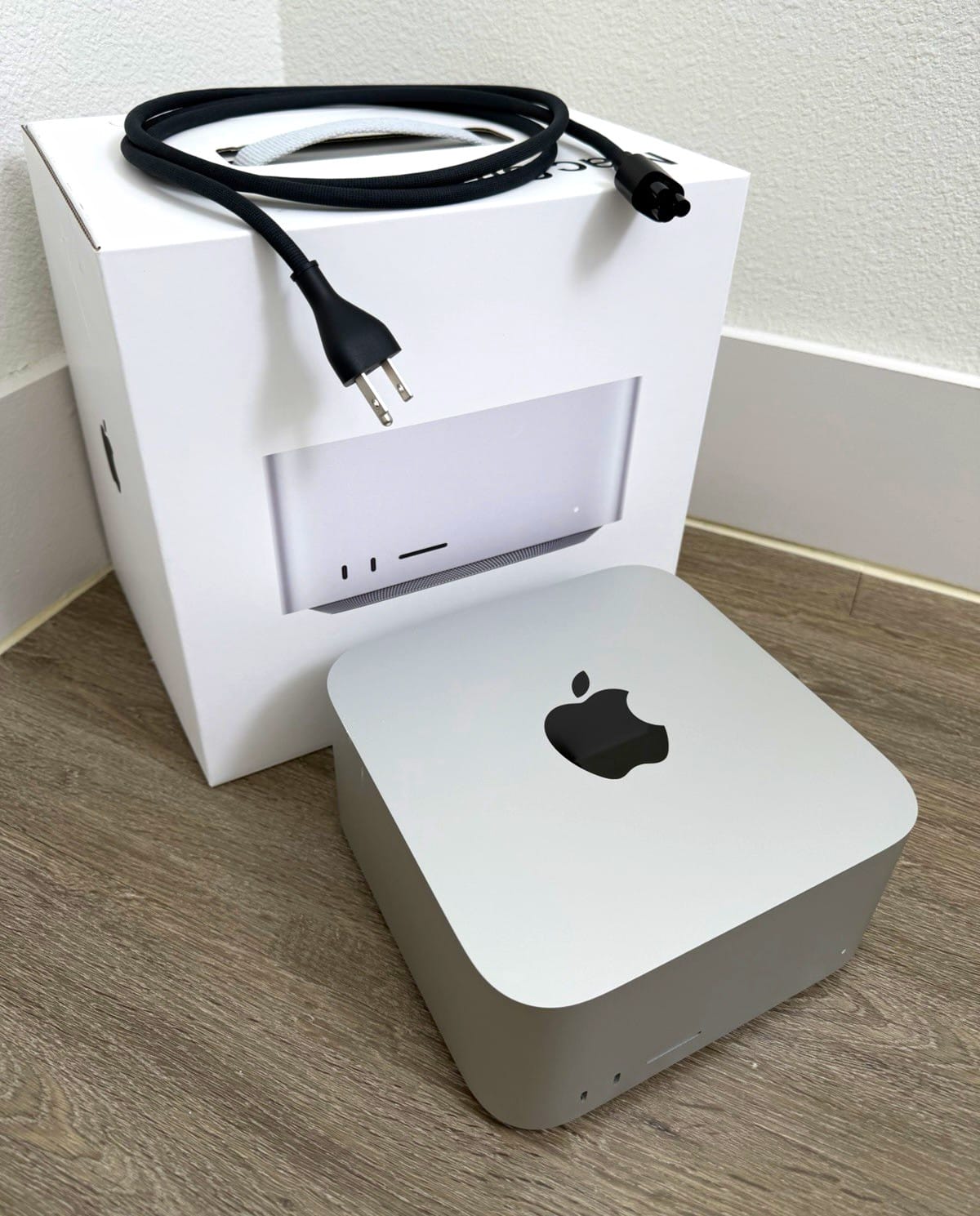
Mistral released the weights of Mistral Large 4 on 29 October 2026, three weeks after an API preview, and the Hacker News thread on the release passed 1,700 points. It is a natively multimodal mixture-of-experts model with about 1 trillion parameters, trained from scratch in Mistral's own data centres in Europe, and the most capable model Mistral has published. For a local runner the headline is blunter: the 4-bit file is 635GB, and the smallest machine you can put on a desk that runs it is a 512GB Mac Studio at 2-bit, where Hugging Face measured about 15 tokens per second. Here is what Mistral claims, what its technical report reveals about the architecture, what the licence allows, and who should download it.
What Mistral says #
The model card describes about 1 trillion total parameters with 49 billion active per token, or 52 billion counting the embedding and output layers. The routing is unusual for this size: 128 routed experts with only 4 chosen per token, plus one shared expert, so each expert is large. It reads text and images, has a 1M-token context, and offers three reasoning efforts (low, medium and the default high). Reasoning cannot be switched off. The checkpoint ships in FP8 (the full repository is about 1.06TB) with an embedded speculative-decoding draft head called DSpark, which Mistral says gives up to 1.9 times higher throughput in vLLM. There is no base model, and a Mistral engineer said in the model's discussions that one is not planned.
The benchmark claims, from the card and the release post: 48% on the Artificial Analysis Coding Agent Index, which Mistral calls "effectively tied" with GLM-5.3 while using 47% fewer tokens per task; a score of 26 on the Artificial Analysis Intelligence Index v5, which the card calls "the highest among western open-weight models" while conceding that leading Chinese open models score higher; and 41% on Terminal-Bench 4.0. Mistral's strongest pitch is security: a 96.6% average safe-response rate on malicious cyber requests and 97.1% attack resistance on the B3 agent security benchmark.
One of those numbers deserves a footnote. A model discussion points out that the 41% Terminal-Bench figure comes from Artificial Analysis running the model inside Mistral's own Vibe coding agent. On the same 66 tasks in the neutral mini-swe-agent harness, Artificial Analysis recorded 24.7%. A 16.7-point gain from the harness alone is large; the same comparison for Grok 4.7 showed 7.5 points. The model is not worse than its card says, but its best numbers depend on Mistral's tooling.
What the technical report reveals #
The technical report contains the most interesting finding for anyone who cares about memory. Mistral first built Large 4 to have a tiny KV cache: three of every four layers used sliding-window attention over 512 tokens, full-attention layers shared caches with their neighbours, and the second half of the network reused the first half's cache using the YOCO design (Sun et al., 2024). Together, the report says, these cut the KV cache "by a factor of 16 compared to a full-attention baseline", and early tests showed little loss on perplexity and knowledge benchmarks.
Then the agent results came in. After fine-tuning intermediate checkpoints, Mistral found the model underperformed "on agentic evaluations, especially those that require long-context reasoning like SWE-bench and BrowseComp", and that SWE-bench scores fell as the architecture moved from full attention to sliding windows and fell further with cache sharing. So mid-training, Mistral performed what it calls model surgery: it removed the sliding windows and most of the cache sharing from an existing checkpoint, kept YOCO reuse in the second half of the network because removing it hurt at full scale, and then converted the model to DeepSeek Sparse Attention, the same mechanism behind Hy4, first described in the DeepSeek-V3.2 report (arXiv:2512.02556). In the shipped config, every one of the 72 layers uses that indexed sparse attention, selecting 2,048 positions per query, on top of compressed latent keys and values.
That is a useful data point for local hardware. Aggressive cache compression is what makes long context cheap on a home machine (Kolibri leans on it), and a frontier lab has now published evidence that it costs agentic quality at this scale. Mistral chose quality. The KV cache explainer covers the trade-off.
The licence: open for you, not for model hosts #
The weights ship under the Mistral Ecosystem Open-Weight License, which the licence file calls "a modified version of the MIT license". Use, modification, fine-tuning and commercial use are permitted, with one exception: a company that operates a "Model as a Service" business needs a separate commercial licence before using it commercially. The licence defines that as giving third parties access to the model for inference or post-training with "meaningful control over the inputs, parameters, or training data", and says the restriction does not apply to internal use. For someone running it on their own machine, it is effectively MIT. For an inference provider, it is not. Several Hacker News commenters objected to calling that "open weight"; our licence map covers where it sits. One oddity: the specification box on Mistral's release post lists Apache 2.0, which contradicts the licence file. The file is what governs.
The files #
llama.cpp supported Large 4 on release, with official GGUFs from ggml-org and dynamic quants from Unsloth:
| File | Size | Fits |
|---|---|---|
| BF16 (upcast) | 2.10TB | Data centre only |
| Q8_0 | 1.12TB | 1.2TB+ of memory |
| Q4_K_M | 635GB | 8× RTX Pro 6000 (768GB) or a multi-machine cluster |
| Official NVFP4 | 606GB | Four GB300 GPUs, per Mistral |
| Q2_K | 381GB | 512GB unified memory |
| IQ2_XXS | 298GB | 512GB unified memory |
| Unsloth UD-IQ1_S | 233GB | 256GB, per Unsloth |
The ggml-org IQ2_XXS build keeps attention, the sparse-attention indexer, the shared experts and the output head at 8-bit and squeezes only the routed experts to about 2 bits, which is why it is usable at all. A vision projector of 3.4GB is separate.
What runs it, and how fast #
Hugging Face's launch blog published the only measured numbers we found:
| Setup | Build | Prompt | Generation |
|---|---|---|---|
| One Mac Studio M3 Ultra (512GB) | Q2_K, llama.cpp | About 90 tok/s | About 15 tok/s |
| 4× RTX Pro 6000 (384GB) | IQ2_XXS, llama.cpp | 500 tok/s short, 129 at long context | 30 tok/s short, 3 tok/s at long context |
| 4× RTX Pro 6000 | NVFP4, llama.cpp, 32K | 130–590 tok/s | About 10 tok/s |
| 8× H200 | FP8, vLLM with DSpark | About 4,300 tok/s across four prompts | 65 tok/s, up to 138 when drafts are accepted |
The arithmetic explains why the Mac is slow even when it fits. With 52 billion active parameters at roughly 3 bits per weight, each generated token reads about 20GB from memory. That is about 2.5 times what a 20B-active model like DeepSeek V4 Flash reads per token, and the reason Large 4 feels heavier than its total size alone suggests (see the MoE explainer). Prompt processing at 90 tok/s also means a 20,000-token agent context takes almost four minutes to read on the M3 Ultra, and the default high reasoning effort then spends thousands of tokens thinking.
The tiers, then:
- 512GB Mac Studio. The only single desk machine. The M3 Ultra runs Q2_K at about 15 tok/s per Hugging Face; the new M5 Ultra 512GB is only now reaching buyers and has no published Large 4 numbers yet. Seewhat to pre-download for a 512GB Mac Studio .
- 256GB Mac. Only the 1-bit 233GB build fits, with little room for context. We would not recommend it.
- Four to eight RTX Pro 6000s. Four cards run 2-bit fast at short context and collapse to 3 tok/s at long context; eight (768GB) hold Q4_K_M. That is the class of machine in ourDGX Station vs 8× RTX Pro 6000 piece, and the multi-GPU trade-offs are inlayer split vs tensor parallel .
- Anything smaller. Use the API, or a smaller model.
The buy-versus-API sum is lopsided. Mistral cut API prices at the weights release, to $0.70 per million input tokens and $2.10 per million output, according to a Hacker News commenter who tracked both price lists. A used 512GB M3 Ultra Mac Studio was listed on eBay at about $21,500 when we checked. At $2.10 per million output tokens, that buys roughly 10 billion output tokens of API use, which at 15 tok/s is more than 20 years of continuous local generation. The API also serves the full-precision model, with the speculative head and faster prefill. Run your own numbers in the cost calculator.
What owners report #
Practical friction showed up quickly. A user serving it through vLLM and LiteLLM to Claude Code reported that every session failed because the chat template rejects a tool message following a user message, an ordering the Anthropic format produces. A Mistral engineer said the template enforces the order the model was trained on and will not be relaxed for this release, and suggested Mistral's Vibe agent or a proxy that normalises the messages. If you plan to run it under a third-party coding harness, test that first. On the engineering side, one team reported porting the model to its own CUDA engine and running it on a single 32GB consumer card by streaming the 9,088 routed experts from host memory, a reminder that "fits" and "runs fast" are different questions.
The Hacker News reaction was split along predictable lines. Supporters pointed to the price cut and to organisations that cannot use Chinese models; one commenter with a four-H200 server (540GB) said that rules out anything Chinese for them and asked whether 3- or 4-bit serving was feasible. Critics pointed out that it trails DeepSeek V4.1 Flash on Artificial Analysis with about twice the parameters, and one wished for a smaller "flash variant" of 120B to 200B to compete with Qwen3.8-Flash-Next, their favourite local model.
Verdict: worth down? #
For almost everyone reading this, no. Mistral Large 4 is a serious European frontier model with a licence that is effectively MIT for private use, a published report with real architectural lessons, and day-one llama.cpp support. But at 52 billion active parameters it is heavier per token than most models of its class, the only desk-sized machine that fits it runs a 2-bit build at about 15 tokens per second, and the API now costs $2.10 per million output tokens. Download it if you already own a 512GB Mac Studio or an eight-card server and need the weights on your own hardware for data-residency or supplier reasons; otherwise use the API, or run GLM-5.3-Flash or DeepSeek V4 Flash locally. The model we would most like to see from Mistral next is the smaller variant Hacker News asked for.
Sources and how we researched this #
Creator documents: the Mistral Large 4 model card, technical report, licence and release post. Research: Sun et al., You Only Cache Once: Decoder-Decoder Architectures for Language Models (2024); DeepSeek-AI, DeepSeek-V3.2 (2025) for DeepSeek Sparse Attention. Files and measurements: ggml-org GGUF, Unsloth GGUF, Hugging Face's launch blog. Community: the model's Hugging Face discussions and the Hacker News thread on the weights release. The per-token memory read and the buy-versus-API sum are our arithmetic; the Mac price is one eBay listing at the time of writing. We have not run the model; the site is non-commercial.
Related: What hardware runs Kimi K3 · GLM-5.3-Flash: what runs it · M5 Max vs M5 Ultra