Microsoft’s first cybersecurity model powers new Project Perception agents
Microsoft Corp. today introduced its first in-house cybersecurity model, MAI-Cyber-1-Flash, and a companion agentic system called Project Perception that fields teams of artificial intelligence agents to probe for weaknesses, investigate threats and remediate them, starting with software vulnerability management.
The model is a compact, code-tuned derivative of Microsoft’s MAI-Thinking-1 line, trained in-house on the company’s own exploit and remediation records. Microsoft said it carries roughly 90% of the workload inside MDASH, the multi-model agentic scanning harness Microsoft detailed in May, and route the hardest 10% to OpenAI Group PBC’s GPT-5.4. Microsoft said that split cuts the cost of running the harness by about half.
On the public CyberGym benchmark, which covers 1,507 vulnerability reproduction tasks, MDASH running on MAI-Cyber-1-Flash scored 95.95%, according to Microsoft. The company put Anthropic PBC’s Mythos at about 84% on the same test. MDASH scored 88.45% when Microsoft disclosed the harness.
That earlier version found 16 previously unknown flaws in Windows networking and authentication components, four of them critical remote code execution bugs, all fixed in May’s Patch Tuesday release.
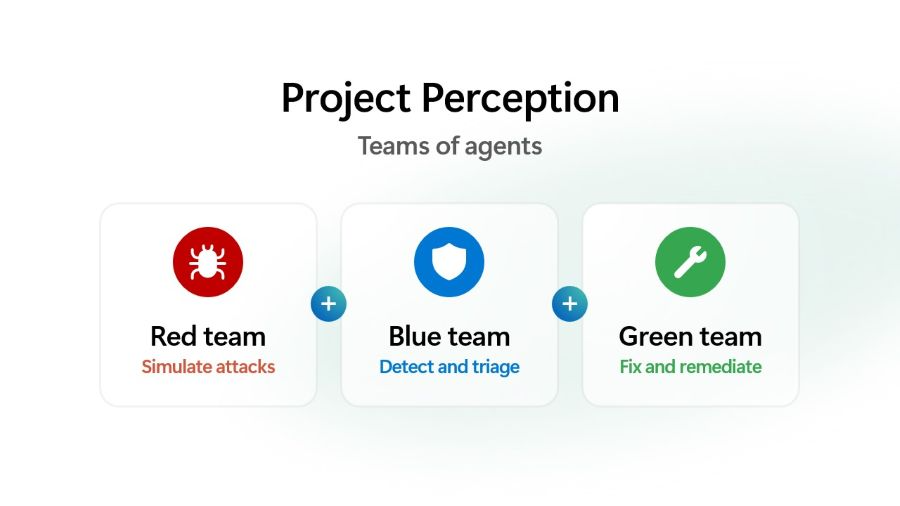
Perception divides its agents into three groups. Red agents probe for weaknesses the way an attacker would, blue agents investigate signals and rank what actually matters and green agents write and deploy fixes. High-impact actions still require human sign-off. Microsoft is pricing the system on consumption, metered in what it calls Security Compute Units.
“Project Perception brings together signals, context, models and specialized agents into a continuously learning system of defense,” Hayete Gallot, executive vice president of Microsoft Security, wrote in the company’s announcement. “It can reason, prioritize and act at machine speed while keeping humans firmly in control.”
Chief Executive Satya Nadella said that when combined with MDASH, the model “delivers world-class performance at 50 percent of the cost of leading models.”
Microsoft is not first out of the gate. Anthropic previewed Mythos in April, Google LLC launched Gemini 3.5 Flash Cyber last week and Cisco Systems Inc. has pushed a security model of its own.
“We’re not going to let the attackers have all the productivity increase,” David Weston, Microsoft’s corporate vice president of enterprise and OS security, told Axios, adding that the company still has to “earn the right” to grant its agents more autonomy.
Perception enters public preview on Aug. 3, initially inside Microsoft Defender. The company said it will extend the system across its wider security portfolio over time. MAI-Cyber-1-Flash becomes available through Azure AI Foundry on the same date, subject to Microsoft’s existing customer vetting process.
Image: Microsoft
Support our mission to keep content open and free by engaging with theCUBE community. Join theCUBE’s Alumni Trust Network, where technology leaders connect, share intelligence and create opportunities.
15M+ viewers of theCUBE videos, powering conversations across AI, cloud, cybersecurity and more** 11.4k+ theCUBE alumni**— Connect with more than 11,400 tech and business leaders shaping the future through a unique trusted-based network.
About SiliconANGLE Media
theCUBE AIand theCUBE SuperStudios — with flagship locations in Silicon Valley and the New York Stock Exchange — SiliconANGLE Media operates at the intersection of media, technology and AI.
Founded by tech visionaries John Furrier and Dave Vellante, SiliconANGLE Media has built a dynamic ecosystem of industry-leading digital media brands that reach 15+ million elite tech professionals. Our new proprietary theCUBE AI Video Cloud is breaking ground in audience interaction, leveraging theCUBEai.com neural network to help technology companies make data-driven decisions and stay at the forefront of industry conversations.