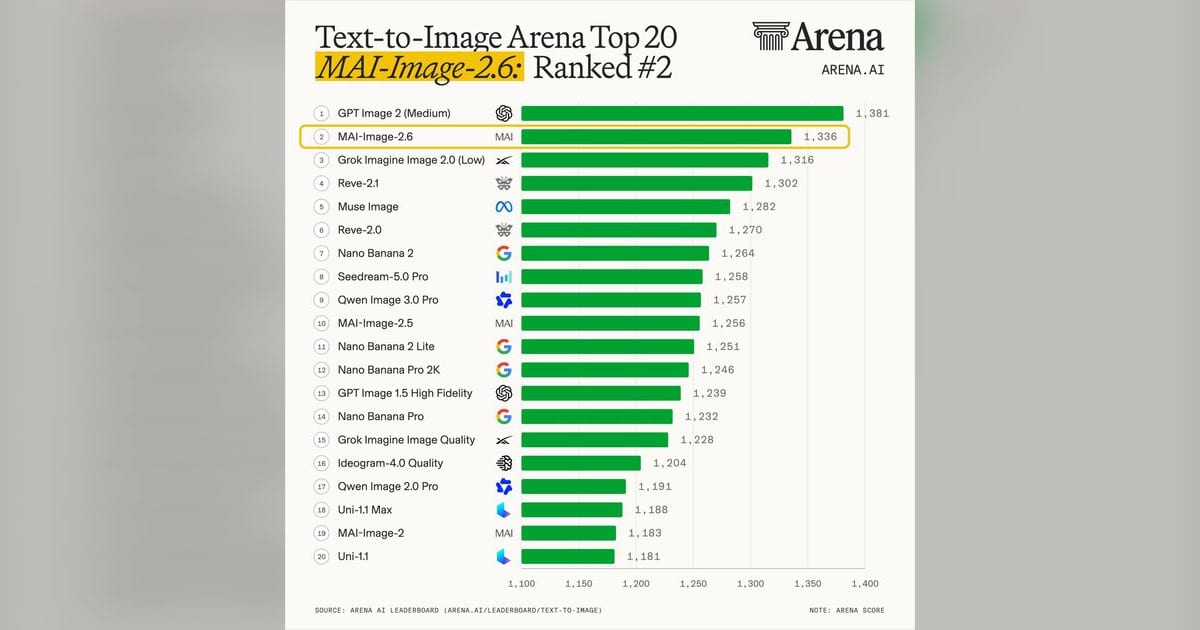
Microsoft AI, the lab led by Mustafa Suleyman, placed its new MAI-Image-2.6 model second in Arena's text-to-image ranking on August 10th, the strongest public evidence yet that Microsoft's in-house model program is closing the quality gap with OpenAI.
MAI-Image-2.6 scored 1,336 points, according to Arena, 45 points behind GPT Image 2 Medium in first place. Microsoft's model finished 20 points ahead of Grok Imagine Image 2.0 Low, which ranked third in Arena's snapshot.
The result marks a sharp generational gain. MAI-Image-2.5 ranked 10th in the same snapshot, while version 2.6 moved to second. Arena also placed the new model first for 3D imaging and modeling, up from sixth for its predecessor. It rose from eighth to second in cartoon, anime and fantasy; seventh to second in product, branding and commercial design; eighth to second in text rendering; and fourth to second in art.
Those category results matter because they point to improvements across commercial design tasks, rather than a narrow gain driven by one visual style. Product imagery and reliable text generation are especially important for advertising, presentation software and other production workflows where malformed labels or inconsistent objects can make an otherwise convincing image unusable.
Suleyman's rapid iteration strategy
The Arena result extends a fast release cycle under Suleyman, the DeepMind and Inflection co-founder who joined Microsoft in 2024 to form and lead Microsoft AI.
Microsoft introduced MAI-Image-2 in March 2026, followed by MAI-Image-2.5 in June. The company said the latter was built for image generation and controlled editing, including localized changes, text replacement and preserving faces across edits. Microsoft subsequently made MAI-Image-2.5 the default model for Bing Image Creator and deployed it in PowerPoint and OneDrive, according to a July 23rd product update.
That product footprint gives each quality improvement unusually direct distribution. Microsoft can move an in-house image model into consumer and workplace applications without waiting for a third-party provider to adjust its pricing, release schedule or product priorities.
Suleyman has described this model-building effort as a push for long-term self-sufficiency. In a June 2nd account of Microsoft's MAI program, he said the lab was training models from scratch and building its own data, training and evaluation systems. Microsoft has continued working with OpenAI, but the MAI program gives it another source of models for products that previously relied heavily on its partner's technology.
MAI-Image-2.6's 45-point deficit to GPT Image 2 shows that OpenAI retained the lead in Arena's August 10th ranking. Microsoft's eight-place jump also indicates that the gap can move materially between successive model versions.
What the ranking measures
Arena's text-to-image leaderboard is based on users comparing two anonymous image generators responding to the same prompt and voting for the result they prefer. Arena converts those pairwise choices into model scores using a Bradley-Terry ranking system and reports confidence intervals and rank spreads to represent statistical uncertainty.
That makes the leaderboard a measure of human preference across prompts submitted to Arena, rather than a controlled test of every production requirement. A high position does not establish a model's latency, operating cost, safety performance, reliability at scale or availability through an API.
Rankings can also shift as more votes arrive and competing models enter the pool. Arena's July 10th leaderboard snapshot, for example, placed MAI-Image-2.5 sixth overall with 1,257 points. By the August 10th post announcing version 2.6, Arena identified the older Microsoft model as 10th. The movement is a reminder that the precise rank is a live market signal, not a permanent technical verdict.
Still, MAI-Image-2.6's debut changes the competitive position of Microsoft's image program. Four months after MAI-Image-2 entered Arena outside the top tier, Microsoft has produced a successor that users ranked behind only OpenAI's leading configuration. The next test is whether Microsoft can carry that preference advantage into its products while matching the cost and speed requirements that determine which model developers and product teams actually deploy.