Get the best of each week in your inbox, free → Microsoft is patenting a mode for PowerPoint that would let an AI take over the entire presentation itself, narrating each slide, advancing them at the right moment, and answering audience questions in real time, with no human at the podium required.
What Microsoft's auto-presenting AI actually does in PowerPoint #
Ever hit 'record' on a presentation and completely frozen up? Microsoft's patent describes a mode that removes you from that equation entirely.
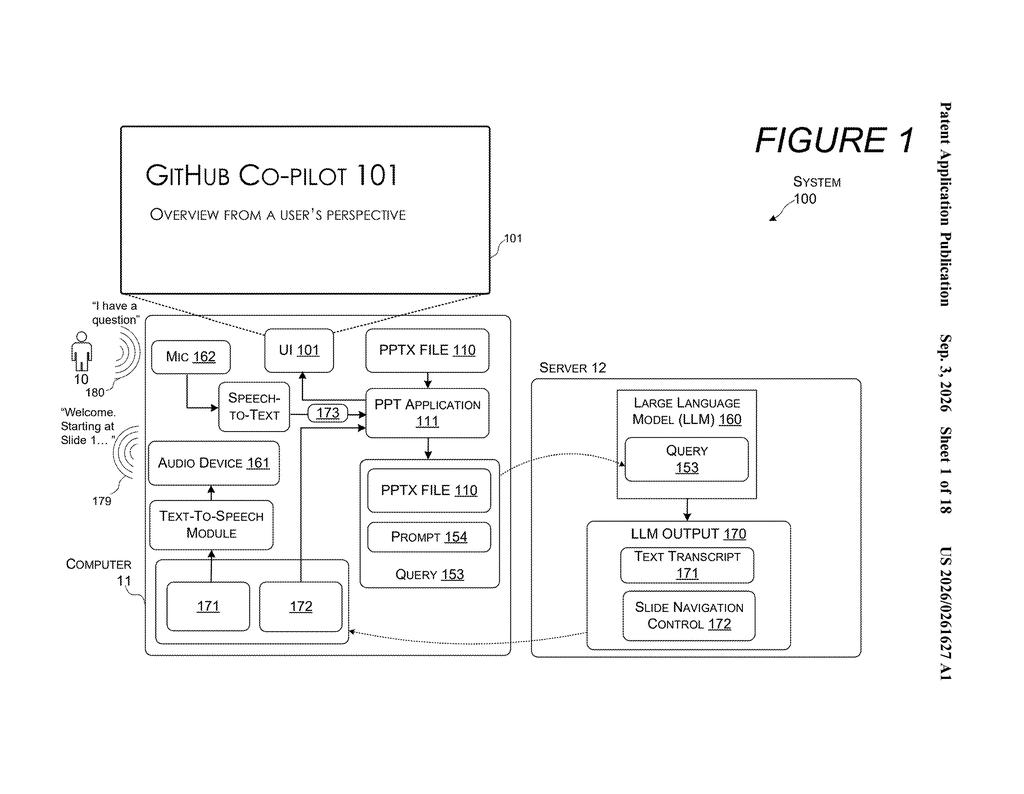
The idea is an "Auto-Present" feature built into a presentation app like PowerPoint. You upload your slide deck, and an AI agent reads through every slide, including any speaker notes, and then delivers the whole thing out loud, in natural speech, advancing slides at the right pace as it talks. It can also field questions from the audience mid-presentation, just like a human presenter would.
You don't record anything yourself. You don't write a script. The AI constructs a narration from your content, times each slide, and speaks it aloud. Think of it as a digital stand-in that shows up to your meeting so you don't have to.
How the LLM reads slides and times each one #
The system works by treating a slide deck as structured input for a large language model (LLM), the same category of AI that powers tools like ChatGPT.
Here is how the process flows:
- The presentation app packages the slide content, including images, text, and any speaker notes, into a prompt sent to the LLM.
- The LLM generates two outputs: a full spoken text transcript that narrates the content naturally, andslide navigation control data that specifies exactly when each slide should appear on screen.
- A text-to-speech engine converts the transcript into audio, producing a human-sounding voice that delivers the narration.
- The app advances slides in sync with the narration, so the right slide is visible at the right moment in the speech.
The patent also describes the agent handling live Q&A, meaning the AI can respond to audience questions during the presentation, not just read out pre-written content. The system is described as maintaining "contextual awareness," which means its answers to questions would be grounded in what was actually on the slides, not generic responses.
What this means for meetings, webinars, and async video #
For anyone who regularly produces training videos, internal briefings, or asynchronous demos, this would cut the production step of recording yourself down to near zero. You build the deck; the AI handles everything else. That is a real time saving for solo creators, small teams, and anyone with camera anxiety. Microsoft's run of AI-in-Office filings shows a clear pattern of embedding generative AI deeper into everyday productivity tools. If Auto-Present shipped in PowerPoint, it would move the app from a tool that helps you present to one that can present for you, a meaningful shift in what presentation software is actually for.
Microsoft's ninth filing we've tracked since July joins indoor turn-by-turn directions and pulling absent colleagues into meetings in our AI agents acting for you watchlist.
Everything described in this patent is software. There is no new device, chip, or camera required, just code layered on top of tools Microsoft already operates: an AI model, a voice engine, and a slide program that already accepts speaker notes and recordings.
The one hard part is live questions. Having an AI narrate pre-written slides is straightforward; having it field unpredictable audience questions without inventing plausible-sounding wrong answers is a different challenge, and the patent offers little detail on how that failure mode gets controlled.
The narration core could plausibly become a real feature in a standard software update. Whether the question-and-answer piece ships alongside it, or gets held back until the accuracy problem is solved, will determine how useful this actually feels to someone sitting through a presentation.
There are more where this came from
We read every patent application Big Tech publishes and send you the ones worth knowing. Plain English, free, every week.
The drawings #
18 drawing sheets from US 2026/0261627 A1 · click any drawing to enlarge
Want this weekly breakdown for a company we don't cover?

[Patentlyze Pro →](https://patentlyze.com/pro/?src=post)
Source. Full patent text and figures from the
official USPTO publication PDF.