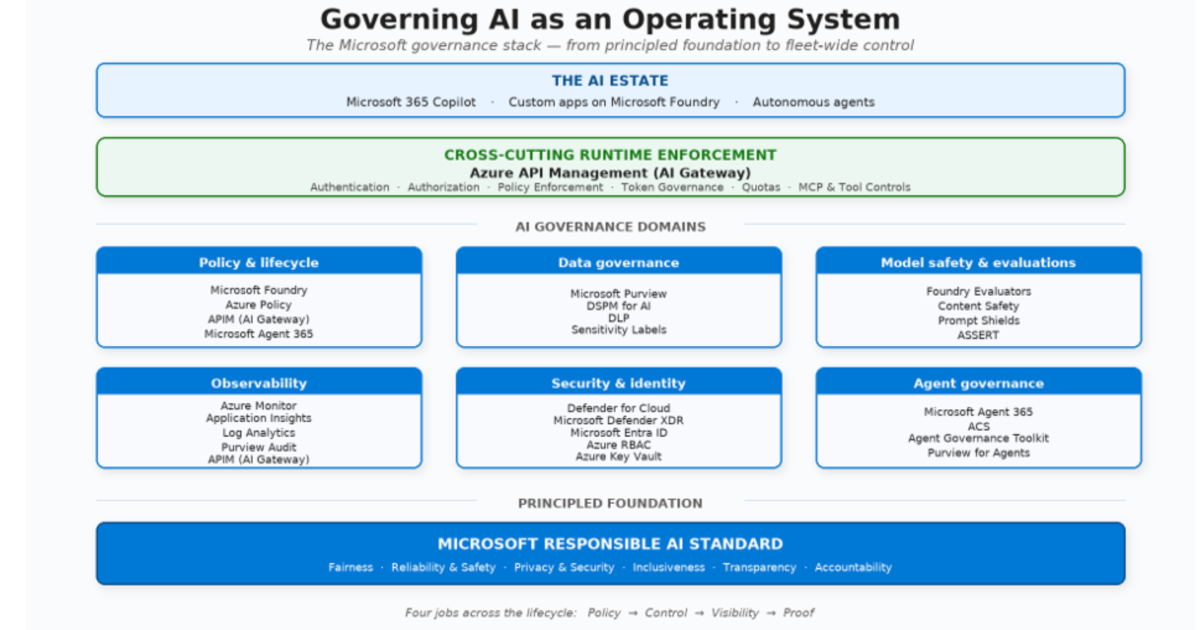
Microsoft has outlined an AI governance architecture that moves governance from documented policies toward runtime enforcement, continuous evaluation, observability, and audit evidence as organizations deploy AI applications and agents in production. The framework spans nine governance domains and four functions: policy, control, visibility, and proof, addressing the need to verify that governance requirements are enforced and observable during AI system operation.
Microsoft AI governance architecture (Source: Microsoft Blog Post)
The architecture treats governance as a continuous operational loop. Policies establish requirements and risk classifications, controls translate them into access and runtime rules, observability captures system behavior, and evaluations test quality and safety. Audit processes then turn operational telemetry into evidence for compliance and incident investigation.
Manasa T. Ramalinga, Cloud Solution Architect at Microsoft, described the motivation in a LinkedIn post accompanying the architecture. She added that organizations moving AI workloads into production are re-architecting their foundational structures to build safer systems, rather than treating governance as an afterthought.
Organizations cannot scale what you cannot control
Microsoft identifies nine governance domains: policy, data governance, model governance, observability, evaluations, security, identity and access, audit and compliance, and agent governance. Runtime controls can span interactions among users, agents, models, tools, APIs, MCP servers, and enterprise systems.
The architecture combines Microsoft Foundry with services including Microsoft Purview, Microsoft Entra ID, Defender, and Azure API Management. Foundry's AI Gateway provides a runtime boundary for authentication, token limits, quotas, and policy enforcement. Microsoft also documents using the gateway to govern MCP tools, providing centralized authentication, rate limiting, IP restrictions, and audit logging without modifying MCP servers or agent code. Microsoft Foundry AI Gateway documentation, Microsoft guidance for governing MCP tools
Evaluations are positioned both before deployment and in production. Microsoft Foundry supports evaluation of AI applications and agents against datasets using built-in and custom evaluators, allowing teams to assess quality and safety before release and monitor production behavior afterward.
Anthony Bartolo, Principal Cloud Advocate at Microsoft, described the operational distinction in a LinkedIn post
Your AI policy is not governance until production can prove it. He outlined the loop as policy defining rules, runtime controls enforcing them, observability capturing behavior, evaluations testing quality and safety, and audit converting telemetry into evidence.
AI governance lifecycle from policy and risk classification (Source: Microsoft Blog Post)
The approach is broader than a Microsoft-specific control plane. The NIST AI Risk Management Framework and Generative AI Profile provide a vendor-neutral framework for managing AI risks across the lifecycle, including governance, measurement, evaluation, and risk mitigation. Microsoft's architecture maps those governance concerns into concrete platform controls and operational telemetry.
Agent governance adds controls around agent identity, access, activity, and workflow checkpoints. Microsoft's open-source Agent Governance Toolkit provides runtime security capabilities for autonomous agents, including policy enforcement and interception points. The architecture also describes the Agent Control Specification as a mechanism for checkpoints across agent inputs, model calls, tool execution, and outputs, with higher-impact actions able to require human approval