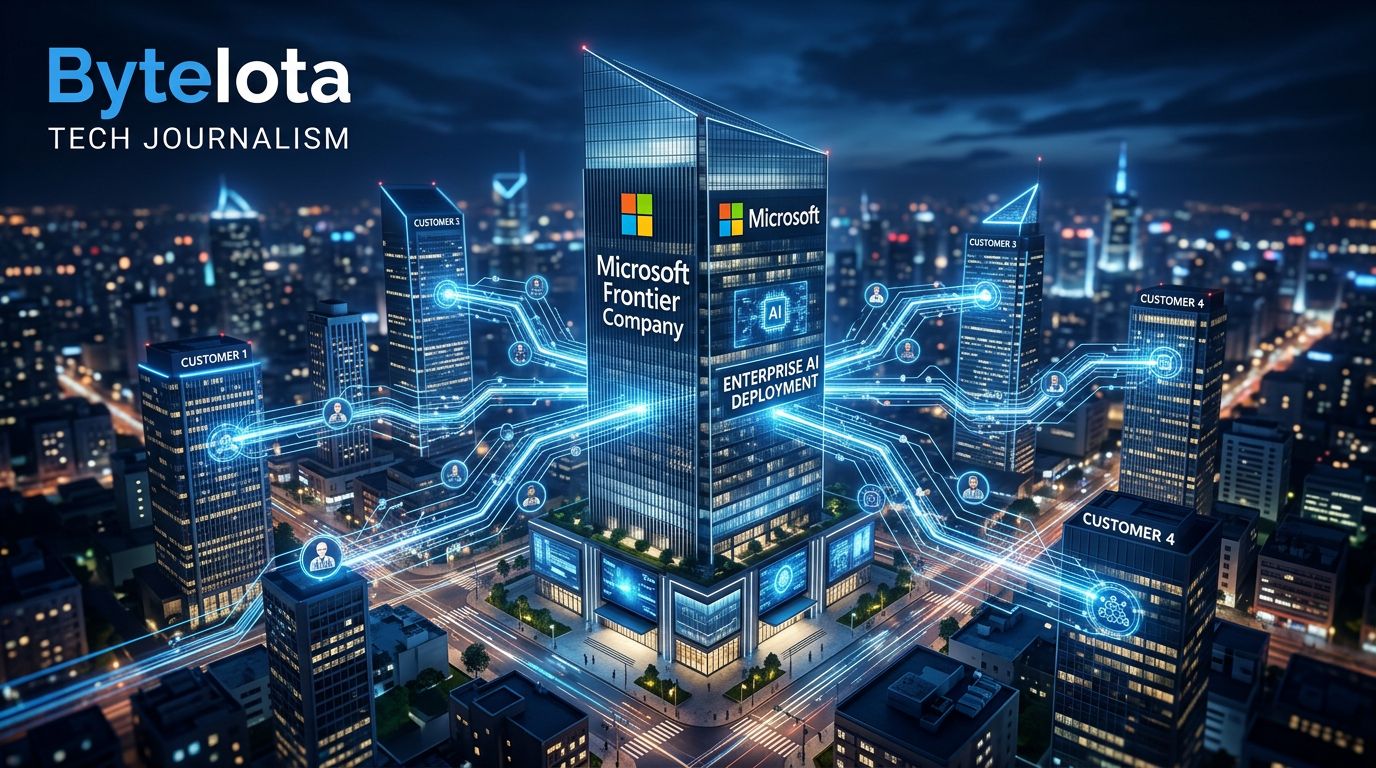
Microsoft just launched a $2.5 billion company whose entire purpose is to deploy AI inside enterprises that bought the software and got nothing out of it. Microsoft Frontier Company, announced July 2, puts 6,000 engineers directly inside customer operations to do what an API key and a documentation portal could not: make enterprise AI actually work. The announcement is dressed as a product launch, but it reads more like a confession.
The Number That Started All of This #
MIT’s Project NANDA found that 95% of enterprise generative AI pilots deliver zero measurable impact on profit and loss. Not less than expected — zero. Enterprises collectively poured $30-40 billion into generative AI tools over the past two years and the vast majority have nothing on their income statement to show for it. Fortune’s coverage of the MIT research puts it bluntly: the models are not the problem. The failure modes are consistent: AI cannot access the right data in the right format; employees do not use tools even when deployed; teams measure AI adoption instead of business outcomes; governance concerns stall production deployments before they ship. These are not AI problems. They are software deployment problems that AI happens to amplify, because the stakes are higher and the implementation surface is wider.
What Microsoft Is Actually Selling Now #
Microsoft Frontier Company is not a product. It is a services firm that embeds Microsoft engineers inside your company to build, deploy, and iterate AI systems until they produce a measurable outcome. Judson Althoff, Microsoft’s Commercial Business CEO, called it the largest, most capable, outcome-driven engineering organization in the industry — a dig at every other vendor selling software and hoping customers figure out the rest.
The structure matters. Frontier Company runs two platforms: an Intelligence Platform that helps customers deploy AI against proprietary data and workflows, and a Trusted Platform that handles governance, security, and FinOps. The contracts are outcome-based, not license-based. Early customers include LSEG, Unilever, Land O’Lakes, and Novo Nordisk — the kinds of organizations with deep operational complexity that off-the-shelf tooling simply cannot navigate alone.
There is also a pointed philosophical position embedded in the announcement: There is no societal permission for an AI future that eats the intelligence of the companies it’s deployed inside. Microsoft is explicitly committing to a model-diverse, open platform — not an Azure monoculture. Whether that holds under commercial pressure is a separate question, but the positioning signals that even Microsoft sees vendor lock-in as a liability when pitching enterprise transformation.
Palantir Was Right the Whole Time #
The forward-deployed engineering model is not new. Palantir built its entire company on embedding engineers inside customer operations instead of selling software and walking away. For years, that looked like an expensive, unscalable consulting business. Then Q1 2026 arrived: 85% revenue growth, 133% U.S. commercial growth. The market validated the model at scale.
Now every major AI vendor is copying it. AWS announced a $1 billion FDE unit on June 30 — one day before Microsoft’s announcement — seeded with thousands of embedded engineers already working inside Allen Institute, Cox Automotive, the NBA, and Southwest Airlines. OpenAI formed a $4 billion+ Deployment Co. in May. Anthropic launched a $1.5 billion joint venture with Blackstone and Goldman Sachs around the same time. Four companies, two weeks, billions of dollars, identical playbook. That is not coincidence. That is an industry reaching a conclusion simultaneously.
What This Means If You Build Enterprise AI #
The skills enterprise buyers will pay for in 2026 are not what they paid for in 2024. Prompt engineering is commoditized. Building demos is table stakes. The FDE skill stack — the thing that earns $185K-$320K base for Agentic AI Engineers according to Kore1’s 2026 salary data — looks like this: RAG pipeline architecture, agent orchestration, eval framework design, production observability, cost optimization, and change management for technical systems. Notice that most of those skills are about making AI reliable and measurable in production, not about making AI smarter. That is the gap the entire enterprise market discovered after two years of pilots. The model was never the bottleneck.
Independent consultants and small AI firms face a structural squeeze here. Microsoft, AWS, OpenAI, and Anthropic going direct into enterprise accounts with embedded engineers reduces the available market for undifferentiated AI generalists. The remaining opportunity is in industry-specific depth — healthcare workflows, legal document processing, financial reconciliation — where generalist FDE teams miss the context that a domain-focused engineer carries.
The Read #
When Microsoft spends $2.5 billion on a problem, the implicit bet is that the problem is worth $25 billion to solve. Enterprise AI deployment is that problem. The market is not moving away from AI — it is moving away from the fiction that AI is easy to deploy, and toward paying serious money for engineers who know how to do it. GeekWire’s analysis frames it correctly: this is a bet that the delivery layer, not the model layer, is where enterprise value gets captured. If your AI work stops at a working prototype, you are building for a market that is contracting. The growth is one layer deeper.