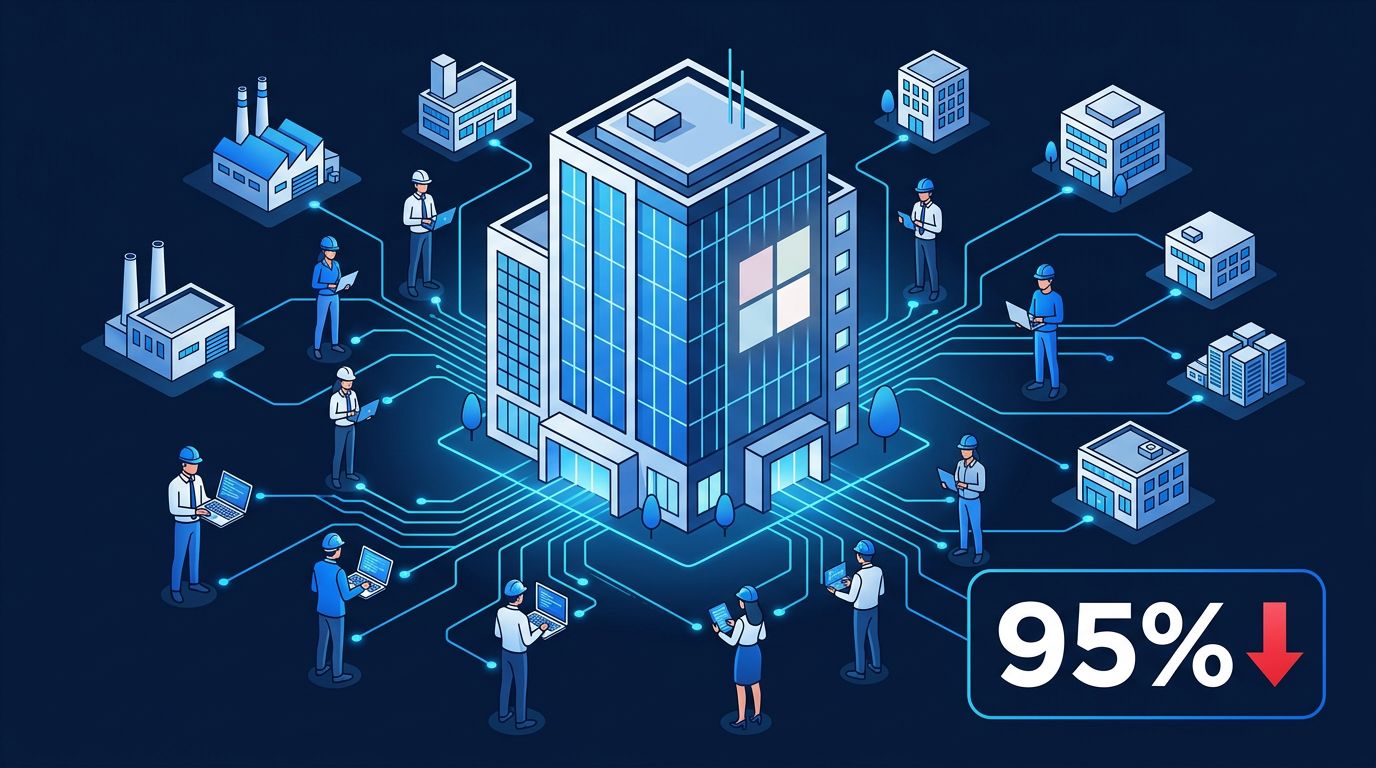
Microsoft launched Frontier Company on July 2 — a $2.5 billion operating unit that embeds 6,000 engineers and industry specialists inside enterprise customers to ship production AI. This is not a consulting arm and it is not a software sale. It is Microsoft betting that the AI demo is dead, and the only thing that matters now is making AI work inside the messy, legacy-riddled companies that bought it.
The 95% Problem #
MIT’s Project NANDA found that 95% of enterprise generative AI pilots deliver zero measurable impact on P&L. Enterprises collectively put $30–40 billion into generative AI and most of it stalled somewhere between a polished demo and a production system. The model was not the problem. The bottleneck is everything around the model — data locked inside siloed ERPs and legacy databases, workflows that never got redesigned, change advisory boards, compliance requirements, and organizations that fundamentally do not know how to integrate AI into the way work actually gets done.
Microsoft is not the first to notice this. OpenAI launched “The Deployment Company” in May with $10 billion in outside capital. Anthropic formed a joint venture with Blackstone and Goldman Sachs the same month for $1.5 billion. AWS committed $1 billion to its own forward-deployed engineer unit on June 30. Microsoft’s Frontier Company arrived two days later. All four of the biggest AI players moved to the same model within sixty days of each other.
The Palantir Playbook, Scaled #
What they are all copying is Palantir. The forward-deployed engineer model — where a vendor’s own senior engineers work from inside a client’s environment, learn its systems and politics, and ship production code against the legacy infrastructure — is what Palantir built its defense and intelligence business on. The rest of the industry spent years criticizing it as unscalable. Now everyone has a version of it.
A forward-deployed engineer is effectively three roles combined: consultant (figuring out where in the business to build), product manager (deciding what to build), and engineer (building it). Coding is the easy part. The hard part is extracting context from client organizations, navigating internal politics, and making AI useful against systems that were never designed for it.
Microsoft’s version includes a named case study: LSEG (London Stock Exchange Group), where embedded Microsoft engineers built a financial Q&A system inside LSEG Workspace, refined iteratively through user testing. The model-agnostic angle is worth noting — Frontier Company claims it will run AI from OpenAI, Anthropic, open-source providers, and Microsoft depending on what a client needs.
What This Means for Developers #
If you work in enterprise tech, two things are worth paying attention to. First, an FDE might show up at your company. The dynamics change when a vendor’s engineer is sitting in your standup, reading your codebase, and shipping code against your systems. They will identify problems fast. They will also develop a very detailed picture of your technical debt, your data architecture, and your team’s capabilities. That is useful and it creates dependency.
Second, if you are an enterprise developer who understands both legacy systems and AI integration, the market is pricing that combination aggressively right now. FDE job postings on Indeed grew 729% year over year. Senior FDE base salaries run $215K–$310K; total comp at frontier labs clears $500K. The specific skill being rewarded is the ability to connect enterprise data — the CRM, the ERP, the decades-old data warehouse — to an AI pipeline in a way that actually works in production.
The Risk Worth Naming #
The IP question is the one nobody is discussing clearly. When an FDE from Microsoft builds and deploys your production AI system — including the data pipelines, the model fine-tuning, the workflow integrations — who owns what they built? Who owns the learnings? If you decide to switch vendors in three years, how much of your AI infrastructure leaves with them?
This is the cloud lock-in problem restated, but with higher stakes. Cloud migrations are painful. Ripping out an embedded AI system that is woven into your operational workflows, built by engineers who are no longer on-site, is a different category of painful. The multi-vendor framing that Microsoft is using is sensible, but the production dependency is real regardless of which model the FDE happened to pick.
Enterprise AI is no longer an infrastructure purchase. It is increasingly a labor relationship, and the terms of that relationship are worth reading carefully before signing.