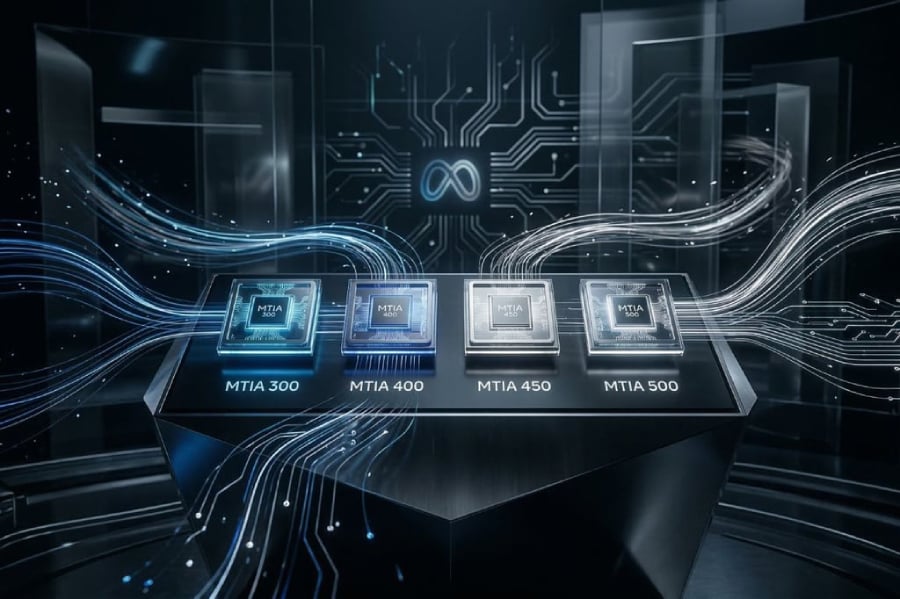
Meta is betting that its own silicon can make the AI bill smaller without slowing down the models powering Facebook, Instagram and WhatsApp.
The tech giant plans to deploy its third-generation custom AI processor, MTIA 450, code-named Arke, in data centers in the first half of 2027, according to Bloomberg. The chip is designed to improve performance per dollar and per watt for AI inference, the stage where trained models generate responses.
Meta received 12 Arke processors from Taiwan Semiconductor Manufacturing Co. on Sept. 1. Early testing put performance within 2% to 3% of the company’s pre-production simulations, and engineers immediately ran Meta models as well as models from DeepSeek and Alibaba on the chips, Bloomberg reported.
The company is working with Broadcom on chip design and TSMC on manufacturing. Meta first announced its custom silicon effort in 2023.
A chip strategy built around inference #
Meta’s MTIA processors are designed for general-purpose inference rather than for applications requiring extremely fast responses. That focus reflects a deliberate decision to optimize the hardware around the workloads Meta expects to run at enormous scale.
“These are the workhorse chips that we’re going to use for general-purpose inference,” Yee Jiun Song, Meta’s vice president of engineering, told Bloomberg.
Meta has committed to deploying more than 1 gigawatt of its custom chips over a 12-month period, with plans to increase that pace if AI demand remains strong. The next generation, MTIA 500, code-named Astrid, is expected to finish design work in about a month and reach data centers by the end of 2027. Meta expects Astrid to be used more widely than Arke.
Why Meta abandoned a bigger chip #
The economics of running AI at massive scale have also changed Meta’s chip roadmap. The company canceled Olympus, a processor intended to handle both AI training and inference that had been targeted for 2028 or 2029. Song said a dual-purpose chip could cost about 30% more than an inference-focused chip.
“When you start to build up gigawatts and gigawatts of capacity, you really care about cost,” Song told Bloomberg. That decision emphasizes building specialized hardware for workloads Meta expects to run repeatedly and at high volume, rather than trying to make a single processor handle every part of AI development.
More must-read AI coverage
-
[SS&C Intralinks DealCentre AI vs. Datasite: Which platform is built for the future of dealmaking?](https://www.techrepublic.com/article/dealcentre-ai-vs-datasite/) -
[SS&C Intralinks FundCentre AI vs. Juniper Square: Which platform better supports modern private markets fund managers?](https://www.techrepublic.com/article/fundcentre-ai-vs-juniper-square/) -
[Why Data, Not Models, Determines AI Success](https://www.techrepublic.com/sponsored/why-data-not-models-determines-ai-success/)
[The Rise of the AI-Native Factory: How Physical AI Is Transforming Manufacturing](https://www.eweek.com/a/artificial-intelligence/the-rise-of-the-ai-native-factory-how-physical-ai-is-transforming-manufacturing/)
Meta isn’t replacing Nvidia, but it could need fewer GPUs for inference #
Meta is not abandoning Nvidia GPUs. Its custom processors are intended to supplement purchased hardware from Nvidia and AMD, particularly by handling inference workloads that do not require the flexibility of general-purpose accelerators.
The potential payoff is economic. If Arke delivers the performance per watt and per dollar that Meta expects, the company could shift more high-volume inference onto hardware designed specifically for its own workloads, rather than using more expensive general-purpose processors for every task.
That would give Meta greater control over both its computing costs and chip roadmap. Meta’s Superintelligence Labs is already feeding information about upcoming models into the chip-development process, allowing engineers to design future processors around workloads the company expects to run before those chips enter production.
What it means for users #
For everyday users, Meta’s custom chips are unlikely to produce an immediate, obvious change. The processors are designed primarily to make the large-scale computing behind AI inference more efficient, rather than to introduce a new consumer feature. Over time, however, lower inference costs could give Meta more room to expand AI-powered features across Facebook, Instagram and WhatsApp. More efficient hardware could also help the company manage the growing computing demands of AI assistants, recommendations and other services without increasing infrastructure costs at the same rate.
There is a limitation: better performance per dollar does not automatically mean faster responses for users. Meta says the MTIA chips are aimed at general-purpose inference rather than the ultrafast workloads that require extremely low response times. That means the biggest benefit may initially be behind the scenes, through the cost and energy required to operate AI services at scale.
Also read: Meta could turn its massive AI infrastructure investment into a new business by selling excess computing capacity to other AI companies.