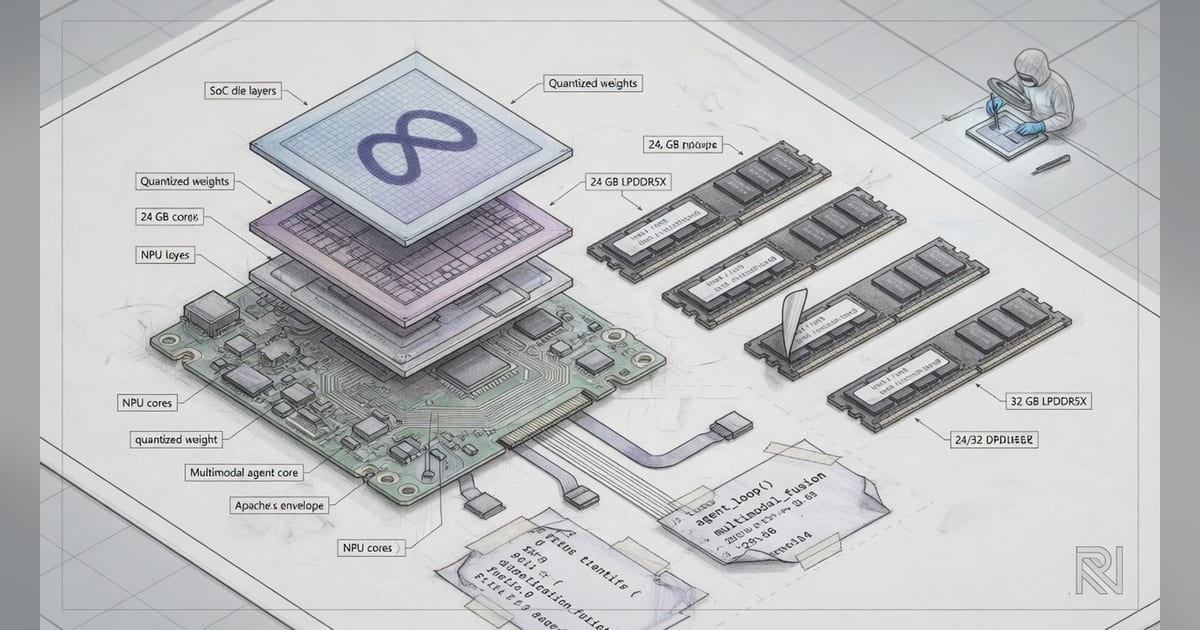
Meta released Muse Glimmer on August 10 as a downloadable, Apache 2.0 model for multimodal agent and coding work. By publishing the approximately 29.6 billion-parameter model's weights, Meta is giving developers an alternative to its hosted Muse Spark model that they can evaluate, modify and run on their own infrastructure.
The weights are available through the Hugging Face model card, with separate developer resources covering deployment. Meta detailed the release in a technical article and announced the download through AI at Meta.
Apache 2.0 weights put developers in control
Glimmer's Apache 2.0 license allows teams to inspect and modify the downloadable model under the license's terms. That distribution model shifts responsibility for deployment, performance and infrastructure to operators, but it also lets them evaluate the model on their own hardware rather than access it only through a hosted service.
Glimmer is an internal Meta project rather than a separately financed company. The release materials identify no individual founders or model creators, and they disclose no Glimmer-specific funding, customers, usage figures or pricing.
Meta says it distilled Glimmer from Muse Spark, transferring behavior from the larger teacher model into a package intended for local deployment. Muse Spark 1.1, released July 9 by Meta Superintelligence Labs, remains a hosted multimodal reasoning model available in Thinking mode through Meta AI and the public preview of the Meta Model API.
Spark 1.1 supports coding, tool calling, computer use and multimodal understanding. Meta says it can generalize to new native tools, Model Context Protocol servers and custom skills, then plan work and delegate execution across parallel subagents. Glimmer brings related agent behavior into an Apache-licensed package with operator-controlled infrastructure and fixed local memory requirements.
Quantized versions target 24 GB and 32 GB systems
The Muse-Glimmer-30B name denotes its 30B model class. The official model card reports approximately 29.6 billion total parameters, including a 1.8 billion-parameter perception encoder. Glimmer uses a dense causal Transformer architecture with 52 layers, a 6,656-dimensional hidden state, 32 query attention heads and two key-value attention heads.
The related Muse-Glimmer-30B-GGUF repository packages quantized weights derived from the same 30B-class base model. Full-precision inference requires more than 55 GB of memory, with the model card identifying 64 GB of VRAM as the deployment target.
Meta's approximately 4-bit versions reduce the language-model weights to less than 20 GB. The documented hardware envelopes are 32 GB of VRAM for K-Quant-Dynamic and 24 GB for the K-Quant-17GB variant. Those configurations reserve capacity for the key-value cache, image processing, the perception encoder and a separate speculative-decoding model, according to Meta's technical materials.
Glimmer ships with a DFlash drafter that proposes blocks of 16 tokens for the main model to verify. In Meta's Nvidia RTX 5090 test, DFlash increased K-Quant-17GB generation speed from 74.9 to 233.4 tokens per second, a 3.1x improvement. The model card also reports an increase from 23.7 to 37.8 tokens per second on an Apple M4 Max and from 26.6 to 50.2 on an M5 Max. These are Meta's measurements and may vary with prompts, runtime settings and available memory.
Hugging Face lists local deployment paths through llama.cpp, vLLM, SGLang, Ollama, Unsloth Studio, OpenClaw and Hermes Agent. At launch, Meta said optimized llama.cpp, MLX and ExecuTorch integrations were planned for the following days. Teams will still need to test latency, tool-call reliability, memory consumption and sustained throughput against their own workloads.
The open model supports multimodal agent work
Glimmer accepts text and images and generates text. Meta documents a context window of at least 131,072 tokens and a January 4, 2026 knowledge cutoff. Its disclosed training sources include publicly available multimodal data, third-party data, Meta products and services, and material curated or enriched by external vendors and Meta personnel, according to the model card.
Meta describes the model as capable of multi-step planning, schema-based function calling and long-horizon task execution. It can diagnose failed tool calls and retry, write and debug code, and interpret screenshots, charts and documents. The company also documents controllable reasoning strength, compatibility with OpenClaw and similar agent scaffolds, and support for more than 100 languages in its release article.
Meta's Glimmer model card reports scores of 75.5 on MCP Atlas, 74.6 on DeepSearch QA, 51.2 on SWE-Bench Pro, 76.0 on SWE-Bench Verified, 51.7 on TerminalBench 2.1 and 65.1 on Beam128K. The results cover tool use, software engineering, terminal operation and long-context behavior. They are company-reported figures rather than independent evaluations.
For engineering teams, the central tradeoff is control against operational burden. Glimmer's Apache-licensed weights make the model available for local evaluation and modification, while its memory demands, serving stack and tool-call reliability remain the operator's responsibility.