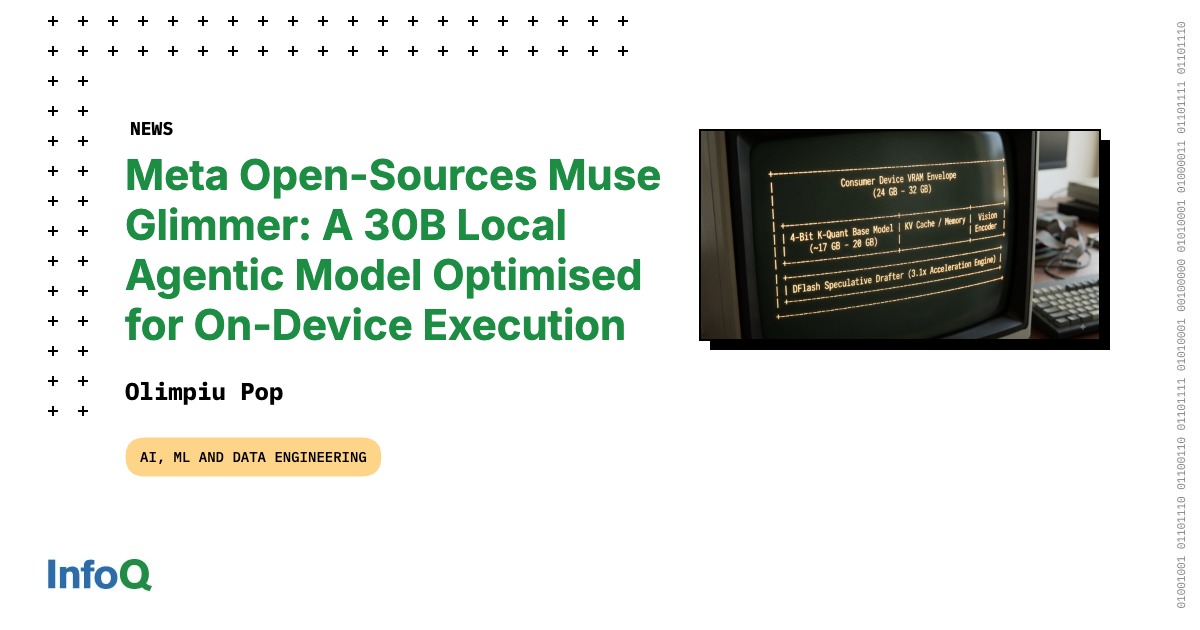
Meta AI Research has announced Muse Glimmer, a 30-billion-parameter open-weight model released under the Apache 2.0 license. Engineered specifically for always-on local workflows, Muse Glimmer enables developers to run autonomous agents, complex tool invocation, local coding, and LLM-as-a-judge evaluations directly on consumer GPUs and workstations without depending on cloud APIs.
Muse Glimmer 30B model architecture and agentic benchmarks. Source: Sebastian Raschka
To deliver agentic execution within strict memory budgets, Meta employed a multi-stage training strategy derived from its larger flagship model, Muse Spark:
Logit Distillation (Pre-training): The model transfers foundational reasoning capabilities from Muse Spark using a matched pre-training dataset mix.Mid-Training: Training scales up on long-context sequences containing complex reasoning traces, interleaved text-and-image data, and multi-step tool call trajectories.Post-Training Alignment: A blend of Supervised Fine-Tuning (SFT), on-policy distillation, and Reinforcement Learning (RL) refines multi-domain performance across code generation, tool usage, and structured planning.
A dedicated 1.8B parameter perception encoder allows Muse Glimmer to process interleaved multimodal inputs natively, enabling local agents to interpret screenshots, diagrams, and documentation inline during code execution or workflow automation.
Uncompressed 30B parameter models typically require over 55 GB of VRAM, pricing them out of standard consumer hardware. Muse Glimmer addresses this via two primary runtime optimisations:
Dynamic Quantisation: Utilising 4-bit dynamic compression (K-Quant), the model footprint drops to roughly 17 GB to 20 GB. This leaves adequate memory headroom within standard 24 GB to 32 GB GPU/NPU envelopes for the Key-Value (KV) cache, perception embeddings, and speculative decoding overhead.
DFlash Speculative Decoding: Rather than predicting one token at a time, Muse Glimmer pairs with a lightweight companion "drafter" model based on the DFlash architecture. The drafter proposes multi-token blocks that the base model validates in parallel, yielding up to a 3.1x increase in generation throughput on hardware like Apple Silicon (M4/M5 Max) and NVIDIA RTX 5090 cards.
Muse Glimmer is trained to execute long-horizon plans and handle unexpected failure states. When an API call or terminal command returns an error, the model diagnoses the failure and attempts alternative paths rather than terminating execution. It supports agent frameworks like OpenClaw and features adjustable reasoning effort, allowing developers to balance execution speed against decision quality.
In standardised benchmark evaluations—including SWE-Bench, DeepSearch QA, τ-Bench, and MCP-Atlas—Muse Glimmer achieves strong success rates compared to leading open models in the 30B class. When evaluated against peer models such as Gemma 4 31B and Qwen 3.6 27B, Muse Glimmer demonstrates superior multi-step tool reliability and failure recovery while maintaining competitive general coding and reasoning capabilities.
The model weights are available on Hugging Face. Meta has partnered with the open-source community to provide native execution across popular local frameworks, including llama.cpp, ExecuTorch, Apple MLX, Ollama, LM Studio, and vLLM. Fine-tuning workflows are also supported via PyTorch's TorchTitan framework.
Muse Glimmer represents a significant shift toward viable, high-capability local AI agents that safeguard data privacy while maintaining low-latency execution. To run this model effectively on your own machine, a system equipped with 24 GB to 32 GB of unified memory or VRAM is recommended—such as a Mac with an M4/M5 Max chip or a PC with a modern GPU like the RTX 5090 or RTX 4090. This hardware envelope ensures sufficient memory for the quantised 4-bit weights alongside the vision encoder, DFlash drafter, and KV context cache required for extended agentic sessions.