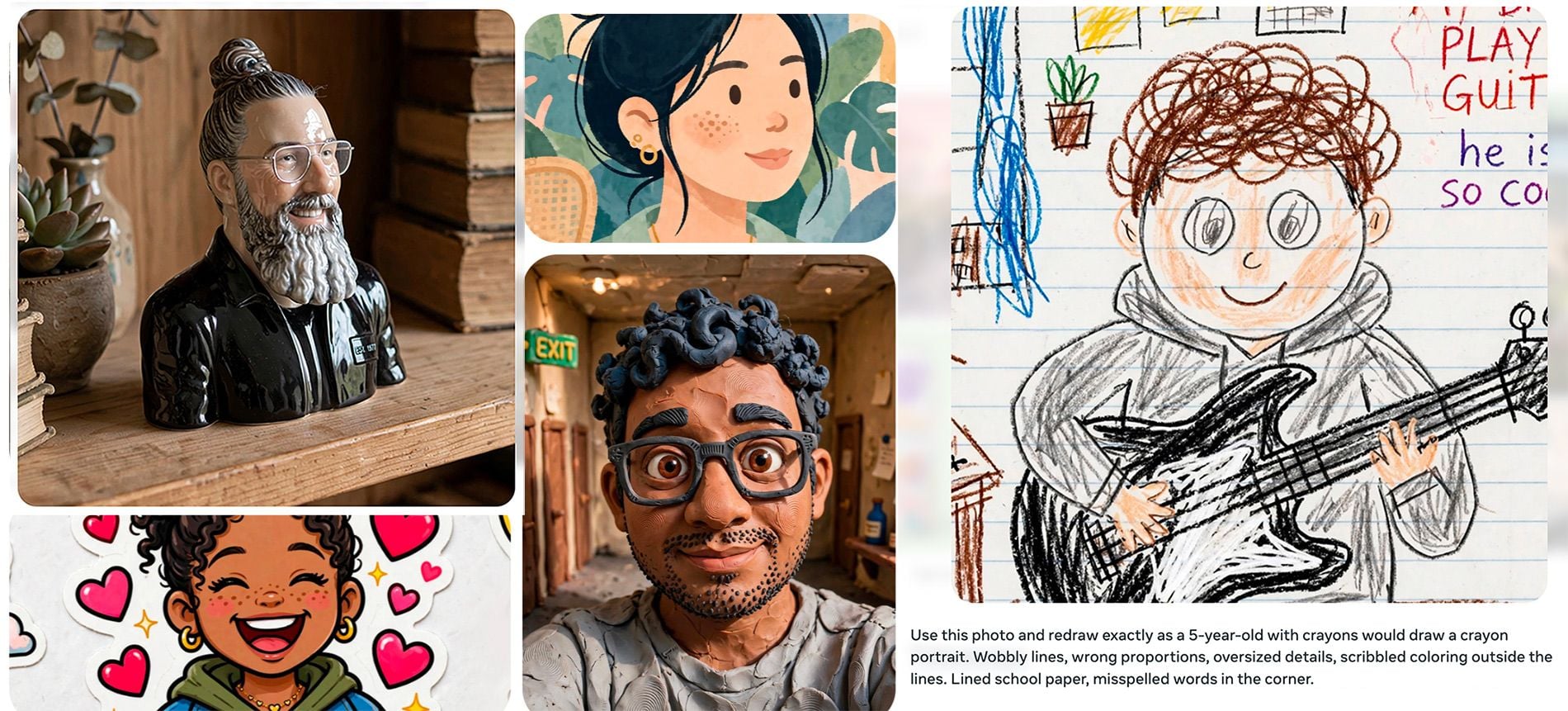
Meta/Facebook has often been its own worst enemy over the years, and the judgment of CEO Mark Zuckerberg continues to baffle and astound.
On Tuesday, Meta proudly announced the release of Muse Image, touting that it "uses advanced reasoning to understand complex prompts, seamlessly blending multiple photos into high-quality creations you can download and share anywhere." The pitch seems to be, naively, that most users will want to use this new tool to make fun and cartoon-y renderings of them and their friends and family via simple and complex prompts, like those seen below.
But the capabilities and goofy applications of Muse Image, however great they may be, are not what have prompted the first reactions from users and the media. As TechCrunch reports, almost immediately after the announcement of Muse Image, people began flipping out about the privacy implications of Meta's newest feature — and privacy concerns have been at the heart of Facebook's trouble's going back over a decade now, leading in part to the 2021 rebrand as "Meta."
As The Verge first reported, anyone's Instagram photos, if they have a public account, could be fodder for literally anyone's AI manipulation or deep-fake creations. Muse Image allows a user to @-tag any other user's photo and turn it into whatever they like, incorporating that other person's likeness — regardless of whether they're a complete strange — to "build a visual," as Meta puts it.
There are already plenty of comments and tweets about this to the effect of "What could go wrong?!"
If you go to Instagram's help center, it now says, "If you have a public account, other Instagram users may be able to create new reels, posts or stories that reuse part or all of your published photos, videos or reels in features like remix, sequence, templates and stickers. In addition, people may be able to create content with your Instagram content using AI features at Meta." True to form with Meta, users now have to opt out of this feature, turning off "reuse" for reels, photos, and videos on their account, or simply making their accounts private — which certainly won't work for the influencer and content-creator set.
And what's worse, changing this setting reportedly only applies to newly posted content, and all existing content on a public page is fair game unless the user goes through and adjusts the setting on each individual post, as KRON4 notes.
Says one app developer on X, "Pulling real users into generated photos without explicit consent is a privacy landmine waiting to detonate."
It won't end here, either, folks. Meta has promised that Muse Video is in development, so that will be the next shoe to drop.
And lawsuits may follow! The fact that Meta is plowing forward with Muse Image, particularly in light of the massive backlash that came to Elon Musk's Grok earlier this year over sexualized deepfakes, is part and parcel of the company's often careless disregard when it comes to privacy concerns.
And who can forget the Cambridge-Analytica scandal from 2018, in which it was found that Facebook was sharing huge troves of personal data on users with a British consulting firm for use in targeting political ads and the like, without informed consent. That led to 30 separate lawsuits seeking class-action status, including one that is still ongoing brought by Facebook shareholders, which the Supreme Court in late 2024 ruled could go forward.
Hilariously, seven years ago, Zuckerberg was talking about shifting Facebook into a "privacy-focused platform" that would focus on the "services that people really want, including in private messaging and stories." Instead, they tried pivoting into the metaverse before coming late to the game with AI, and now they're back to creating open-sharing tools where everyone's content is fair game and privacy is barely even part of the conversation. Good luck selling this one, Mark!
**Previously: **Meta Is Creating an AI Version of Mark Zuckerberg to Attend Meetings for Him