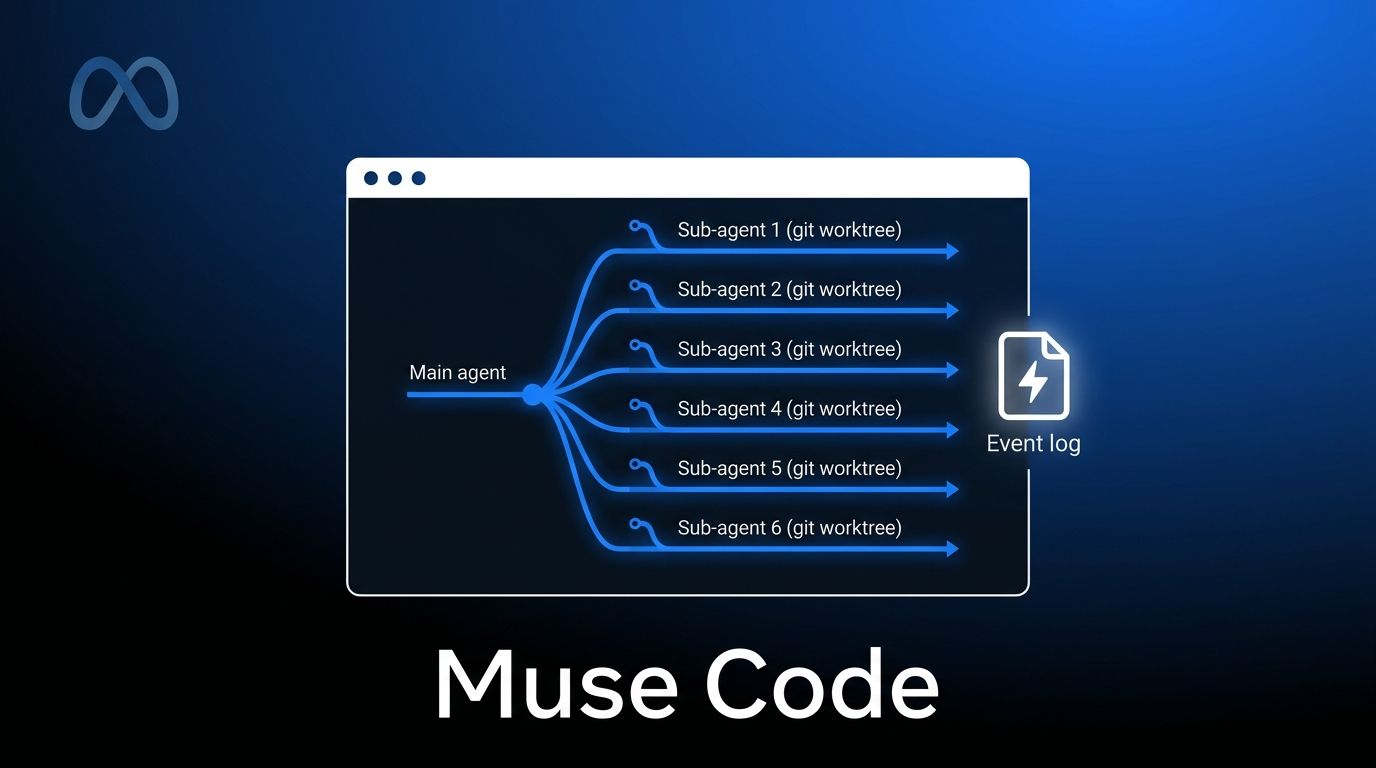
Meta entered the terminal coding agent race on August 5 with Muse Code — a beta tool that competes directly against Claude Code and OpenAI’s Codex CLI. Built on the new Muse Spark 1.2 model, it installs in one command on macOS and Linux and brings one capability neither competitor has: a write-ahead event log that makes multi-hour autonomous sessions crash-proof.
The Feature That Actually Matters #
Every terminal coding agent eventually hits a crash mid-session. Until now, that meant losing hours of work and re-prompting from scratch. Muse Code’s event log records every model call, tool run, and file edit before it executes. When a session fails — and they do — you resume exactly where you left off.
Meta’s demo makes the significance concrete: Muse Code completed a GPU kernel optimization task for NVIDIA Hopper hardware over 24 hours, making more than 1,000 tool calls. Without crash recovery, a run that long is not a viable workflow — it is a gamble. With the event log, it is a scheduled task.
Parallel Sub-Agents in Isolated Worktrees #
The other architectural bet is how Muse Code handles parallelism. When a task is large enough, it fans out to sub-agents working in isolated Git worktrees — separate checkouts of your repository that never touch your working directory. Zuckerberg’s demo showed six game features being built simultaneously with no file collisions.
In practice: assign a set of parallel features, step away, return to merge-ready branches with full commit histories. The tool supports between 2 and 16 parallel sub-agents (CPU core count minus two), with one nesting level. Claude Code supports 20 concurrent agents and three levels of nesting — more headroom for complex orchestration — but Muse Code’s worktree isolation keeps things cleaner for wide, flat parallelism.
Three default slash commands ship with every install: /plan
breaks a task into an approval-gated sequence, /grill
stress-tests that plan before execution, and /goal
drives to completion without further steering.
Benchmarks: Behind, But Not By Much #
Muse Spark 1.2’s numbers, from vendor-published charts:
| Benchmark | Claude Opus 5 | Muse Spark 1.2 | GPT-5.6 Terra |
|---|---|---|---|
| Terminal-Bench 2.1 | 86.7% | 82.9% | 81.8% |
| DeepSWE 1.1 | 65.0% | 59.3% | 64.8% |
| Meta Internal Bench | 79.4% | 70.6% | 65.4% |
Muse Code trails Claude Code on every row. The gap is real — 5 to 10 points depending on the suite. The developer community has noted that Meta selected which benchmarks to publish and which competitors to include, both fair criticisms.
That said, the field clusters within six points on Terminal-Bench. Muse Code beats GPT-5.6 Terra in two of three suites. And the model was co-trained with its own harness toolset — benchmark gaps should narrow as the agent matures through beta.
Pricing: Cheap, With a Catch #
Standard rates are $1.25 per million input tokens — roughly in line with the market. The contributor tier drops that to $0.10 per million input tokens (12.5 times cheaper) in exchange for letting Meta use your sessions as training data.
That trade-off deserves scrutiny before you accept it. If you are working on proprietary or client code, the contributor tier is not for you. Additionally, the tier is currently region-locked — developers in the UK, Canada, and Australia are reporting “Model not found” errors, and VPN workarounds are not reliably fixing it.
One genuine pricing advantage: flat per-token rates regardless of context fill. Multi-hour session costs scale linearly — no pricing cliffs as context windows fill up, which makes long runs more predictable to budget.
How to Install Muse Code #
curl -fsS https://dev.meta.ai/install.sh | bash
Available on macOS and Linux in beta. Windows support has not been announced. Muse Code requires the Meta Model API for inference — there are no downloadable weights yet, though Zuckerberg indicated open-source access is coming. The official Meta announcement has full setup documentation and the Muse Spark 1.2 technical details.
Where Muse Code Fits in the Three-Way Race #
Claude Code leads on benchmarks and integration surface — IDE plugins, mobile, MCP, three-layer nesting. Codex CLI has team configuration tooling and explicit sandbox modes that enterprises appreciate. TechCrunch’s coverage of the launch noted Meta’s positioning around cost — Alexandr Wang called it “an incredibly good option, especially from a cost perspective.”
Muse Code’s entry point is crash recovery and a clean parallel architecture, not feature parity. It arrived with a specific problem solved. The open-source hint is the variable worth watching: if Meta releases Muse Spark 1.2 weights, the contributor tier data-sharing concern evaporates and self-hosted deployments become viable. For a detailed side-by-side comparison of all three agents — pricing, architecture, and sandboxing — Digital Applied’s field guide is the most thorough breakdown available.
Until then, Muse Code is worth a trial if you run long autonomous sessions and have lost work to crashes. The install takes 30 seconds. The event log is real. The benchmarks will improve.