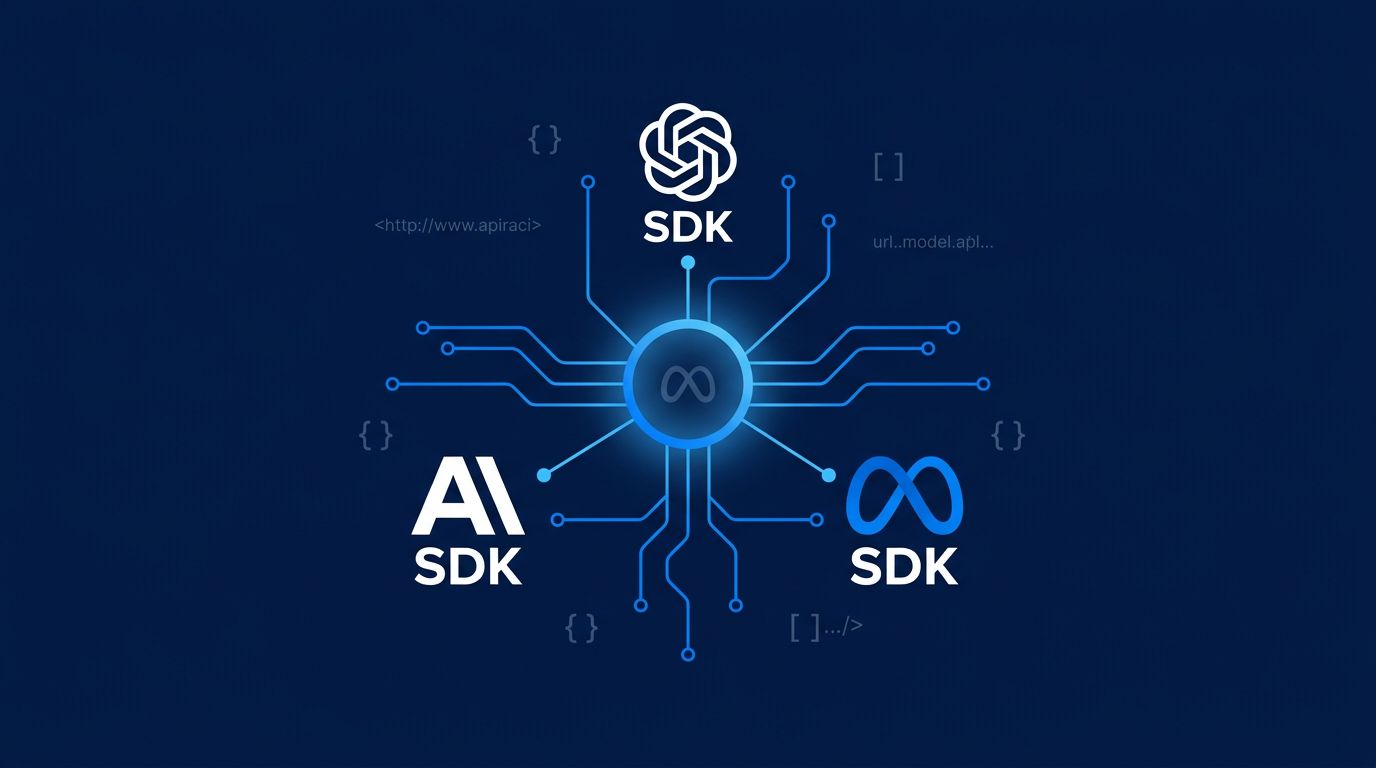
Meta’s paid AI API went live on July 9. If you’re already running the OpenAI SDK or the Anthropic SDK, you can switch to Muse Spark 1.1 by changing one URL and one API key. That’s it. No rewriting. No new SDK to learn. Meta just became a third frontier provider option, and the experiment costs you nothing — every new account gets $20 in free credits.
What Launched #
Meta Superintelligence Labs shipped Muse Spark 1.1 on the new Meta Model API in public preview for US developers. The model is a multimodal reasoning system designed for agentic tasks — parallel tool calling, computer use, multi-agent orchestration. It carries a 1 million token context window and supports images, video, and documents in a single call.
The real news is not the model. It is the API surface: Meta Model API speaks both the OpenAI Chat Completions format and the Anthropic Messages format out of the box. This is not a gimmick. It means your existing agent code routes to Muse Spark by swapping a base URL and a key.
The Migration Is One Line #
Here is what switching from OpenAI to Meta Model API looks like in Python:
from openai import OpenAI
import os

client = OpenAI(
    base_url="https://api.meta.ai/v1",
    api_key=os.environ["MODEL_API_KEY"],  # not OPENAI_API_KEY
)

response = client.chat.completions.create(
    model="muse-spark-1.1",
    messages=[{"role": "user", "content": "Summarize this document."}],
)
print(response.choices[0].message.content)
One caveat: the OpenAI SDK does not auto-read MODEL_API_KEY
, so you need to pass it explicitly. The Anthropic SDK migration is equally straightforward — the Meta Model API accepts the Messages format without modification.
Pricing in Context #
Muse Spark 1.1 runs at $1.25 per million input tokens and $4.25 per million output tokens. Cached input drops to $0.15 — which is aggressive at any comparison point. That puts it well below Claude Fable 5 ($10/$50), below GPT-5.6 Sol ($5/$30), and roughly comparable to GPT-5.6 Luna on input with lower output costs. Check the full Meta Model API pricing page for current rates.
Web search grounding is available as a built-in tool and costs $2.50 per 1,000 queries on top of token costs — a fair price for real-time, cited answers without a separate RAG pipeline.
Where Muse Spark 1.1 Wins #
The model was built for agentic pipelines, not raw code generation, and the benchmarks reflect that. On MCP Atlas, a tool-use benchmark, Muse Spark 1.1 scores 88.1 — ahead of Claude Opus 4.8 and GPT-5.5, which both land in the high 70s to low 80s. If you’re building a multi-agent system where the model’s job is to coordinate tools, call APIs, and orchestrate subagents, this is a credible option at that price point.
The built-in features that matter most for agent builders: parallel tool calling, structured output, a Files API, prompt caching, and native MCP server integration. According to the DataCamp developer breakdown, the model zero-shot generalizes to new MCP servers and custom skills without fine-tuning.
Where It Trails #
Do not reach for Muse Spark 1.1 for pure coding tasks. On SWE-Bench Pro it scores 61.5, trailing Claude Opus 4.8 at 69.2. On DeepSWE 1.1, a long-horizon agentic coding benchmark, it scores 53.3 against GPT-5.5’s 67.0.
There is also a transparency gap at launch. Meta released limited independent benchmark data and no system card. The API is US-only in public preview and carries no published SLA. For production workloads where uptime commitments matter, this is worth tracking.
How to Think About This for Your Stack #
The practical routing strategy is straightforward: Muse Spark 1.1 earns a place in the agentic orchestration layer — the parts of your system that call tools, coordinate agents, and handle high-volume summarization. For critical reasoning tasks, complex code generation, and anything where accuracy is paramount, stay with Claude or GPT-5.6.
The $20 in free credits removes any reason not to test it today. Bloomberg noted this is the first time Meta has charged for AI access — the company has always defaulted to open weights or free APIs. That strategic shift means they’re serious about sustaining this product, which matters more than any benchmark score.