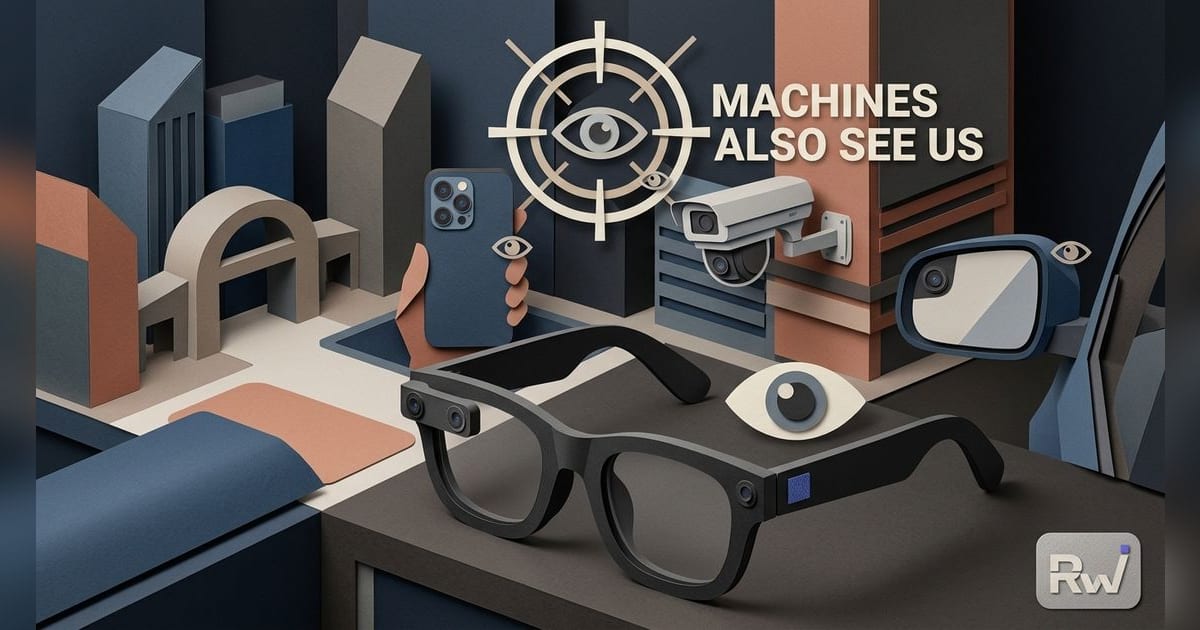
Meta's June 23rd launch of cheaper smart glasses under its own brand has revived the old camera-on-your-face privacy fight, and the anger is aimed too narrowly at the frame instead of the surveillance stack around it.
The new Meta Glasses start at $299, according to TechCrunch, and are made with EssilorLuxottica without the Ray-Ban or Oakley branding that helped Meta make smart glasses look like ordinary eyewear. The lineup includes Meta Adventurer, Meta Fury, and Meta Glasses by Kylie, a Kylie Jenner collaboration that gave the product a social-media ignition source as much as a fashion one.
The reflexive criticism is easy to understand. Glasses sit on a face. A camera in the corner of a lens feels more intimate than a phone held at chest height. A wearer can look at you while recording you. Meta's own system card says Ray-Ban Meta glasses pass captured images and spoken words to an AI model when the user invokes the assistant, and Meta tells users the capture LED is supposed to notify people nearby when the camera is active. Meta's AI system card is also plain about the bargain: these devices work because the camera, microphone, assistant, app, cloud, and training pipeline are parts of the same product.
That bargain deserves scrutiny. The weak version of the backlash does not. Treating Meta glasses as the line where public privacy collapses ignores the decade of consumer behavior that brought us here.
Camera glasses have already had their first public trial. Google opened access to the Glass Explorer program in 2013, at $1,500, and the product immediately became a symbol for covert recording anxiety. Snap followed in 2016 with Spectacles, $129 sunglasses that recorded short first-person video. The cultural verdict on both was driven as much by awkwardness, price, and weak use cases as by privacy. The lesson was never that camera glasses were uniquely dangerous. The lesson was that people tolerate cameras fastest when the product is useful enough or familiar enough to fade into habit.
Meta co-founder Mark Zuckerberg's current bet is that AI makes the old smart-glasses pitch useful. In September 2025, Zuckerberg introduced Meta Ray-Ban Display, a $799 pair with an in-lens display and EMG wristband. Meta framed it as a way to check messages, preview photos, see translations, use captions, and ask Meta AI questions without pulling out a phone. The June 23rd cheaper lineup pushes the same thesis down-market: remove the luxury eyewear tax, keep the camera and assistant, and make the device feel ordinary.
That is the real privacy issue. The risk is ordinary behavior at scale, not a new class of villains with cameras on their temples.
A smartphone can already record a stranger in seconds. Google Photos can create face models when Face Groups is enabled, cluster similar faces, and retain those face models until the user deletes them or the account becomes inactive for more than two years, according to Google's help documentation. Apple's Photos uses on-device analysis to recognize and group faces in the People & Pets album, and iCloud Photos stores photos and videos across enabled devices, according to Apple's privacy disclosure. The average user's camera roll has already become a searchable, location-tagged, machine-analyzed archive of other people's faces.
The same normalization has happened off the phone. Waymo says its vehicles use exterior cameras with a 360-degree field of view and interior cameras to support rides, check seatbelts, confirm the car is clean, and help with support issues; Waymo also says support staff may review video after issues are reported and may access live video in urgent circumstances. A rider who objects to being recorded inside a robotaxi is raising a real privacy concern. It is just not a concern created by sunglasses.
Airports moved even further. A 2026 staff report on TSA's use of facial recognition found that the agency's CAT-2 facial recognition devices were deployed at more than 250 U.S. airports, where they compare a live traveler photo with the image on an identity document before the traveler proceeds through security. The report says travelers may opt out of one-to-one facial recognition and receive manual identity verification, and it says images for that one-to-one check are retained only for the seconds needed for comparison before deletion. That combination of scale, opt-out design, and biometric matching shows how mainstream machine vision already is in public infrastructure. The report reads like a more consequential privacy debate than whether one person at a bar is wearing Meta frames.
None of that absolves Meta. Meta has earned more skepticism than a hardware startup would. Meta's glasses are different from a phone in one important way: the social signal is weaker. A raised phone telegraphs recording. A pair of glasses can look like a pair of glasses. The LED helps only if people notice it, know what it means, and trust that it has not been disabled. Meta should make the recording indicator harder to miss, harder to tamper with, and easier for venues to police. Physical shutters, louder capture cues in sensitive spaces, obvious camera modules, and clear rules for gyms, schools, bars, hospitals, and workplaces would do more than another round of platform discourse.
The privacy debate also needs sharper targets. Laws and venue policies should focus on conduct and data flows: recording in private spaces without consent, biometric identification of bystanders, retention of captured media, cloud processing defaults, human review, law-enforcement access, and the resale or training use of images and audio. A blanket taboo on camera glasses lets every other camera keep doing the same work with less attention.
The backlash will likely cool for the same reason the Google Lens panic cooled: the behavior will be absorbed into products people already use. Visual search, face grouping, camera rolls, doorbells, robotaxis, and airport identity checks have trained the public to trade ambient capture for convenience. Meta glasses make that bargain visible again because the camera is on a face. Visibility is useful if it pushes better rules. It becomes theater when it pretends the privacy problem begins at the bridge of a pair of glasses.
The operator's question is practical. If AI hardware is going to move from novelty to daily use, the trust layer cannot be left to manners and tiny LEDs. Meta's advantage is distribution through eyewear people already recognize. Meta's liability is that its product asks strangers to trust the wearer, the indicator light, the app settings, and Meta's data practices at once.
That is too much trust to demand from a passerby. It is also too narrow a reason to single out one gadget as the surveillance state. The privacy fight worth having is over recording norms and biometric data everywhere cameras now live. Meta glasses are simply the latest object visible enough to take the blame.