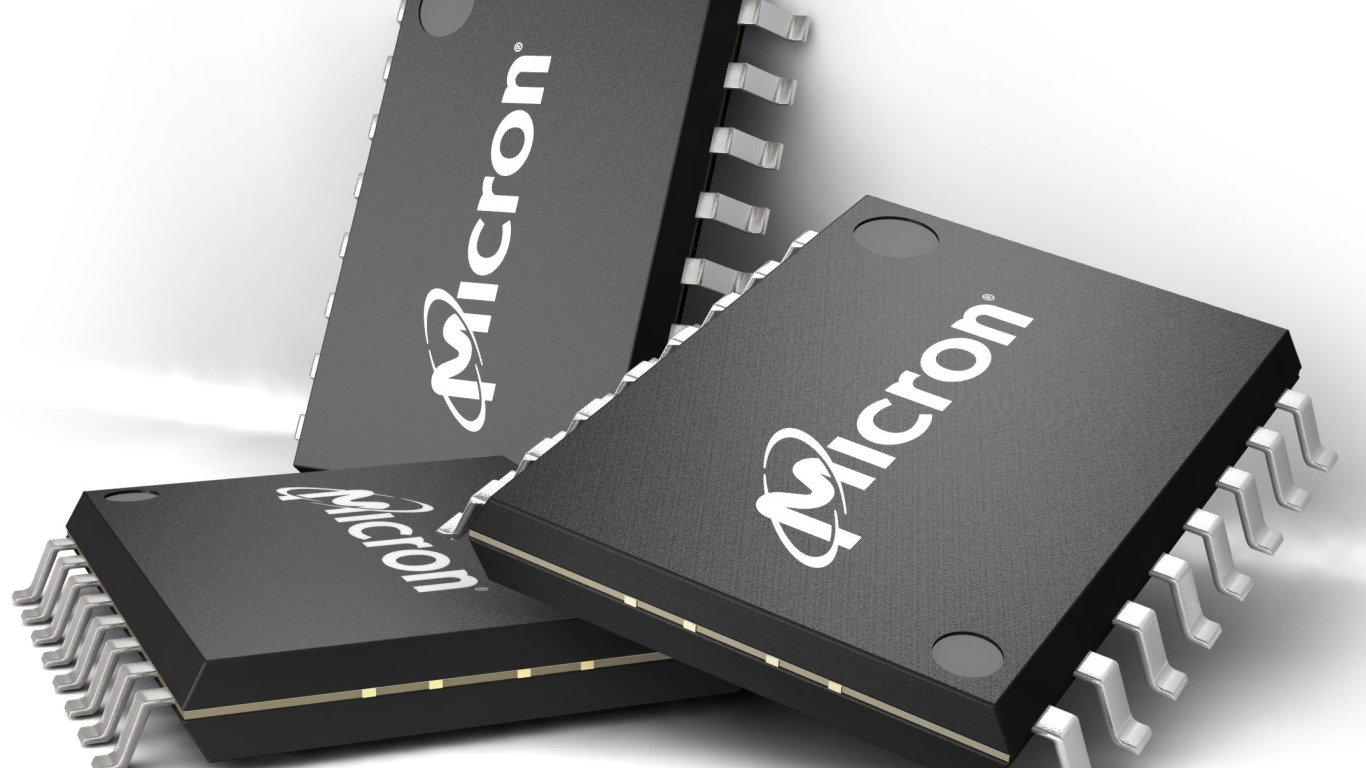
The AI buildout has rewritten the rules of the semiconductor cycle. Server demand now drives more than half of DRAM needs, turning what used to be a boom-bust commodity into a multi-year bottleneck. Factories cannot keep up, inventories sit at multi-year lows, and new capacity takes years to arrive. That structural shift has handed pricing power to the handful of producers who can deliver advanced memory today.
Goldman Sachs quantifies the squeeze in its latest supply-demand analysis. DRAM will run undersupplied by 5.0% in 2026, widening to 5.9% in 2027 — the tightest shortfall since the 4.2% deficit of 2017. NAND follows a similar path, with undersupply reaching 4.6% in 2027. The industry is swinging from mild oversupply in 2024 and 2025 into a multi-year deficit that Goldman does not expect to ease before 2028.
Pricing power shifts to producers in exactly these conditions, and it tends to stick for years because new fabs cannot be hurried.
Micron Already Controls the Scarcity Advantage #
Micron Technology (NASDAQ:MU | MU Price Prediction) sits at the center of this imbalance. Its entire 2026 high-bandwidth memory (HBM) output is sold out. HBM4 commands a 55% to 70% price premium over the prior generation, according to industry tracking. In its fiscal third-quarter 2026 results, the company reported revenue of $41.46 billion — more than four times the year-ago figure — and non-GAAP EPS of $25.11. Gross margins crossed 80%. Guidance for the current quarter points to roughly $50 billion in revenue.
More important than the quarter itself are the 16 multi-year Strategic Customer Agreements Micron has signed. Fourteen of them lock in roughly $100 billion of minimum revenue through 2030 under take-or-pay terms. Customers have committed $22 billion in deposits and related financial support just to secure supply. These contracts include price floors that management says will keep gross margins above any prior-cycle peak. In short, a meaningful slice of future revenue is already booked at attractive economics even if spot prices soften later.
New capacity from Micron, Samsung, and SK Hynix (NASDAQ:SKHY) does not ramp in volume until 2027-2029. That lag keeps the market tight exactly when Goldman projects the deficit will peak. AI server customers continue to request more memory than available supply, reinforcing the multi-year pricing environment.
What Could Hold Micron Back? #
At a recent price near $910, Micron trades at a trailing P/E of roughly 21 and a forward P/E near 6 based on consensus fiscal 2027 estimates. Revenue is projected to climb from about $130 billion this fiscal year toward $250 billion next year. That valuation sits well below many semiconductor peers on a growth-adjusted basis.
Granted, memory remains cyclical. A sharp slowdown in AI capital spending or faster-than-expected capacity additions could pressure prices after 2028. Competition from Samsung and SK Hynix remains intense, and geopolitical risks around advanced technology never fully disappear.
That said, the combination of sold-out HBM, contractual floors, and Goldman’s widening deficit forecast narrows the range of outcomes more than in prior cycles.
Key Takeaway #
The memory shortage is getting worse, not better. Micron has already converted that scarcity into locked-in revenue, sold-out advanced product, and margins protected by contract.
For investors seeking pure exposure to the AI memory bottleneck, the company offers the most direct and data-supported path through at least 2027. The numbers — 5.9% DRAM undersupply, $100 billion in minimum contracts, forward P/E near 6 — make the case clearer than narrative alone. Contact [email protected] for any questions or corrections.