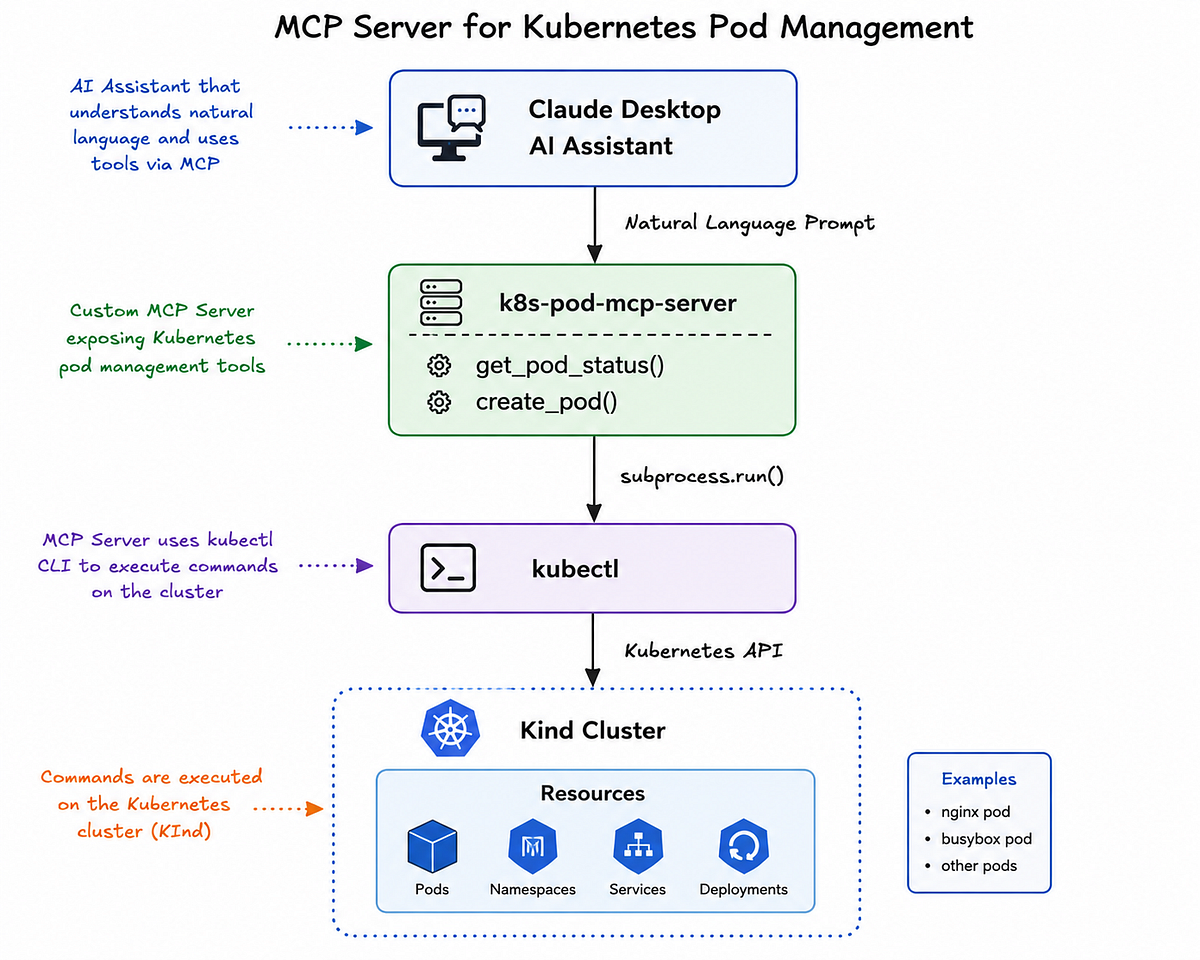
The Devopstronaut tutorial published on July 8, 2026 shows practitioners how to build a Kubernetes MCP server in about 15 minutes with Python, FastMCP, kubectl, and a local kind cluster. The walkthrough exposes two tools, get_pod_status and create_pod, then tests them with the official MCP Inspector. The useful lesson is the pattern, not model novelty: a small server can give an assistant a typed interface to platform operations while keeping cluster access, command validation, and failure handling in ordinary engineering code. Teams adapting it for production should tighten RBAC, validate inputs, and prefer read-only tools before allowing mutating Kubernetes actions.
The practical value of this tutorial is that it turns MCP from an abstract integration standard into a small platform-engineering exercise. For teams exploring assistant-driven operations, the key design question is where to put the boundary between model interaction and cluster authority.
What happened
Devopstronaut published a hands-on walkthrough for building a Kubernetes MCP server with Python, the mcp package, FastMCP, kubectl, and a local kind cluster. The example exposes get_pod_status and create_pod tools, then uses the MCP Inspector to test the server. The article lists Python 3.10+, kubectl, kind, and Node.js as prerequisites.
Technical context
The tutorial shells out to kubectl, so the server reflects the live cluster context configured on the machine running it. That keeps the example concrete, but it also makes the trust boundary clear: validation, RBAC, command construction, and error handling belong in the server, not in the model prompt. The official MCP Python SDK and Inspector docs support the same basic development pattern of exposing tools and testing protocol behavior before wiring a server into a client.
For practitioners
Use the example as a local prototype, not a production security model. A production Kubernetes MCP server should start with read-only tools, namespace scoping, service-account permissions, structured outputs, and explicit allowlists for mutating actions. Teams should also log tool calls and test failure cases such as missing contexts, unavailable clusters, and invalid resource names.
What to watch
The important next step is whether DevOps teams standardize MCP adapters around safe operational primitives instead of broad shell access. That will determine whether MCP becomes a reliable automation layer for platform engineering or another unmanaged path into sensitive infrastructure.
Key Points #
- 1The tutorial gives platform engineers a concrete MCP pattern using Python, FastMCP, kubectl, and a local kind cluster.
- 2Production adaptations should start read-only and move Kubernetes permissions into RBAC rather than model instructions.
- 3MCP Inspector testing helps validate tool contracts before connecting the server to assistants or operational workflows.
Scoring Rationale #
This is a practical tutorial with direct value for DevOps and platform teams experimenting with MCP-based operational tooling. It is not a novel research result or major product release, so the impact stays moderate.
Sources #
Public references used for this report. Practice with real Ride-Hailing data
90 SQL & Python problems · 15 industry datasets
250 free problems · No credit card