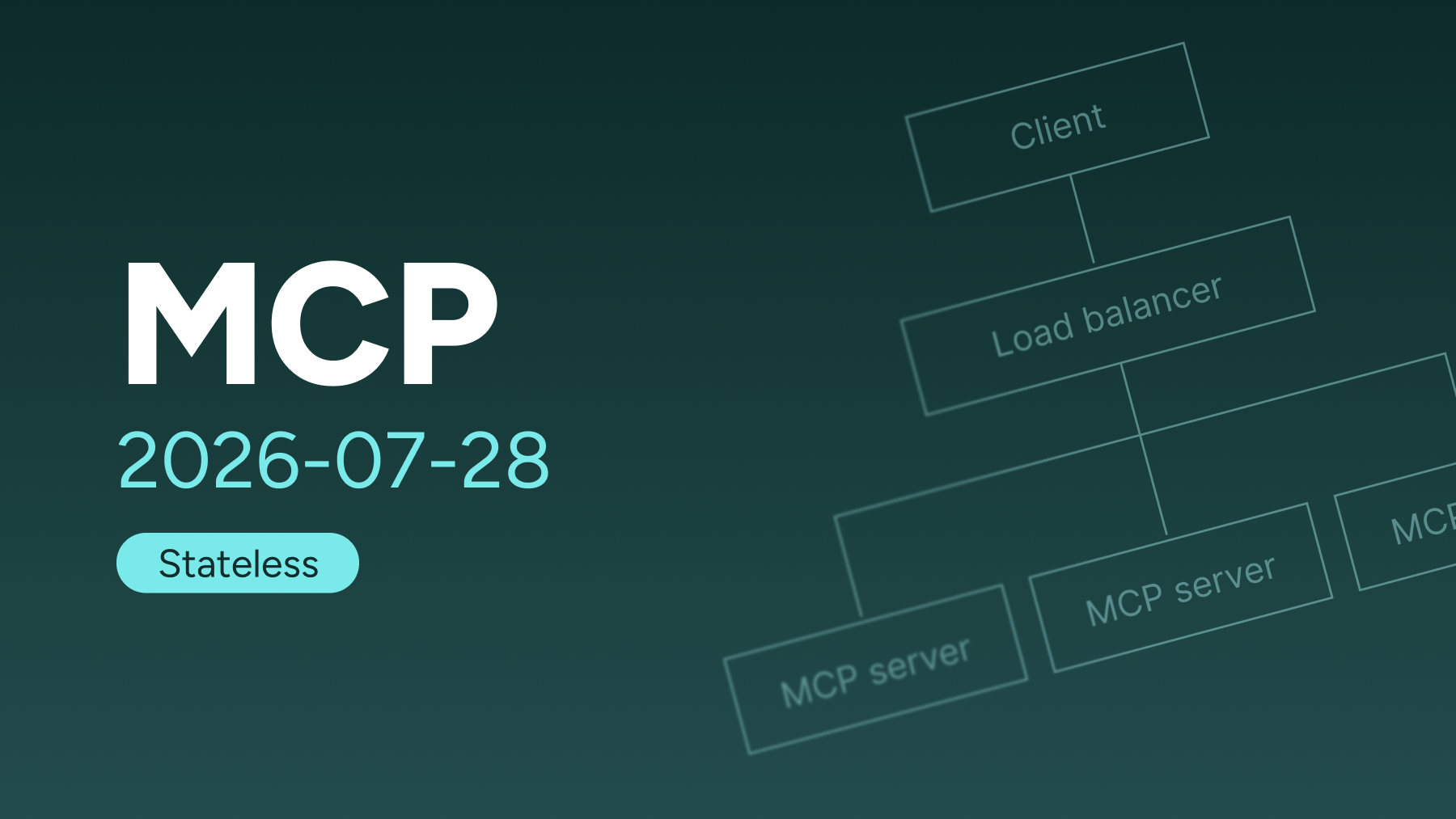
Agents are now a primary user of the software we build. At Netlify, we’ve spent the last couple of years thinking deeply about Agent Experience (AX): how easily an agent can discover what a service does, call it reliably, and recover when something goes wrong. Much of that experience is determined by how the servers behind an agent’s tools are built.
The MCP 2026-07-28 specification makes the protocol stateless at its core, turning an MCP server into an ordinary HTTP workload. No sticky sessions. No session store. No shared state across instances. By removing session management from the equation, an entire layer of operational complexity disappears with it. Building an MCP server becomes something almost any developer can do, rather than just teams experienced with running stateful infrastructure.
Netlify has believed in this direction since MCP was first introduced and we have advocated for a stateless architecture from the beginning. That’s why we’re excited to support the new specification from day one.
Building MCP is no longer painful #
The biggest consequence of a stateless protocol is who gets to build.
When an MCP server needed to manage sessions and maintain state, standing one up carried real operational overhead. A stateless server, by contrast, is just an HTTP service. On Netlify, that means writing a function and deploying it the same way you deploy anything else: no session plumbing; no infrastructure designed around long-lived connections; nothing to keep warm.
That lowers the bar for everyone. A team that would never have taken on an always-on stateful service can ship an MCP server in an afternoon, and it still scales like any other request-driven workload once people actually start using it.
We think that’s the real unlock. The value of MCP grows with the number and variety of good servers out there, and the fastest way to get there is to make building one feel ordinary instead of taxing.
This also improves Agent Experience. Stateless servers don’t depend on requests landing on the same instance, so redeployments no longer interrupt ongoing interactions. Fewer moving parts means fewer subtle failure modes for agents to recover from. And when building reliable servers becomes this simple, more of the web can expose robust, dependable tools instead of fragile integrations held together by session state.
The Extensions framework #
The 2026-07-28 specification also formalizes the Extensions framework, with MCP Apps and Tasks becoming the first official extensions. That’s a bigger deal than it might seem.
Connecting an AI to an application has historically meant a bespoke, one-off build for every pairing: custom glue code, a custom contract, and a custom thing to maintain. MCP already collapsed much of that into a shared interface. MCP already replaced much of that duplication with a shared interface. MCP Apps push the idea further by making the user experience a server provides portable across clients instead of being rebuilt for each one.
For AX, that’s a significant improvement. Agents can interact with services through a consistent interface regardless of which client they’re running in, rather than learning a different implementation every time. We think this opens the door to an entirely new class of AI applications: experiences that can be built once and work across many clients. What does that look like in practice? The example below shows an airline seat picker delivered by a remote MCP server and rendered directly inside Claude. Previously, functionality like this had to be built into each individual AI client. With the new Apps extension, MCP servers can provide rich, interactive experiences that integrate directly into compatible clients, allowing developers to build them once and make them available everywhere the extension is supported.
Try the Netlify MCP server #
The Netlify MCP server already supports the 2026-07-28 specification. If you’re using a compatible client (supported today in Claude.ai and Claude Managed Agents, with Claude Code support coming soon) you can connect with a single command:
If you’re client is not on the latest spec yet, the Netlify MCP is backwards compatible. Check out our docs for more information around setting up Netlify for your agent. MCP is an open standard, now governed under the Linux Foundation, and it just became far easier for anyone to build on. Netlify is one of the companies featured in the launch announcement, and we’re glad to be building on it.