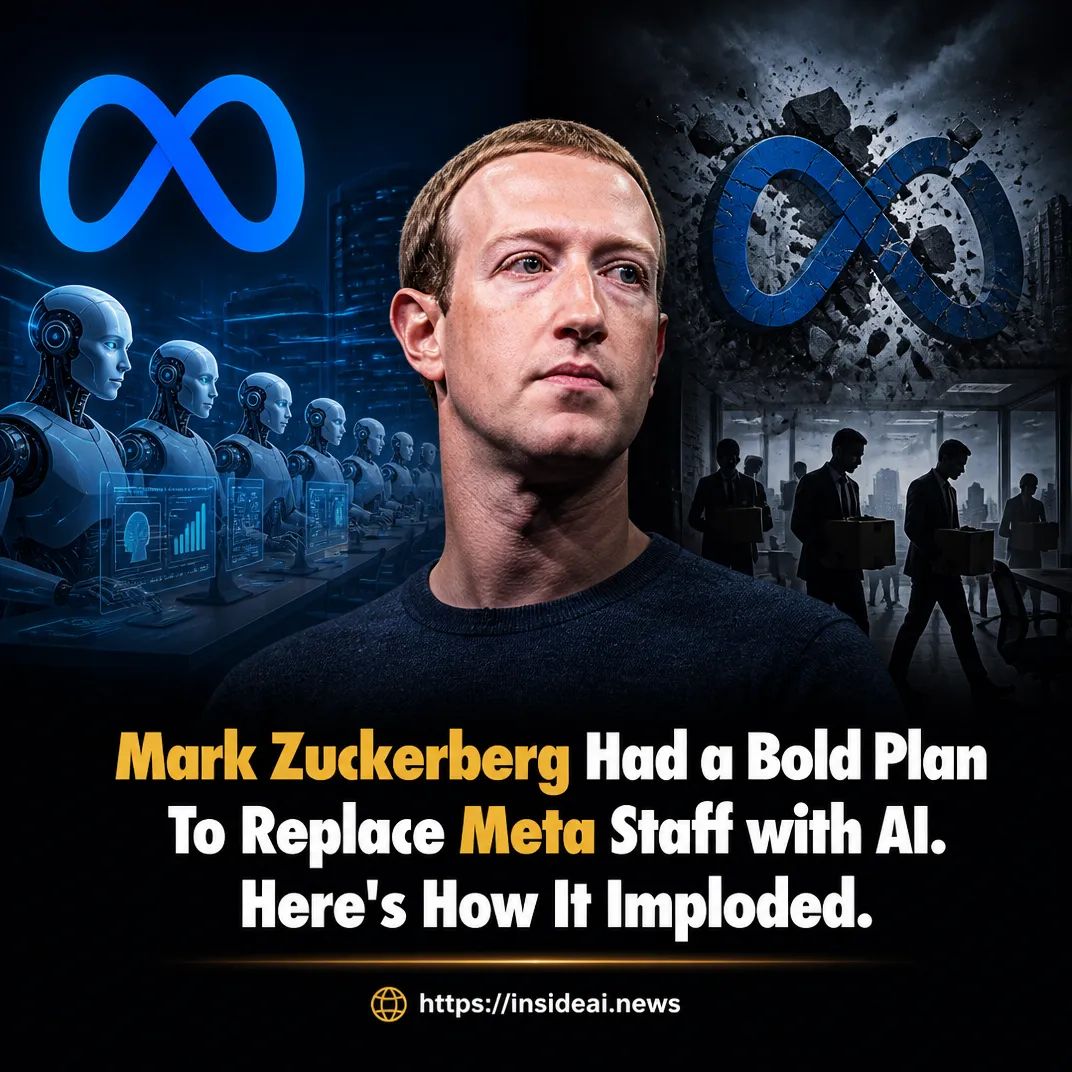
August 26, 2026, (Inside AI) — In January, Mark Zuckerberg and his top lieutenants gathered at his Hawaii compound for an annual leadership retreat. There they hatched a radical plan to reimagine work at Meta in the age of artificial intelligence.
Code-named Project OT, short for Organization Transformation, the plan envisioned an “AI native” future for the owner of Facebook and Instagram. AI would take over much of the daily work performed by thousands of human employees. Virtual workers would be overseen by smaller, “talent-dense” cadres of human staffers, according to internal planning documents and people familiar with the project.
Executives explored slashing the size of many teams by as much as 60% in two waves. The first purge would come in May, followed by another shake-up in November. Layoffs would be supplemented by closing open positions and pushing out poor performers.
But on the night of May 19, just hours before the first layoff wave, Zuckerberg blinked. Meta laid off 10% of its employees the next day, but it called off planning for the November cuts, according to an internal document.
By then, Meta employees were in open revolt, convinced that the company’s AI transformation initiatives were partly aimed at replacing them. Internal data also suggested that autonomous AI “agent” technology at the heart of the strategy was failing to deliver hoped-for productivity gains. Some investors questioned what Meta had to show for its gargantuan spending on AI.
Meta confirmed the existence of Project OT, describing it as a year-long project focused on cost cutting, redesigning team structures and shifting staff into new priority areas, such as producing training data for its AI models.
The company acknowledged the plan was to be carried out in two waves and that the most drastic scenarios involved reducing the size of some teams by up to 60%. But it declined to specify which units were involved and said several major ones weren’t part of it. Meta said the scenarios included both layoffs and redeployments, and that the company at no point intended to lay off 60% of its entire workforce.
“As part of our company restructuring earlier this year, we asked some teams to conduct a scenario planning exercise looking at the potential impact of redeployments, open role closures and cuts,” Meta said in a statement. “This ultimately resulted in moving thousands of employees to do priority work on several newly-established teams, as has been publicly reported. Ultimately, we didn’t move forward with every scenario from the exercise - and it was never assumed we would.”
Ever since the release of OpenAI’s ChatGPT in late 2022, Silicon Valley leaders have been imagining the revolutionary possibilities that generative AI might unleash for the future of work. They have been especially intrigued by the promise of “agentic” capabilities. Agents are designed to take autonomous actions such as shopping, booking travel and creating new apps.
At Meta, executives last year threw themselves into AI-inspired management philosophies. They were captivated by ideas emerging out of the startup world about how companies shouldn’t just incorporate AI into their existing processes, but instead go fully “AI native.” As one Project OT document envisioned it: “AI-ready tools and agents interact, workflows are automated, new builds are AI-first.”
Meta executives, including Chief Data Officer Alex Schultz and Head of Product Naomi Gleit, visited Asia last year and admired how startups there had built their organizational charts around AI. They also commissioned research into how AI startups were organized and set up pilot projects.
In July last year, Ime Archibong, a long-time vice president of product management, announced one of Meta’s earliest pilot projects. He described the transition in sports terms.
“In basketball, embracing the fast break lets you take more shots - and better ones. We expect the same with AI tools: they allow us to explore more ideas with less cost and higher fidelity,” Archibong wrote.
His pilot involved setting up five “small tech pods,” each consisting of two to three engineers and a designer, all equipped with AI tools. The groups would dispense with established processes for releasing new products, such as fixed six-month planning cycles. Instead, they would aim to build prototypes in four-week “sprints.”
By June, at least 11 units, including engineering and research teams, had implemented small pods. Traditional roles for product designers and engineers would vanish, and tech pod members would get a new generic title: “builder.” Layers of middle management would be eliminated.
Meta introduced a “village approach” to managing people. Job performance ratings and promotions would be decided by high-level unit heads, or “Org Leads,” supported by human-resources personnel and unspecified “AI systems.” Each unit head would oversee between 30 and 50 people.
One Meta staffer assigned to manage a pod expressed confusion on an internal message board. “I’m not going through manager training, and I’m not getting access to ratings & manager tools,” the person wrote.
Meta said that “Performance rating and promotion decisions were and are made by people, not AI.”
On March 13, before many leaders at the vice-president level had even been briefed on Project OT, news emerged that Meta was planning layoffs that could affect 20% or more of its workforce. The report caused alarm. Many rank-and-file employees were rattled, and executives were unprepared for the backlash.
In April, more details surfaced: Meta was set to cut about 10% of its workforce in a first wave on May 20 and aimed to shed more staff in the second half of the year. Some engineers were reassigned to a new Applied AI Engineering unit tasked with creating software-engineering puzzles to be used as training data for Meta’s AI models. Many staffers derided the work as rote and boring.
Believing they might be training their own AI replacements, and irate over the lack of detail about the layoffs, many employees flooded Meta’s in-house communications network, called Workplace, with angry screeds and gallows humor. Staffers replied to executives’ internal posts with pictures of elephants, symbolizing that layoffs were the elephant in the room.
Staff morale sank. Meta’s internal measure of employee sentiment dropped from 74% favorable to 55% favorable, according to the company’s half-year Pulse survey. Labor organizing efforts gained momentum.
Amid the rebellion, other internal data indicated that the tech at the heart of the plan wasn’t delivering. Employees’ use of AI had resulted in a vast increase in the code they generated, but with questionable impact on productivity. Code changes made to internal software platforms were up 220% year-over-year, but changes that led to new or upgraded features reaching Meta users were only up 36%.
As early as March, infrastructure teams were warning of “reliability warning signs” caused by the AI coding surge. Unchecked AI agents were performing “large-scale, disruptive actions that humans are unlikely to execute.” Major technical and security incidents spiked 40% from the previous year, with time spent firefighting them up 70%.
With pressures piling up, Zuckerberg changed course. Hours before the first wave of Project OT layoffs on May 20, he conferred with his top lieutenants and called off the second wave planned for November. The next morning, Meta went ahead with the 10% cut. After the notifications went out, Zuckerberg posted a memo on Workplace telling remaining employees he did “not expect other company-wide layoffs this year” and expressed his desire to give them more “stability.”
Executives then tried to shore up morale. They encouraged unit heads to acknowledge employees’ feelings, d the mouse-tracking program, let some employees in the new AI engineering unit transfer back to their old teams, and dispatched Chief Financial Officer Susan Li to boost perks. A stream of empathetic executive posts arrived on Workplace, along with pledges to improve snack quality and increase spending on travel and social events.
In early July, Zuckerberg made a surprise appearance at an internal town hall and conceded miscalculations on the reorganization’s timing. AI agent technology, he said, had not “accelerated” as quickly as he had anticipated. He added that he expected the tech to improve and begin showing more benefits in the next three to six months.
As Zuckerberg has dialed back the most disruptive aspects of the internal AI transformation, he has also launched a public-relations blitz positioning Meta as people-centric. The push included a video advertisement proclaiming the company is “betting on people.”
Still, Zuckerberg has stuck to the words “company-wide” and “this year” in discussing layoffs with employees. That has prompted some employees to speculate that he’ll continue trimming the ranks via team-specific cuts or performance-based dismissals, or delay company-wide headcount reductions until next year.
Meta plans to invest at least $130 billion in AI chips and other infrastructure this year, which analysts expect will eat up its operating cash for 2026, estimates from LSEG show.
In his essay on the future of AI, titled “The Future is for Everyone,” Zuckerberg predicts there could be “an abundance of jobs in the future.” But some companies might end up with fewer employees.
“Company sizes may shrink - just as they did in the transition from industrial giants to tech companies,” he writes. “But this doesn’t mean fewer jobs overall. It implies a larger number of companies with fewer people each.”