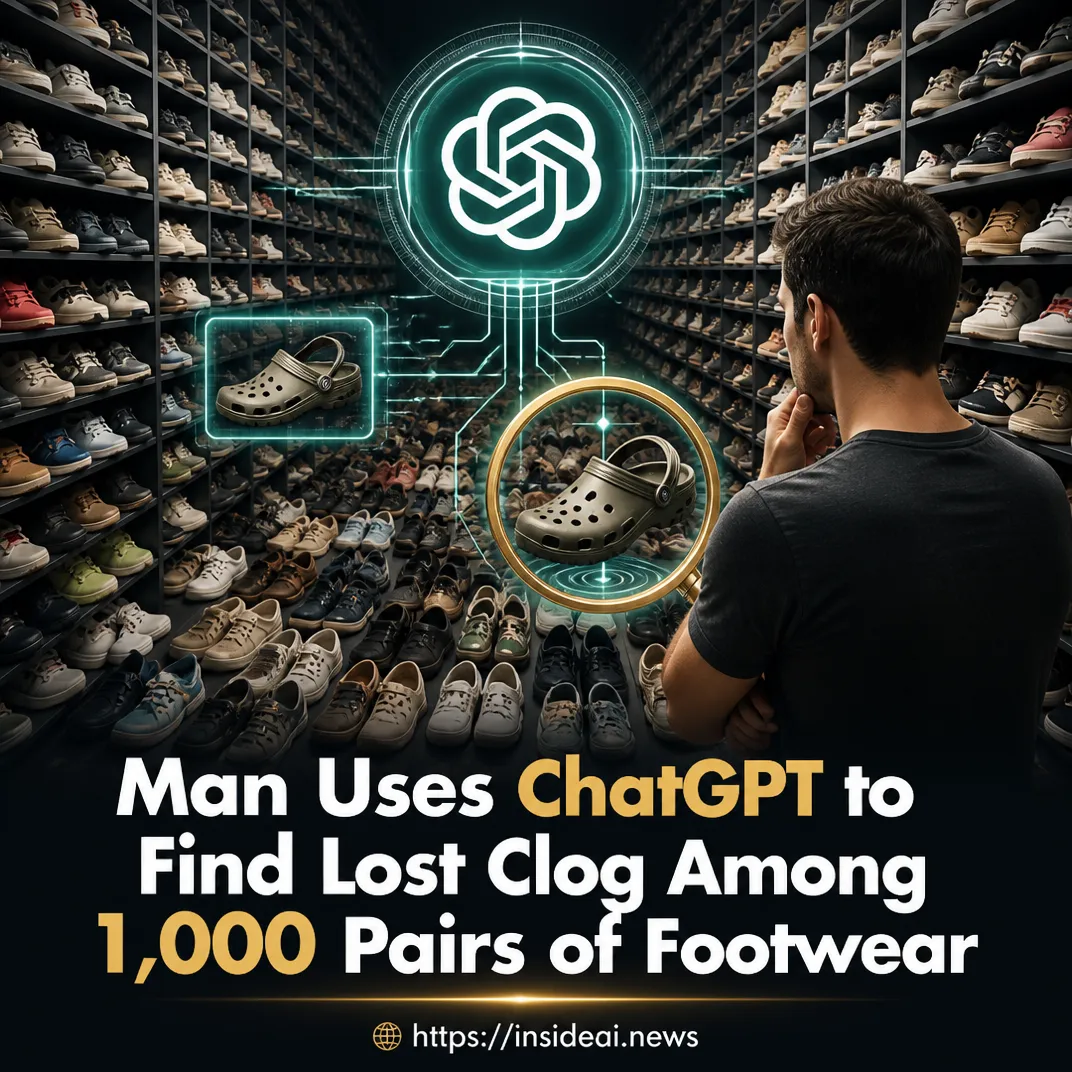
August 15, 2026, (Inside AI) — A man in India used ChatGPT to find a single lost clog among more than 1,000 pairs of footwear. The moment, captured on video and shared on Instagram by user Shubhang Borkar, has drawn over 2 million views.
Borkar photographed a crowded pile of shoes and slippers, then asked the AI chatbot to identify his missing clog. ChatGPT narrowed the search area, and he located the footwear shortly after. The clip shows a mundane problem solved through an unexpected tool.
The viral response reveals how quickly generative AI has moved from novelty to utility. Users are applying chatbots to tasks that once required human eyes alone: finding a book at a sale, counting mangoes from a tree, locating a menu option on a cluttered screen.
One commenter wrote, “My husband went to a book sale, took pics and asked ChatGPT to find a specific book for him and it pointed that exact one out.”
Another added, “I used ChatGPT to count the mangoes we removed from our tree.”
The humor in the comment section is telling. One user joked, “ChatGPT be like: Meri Shaktiyo Ka galat istemaal hua.” The Hindi phrase translates roughly to “My powers have been misused,” a playful nod to a famous Bollywood line. The joke lands because it captures a real tension: AI built for complex reasoning is being used for lost slippers.
Yet the practical value is undeniable. Visual search tools from Google Lens to Pinterest Lens have offered similar functions for years. What changed is the conversational layer. Users no longer need a dedicated app or a specific query format. They can describe a problem in plain language and get a useful answer.
This shift matters for how people think about AI. Early adoption focused on productivity: coding, writing, data analysis. The clog incident shows a different pattern. People are using AI for small frictions in daily life, the kind that rarely justify down a specialized tool.
The broader context is a wave of experimentation. In 2025, OpenAI reported that users were already testing ChatGPT for tasks like identifying plants, reading labels, and organizing photos. Competitors such as Google Gemini and Anthropic's Claude have pushed similar capabilities. The market for visual AI assistants is expanding fast.
When Everyday Problems Meet Advanced Vision Models #
The technical backbone here is multimodal AI. ChatGPT can process images and text together, matching visual patterns against a user's description. For Borkar, that meant up a photo and asking for help finding a clog. The system likely used object detection and similarity matching to suggest a region of the pile.
This is not new technology. Computer vision has powered industrial sorting for years. What is new is the ease of access. A person with no technical background can point a phone camera and get a useful answer in seconds.
The implications go beyond viral videos. Retail workers could use the same approach to locate inventory. Warehouse staff could find misplaced items faster. Even homeowners could sort through boxes after a move. The cost of visual search has dropped to near zero for anyone with a smartphone.
The Real Story Is About Lowered Barriers, Not AI Overreach #
Some observers might dismiss the clog story as trivial. That misses the point. The history of technology is full of serious tools finding silly first uses. Early cameras captured family snapshots before art. Early internet connected people for jokes before commerce.
What matters is that a person faced a small, annoying problem and reached for AI without hesitation. That behavior signals a shift in mental models. AI is becoming a default problem-solving tool, not a last resort.
The video also highlights a cultural moment. The Hindi joke about misused powers resonates because it frames AI as a genie in a bottle, capable of great things but often summoned for small wishes. That framing may shape how people adopt future AI tools.
OpenAI has not commented on the viral video. The company continues to push ChatGPT toward more complex agentic tasks, including booking appointments and managing workflows. But the everyday use cases may prove stickier. People remember the tool that found their shoe.
For now, the clog is found. The video is viral. And the comment section is a reminder that AI adoption is not just about enterprise contracts or research breakthroughs. It is also about a person in a crowded room, holding up a phone, and asking a chatbot to help find a missing slipper.