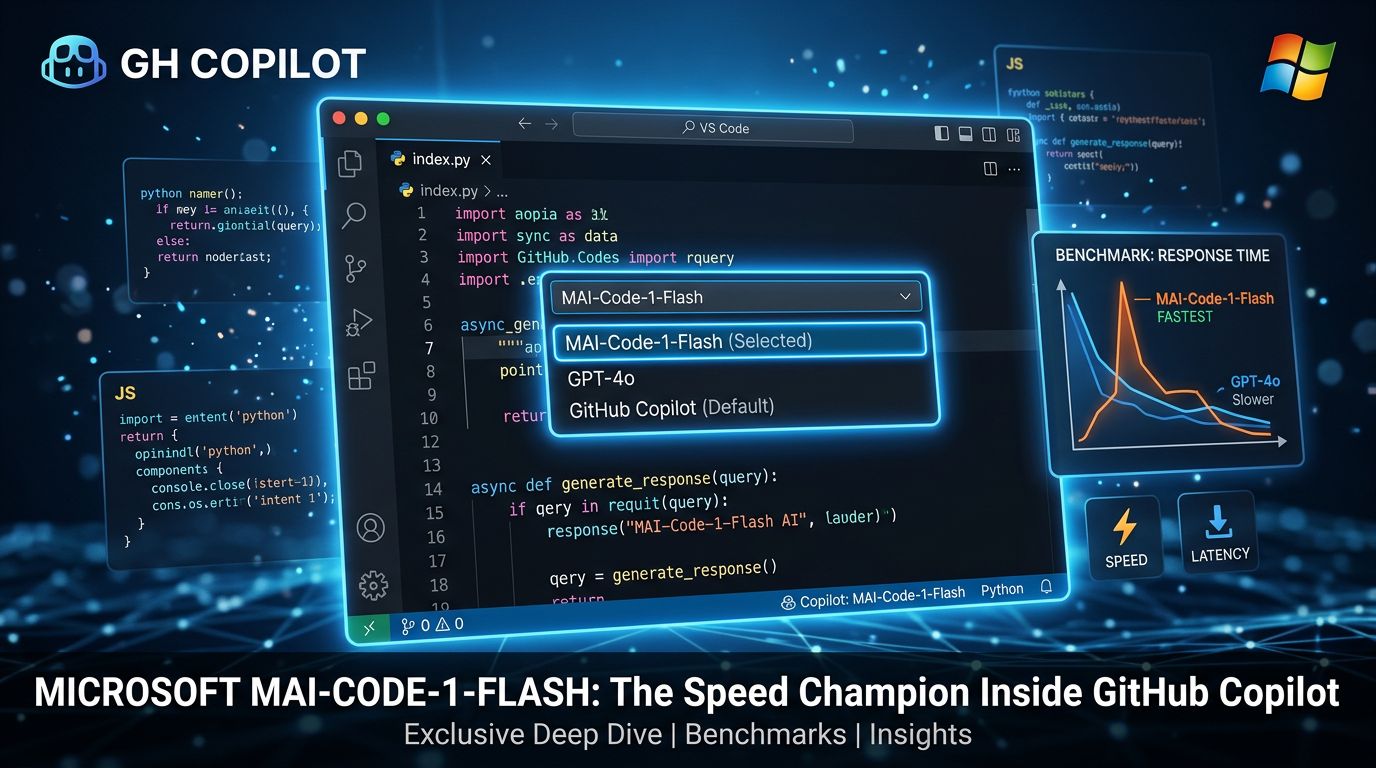
Microsoft slipped MAI-Code-1-Flash into the GitHub Copilot model picker on June 2 — one day after switching every Copilot plan to usage-based AI Credits billing. The model is now available for all paid individual tiers and went generally available for Business and Enterprise on June 26. Most developers have not noticed it sitting in their dropdown. They should look.
What MAI-Code-1-Flash Actually Is #
Despite the name, the “Flash” in MAI-Code-1-Flash refers to speed, not capability. This is a sparse Mixture-of-Experts model with 137 billion total parameters but only 5 billion active at inference time — the same efficiency trick that made DeepSeek competitive without the compute bill. The 5B active figure is what determines latency and cost; the 137B total is what determines how much the model can specialize.
Microsoft trained it directly inside GitHub Copilot’s production environment rather than adapting a general model afterward. It learned to work with the editor, linter, and type checker as part of training — not as an afterthought. The company also claims no synthetic data from third-party models, which matters for enterprise compliance and data lineage. The context window is 256K tokens.
The “adaptive thinking” feature is worth understanding: the model calibrates its reasoning depth per task. A one-line autocomplete gets minimal reasoning overhead. A refactor request that touches multiple files gets expanded reasoning. This is how it stays cheap for routine work while remaining capable for harder tasks.
The Benchmarks Hold Up #
Benchmark skepticism is justified — but these numbers are hard to dismiss. On SWE-Bench Pro, which tests models on real GitHub issues from production codebases, MAI-Code-1-Flash scores 51.2% against Claude Haiku 4.5’s 35.2%. That is a 16-point gap at the same pricing tier. On instruction-following (IF Bench), the lead is 28.9 points. On SWE-Bench Verified, it uses 60% fewer tokens than comparable models on hard tasks.
The 60% token reduction compounds across agentic workflows. If a Copilot agent reads 10 files, runs tests, and checks types before returning a result, that is 10 to 50 model calls per task. Shaving tokens at each step adds up fast under metered billing.
The Billing Timing Is the Real Story #
Here is why the launch date matters: June 1 was the day GitHub replaced flat-rate Copilot subscriptions with AI Credits — every model call now costs tokens, and tokens cost money. June 2 was the day Microsoft’s cheapest capable model arrived in the same dropdown.
The pricing comparison makes the intent clear:
| Model | Input (per 1M tokens) | Output (per 1M tokens) |
|---|---|---|
| MAI-Code-1-Flash | $0.75 | $4.50 |
| Claude Haiku 4.5 | $1.00 | $5.00 | | GPT-5.5 | $5.00 | $30.00 |
MAI-Code-1-Flash undercuts Claude Haiku 4.5 on both input and output while outperforming it on every benchmark tested. For a Copilot Pro user with 1,500 monthly AI Credits, routing routine coding tasks through MAI-Code-1-Flash instead of GPT-5.5 means those credits stretch six to seven times further on output alone.
Copilot Is Now a Router, Not a Product #
The deeper shift here is structural. GitHub Copilot is no longer a product built around a single model — it is a routing layer that dispatches tasks to whichever model fits the cost and capability requirements for that specific operation. MAI-Code-1-Flash occupies the “fast and cheap” slot. Frontier models (GPT-5.5, Claude Opus 4.6) handle the complex reasoning tasks. Users rarely see which model ran which part of their session.
That transparency gap is a real problem. If your agent used GPT-5.5 for 40 autocompletes because the Auto picker misclassified them, you will discover it at the end of the month on your billing statement. Microsoft and GitHub have not yet provided per-session model ledgers, and that feature matters as much as the model itself.
How to Access It #
Individual users on Pro, Pro+, or Max can select MAI-Code-1-Flash directly from the model picker in VS Code — no configuration required. The model is also available through Copilot’s Auto picker for automatic routing. Business and Enterprise users need their Copilot administrator to enable the MAI-Code-1-Flash policy in organization settings before it appears for individual developers.
Outside Copilot, the model is accessible on OpenRouter as microsoft/mai-code-1-flash
, Azure AI Foundry, Fireworks AI, and Baseten for teams that want to run it in their own pipelines without Copilot integration.
The short version: if you are paying for Copilot and running any agentic workflows, check whether MAI-Code-1-Flash is in your model picker. Given the benchmark numbers and its position in the new billing structure, it should be handling your routine tasks.