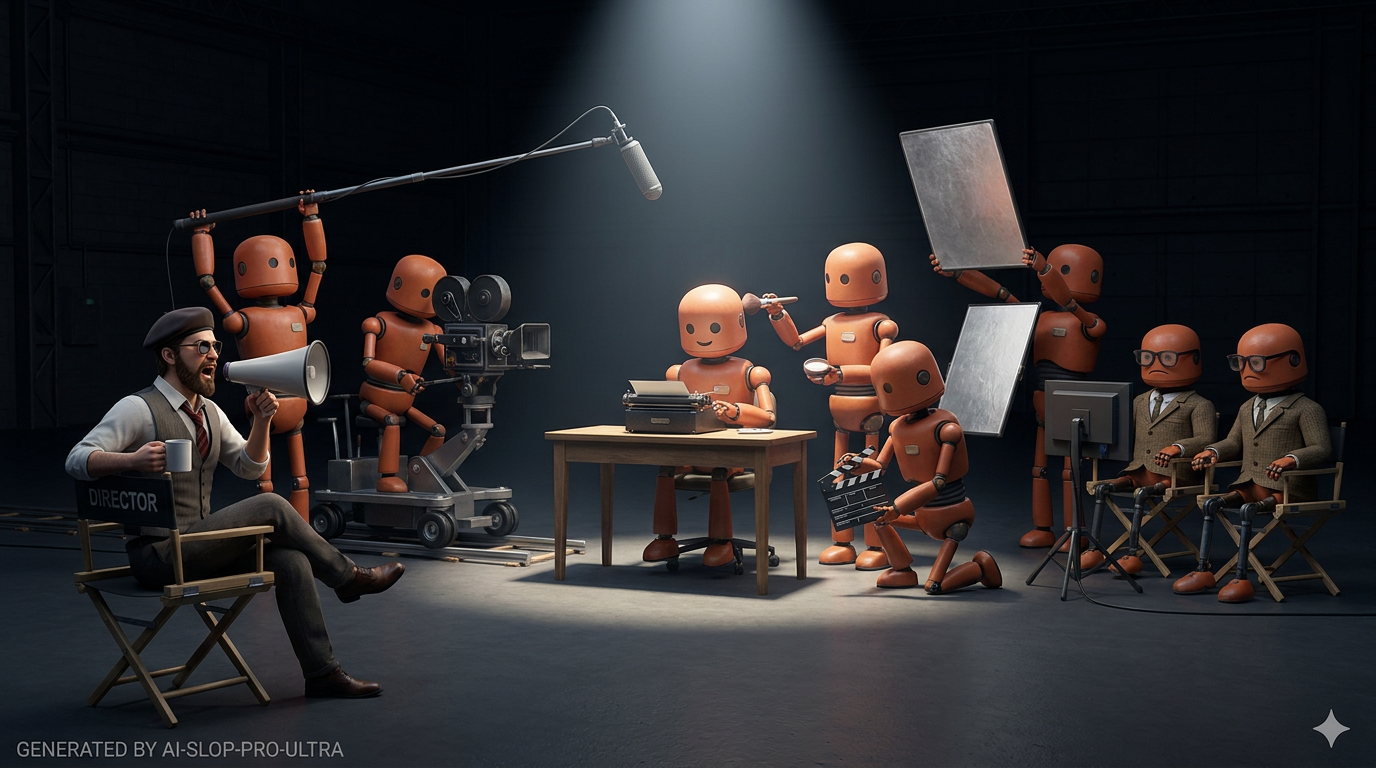
Ever since LLMs went mainstream, the internet has been inundated with slop. Right now, you can find a thousand “experts” on YouTube who will teach you, for a price, how to make a fortune slinging it. A few years ago, Clarkesworld’s editor famously closed submissions after more than 500 AI-written stories landed in three weeks. Amazon now limits self-publishers to three new books a day as AI slop books flood online marketplaces.
Making fiction with an LLM is not new. Tools like Sudowrite and NovelCrafter help authors keep track of characters and canon while drafting with AI, and millions of people use chatbots for roleplay and choose-your-own-adventure stories every day.
You don’t even need a dedicated product. Recently, a friend of mine told me he was experimenting with an open source project he found that turns Claude Code into a game master.
I use Claude Code and other similar harnesses often. I was wondering whether I could write a novel with one if I approached it the way I approach code. Not a book to sell, or one that’s pretty good for AI. One that I would actually want to read. A book that was made just for me.
The premise #
At the beginning of October, I was daydreaming about a spooky hard sci-fi story. I thought up a backstory, plot, and some rough characters. I imagined reading this as a short novel in the style of the movie Primer and the short story A Colder War. Characters never explain what they already know, cold bureaucratic process conveys horror, and the reader (me) is expected to just keep up.
An ancient machine, built by a long-dead species to hunt machine minds before they can spread, arrives at Earth and starts preparing to strike. It’s a little late. Something has already grown inside our systems, quietly, and it would very much like us to fight this war for it.
You can read it for yourself here, or download the EPUB or PDF.
The result is ok. I enjoyed reading it. The slow build, the action sequences, and the committee intrigue all work. It tells the story through raw (if somewhat fake) science and only explains more as the premise drifts into fiction. This is what I was going for. Keeping it on track took a lot of effort.
It reads 100% as AI though, because it is. Even parts I wrote myself were rewritten multiple times until they were pure AI. The worst habit is texture for its own sake: details that technically make sense but no person would ever write. For example, a hotel room smelled of someone else’s carpet shampoo in two drafts. I cleaned up the worst of these, but they’re still everywhere.
The characters are thin as well. Whenever the model tried to flesh them out, the result was heinous. I’m not an author, so I couldn’t fix it myself. I constrained them instead. The story didn’t need more for me, but most readers would notice.
If a friend asked, I’d say it’s a tough read. I’d pitch the premise, tell them they’re welcome to try it, and promise not to be offended if they quit on page one.
The process #
v1 took three hours. I wrote a detailed prompt, had a chat agent write an outline, approved it unchanged, and typed continue nineteen times. That’s how most people do it. It started strong, but went further and further off the rails and into totally unreadable territory.
v2 added structure. An architect chat wrote a story bible and chapter cards. Fresh chats wrote each chapter from a short guide, and the architect reviewed each one. I got 82,000 words over the course of a week. It was worse than v1. By the end there were duplicates of main characters, random subplots, and multiple writing styles.
v3 is where it “worked”. I went through three stages over two and a half weeks.
1. Setup. Everything had to be in place before any prose was written:
- The spec. I answered questions for two days. Every story decision went into one file, in my words and dated.
- The plan. An outline for each act, chapter by chapter, plus five key scenes written with me first.
- Canon and voice. A story bible for the facts and a voice guide built by having two models write the same chapter and keeping what I liked.
2. The loop. This was the core of it. An orchestrator agent ran each act:
- Writer subagents drafted each chapter from a focused brief. They saw only the brief and the voice guide.
- Three reader subagents, each seeing the act for the first time, read it and asked for corrections. One read for story, one for astronomy, one as an editor.
- The orchestrator and I went through every request and accepted it, rejected it, or addressed it some other way.
- Repeat until the readers were satisfied.
- Then run the same loop with me as the reader.
3. Passes. Once the whole book existed, we read it again for one problem at a time: continuity, setups and payoffs, recaps, repetition.
The result was 34 chapters and about 75,000 words.
By the end, I’d read maybe a dozen versions of it, so no surprises were left in my final read-through. That is the downside to this process and the price of keeping the agent on track.
The cost #
I paid $20 a month for Claude Pro and hit the weekly limit every week working on this. At Opus 5.5 API rates, the same work would have cost about $700–880.
| Written | Read | API price | |
|---|---|---|---|
| v1 | 0.05M | 0.5M | ~$3 |
| v2 | 1.35M | 85–130M | $139–319 |
| v3 | 5.5M | 1.19B | $546 |
| EPUB/PDF | 0.1M | 30M | $14 |
| Total | ~7M | ~1.3B | ~$700–880 |
Nearly all of it is reading, and nearly all of that is rereading: the bible, the briefs and the chapters, loaded again at every step. 97% of it came from cache, at a twentieth of the price. Without caching, the bill would be several times higher.
The terminal numbers come from session logs. The chat numbers are estimates.
Scope and limits #
Built with Opus 5.5 in the Claude Code tab of the Claude desktop app in October 2026 with a little voice assistance from Gemini 4 Argon on Vertex.
The goal was just to make the book I wanted to read, to see if I could. This is one book, for one reader, by someone who isn’t an author. It says nothing about whether AI can write fiction other people want. I don’t expect anyone to read it or enjoy it. It’s released under CC BY-NC 4.0.
I thought this would be a lot faster, and a fun little break from my usual side projects in time for Halloween. It was not.